Saturday, February 27, 2010

Another Riddle

This thing all things devours:
Birds, beasts, trees, flowers;
Gnaws iron, bites steel;
Grinds hard stones to meal;
Slays king, ruins town,
And beats high mountain down.


David E. Sanger of the NY Times recently wrote an intriguing piece on the latest twist in the ongoing saga of Iran’s nuclear program. In yet another enigmatic move, at least to Western observers, the Iranians have moved their entire stockpile of low-enriched nuclear fuel to an above-ground location. This comes some five months after the US released details of a secret enrichment plant at a military base close to Qom. The Iranians claimed the underground facility was necessary given a hostile international reception to their attempts to build a peaceful nuclear program. So why the change?

The move has prompted a lot of discussion but little in the way of definitive answers. Sanger posits three of the most likely hypotheses. In the first, Iran, and in particular the Revolutionary Guard Corps, is tempting Israel into a first strike. In the other, they are leveraging for further negotiations and then concessions from the West. The third, and seemingly most benign, envisions Iran having simply run short of storage containers for radioactive fuel.

The first option seems to be the most irrational because there are more unknowns. When would Israel commit a first strike, if ever? And what would the result be in terms of the nuclear program? Viewing it as irrational may be a case of mirror imaging, however, especially considering the leaders of the Revolution may perceive their grip on power as slipping. Desperate situations have induced desperate actions before. The second seems more likely, as Kenneth Pollack points out in the article, but the third option is the one which the Obama administration is ostensibly touting. Only the answer to the riddle will tell, but until then, let the theorizing continue.

Friday, February 26, 2010

E-Day In Iraq


Tom Ricks’ perspective on Iraq’s future is enough to make anyone need a Prozac. As he noted in his recent lecture at the University of Kentucky, none of the major issues underlying tensions in Iraq have been resolved. There is no oil law. There is a scary sectarianism that threatens to tear apart a very fragile societal fabric. In his perspective, the upcoming (March 7, 2010) Iraqi elections are possibly the catalyst that will undo whatever “progress” the U.S. has made over the last few years. What’s more, in his mind, if Iraq’s major problems are not solved (and he thinks they won’t be) AND the U.S. pulls its troops out on schedule, Iraq is likely in for a civil war that could spawn a regional bloodbath. Goodbye “stable” functioning Iraqi democracy, hello massive death tolls and---- $10.00 gasoline----- and (maybe just maybe) a new Great Depression.


Need that Prozac?


There is no question that Ricks’ ideas should be taken very, very, seriously (also see his blog). Few people have his level of experience, access, and insight. However, there are reasons to give your psychiatrist pause over his prescription pad.


For example, Mr. Ricks, to his extreme credit, recently had Nir Rosen write a guest post for his blog on ForeignPolicy.com. Mr. Rosen paints a considerably rosier picture of Iraq. In his post, Rosen notes that he has little to no use for the hysterics in the international media (or lack of) about an unraveling in Iraq. After an extended stay in Iraq, in which he traveled widely and (ohmygawd!) at night, Mr. Rosen returned and could only complain about his time spent in traffic. In his estimation, Iraqis appear to have no stomach for sectarianism or hyper religious political parties. Critically (and interestingly), he found widespread support and praise for the Iraqi Security Forces among the Iraqi populace no matter how far flung or “shitty” the village he traveled to.


Besides Mr. Rosen’s anecdotes, there are other bits of evidence that, together, begin to make a compelling case against medicating yourself over Iraq’s problems. The New York Times recently published a series of fascinating reports about Iraqi grassroots democracy. One piece reported a political debate held in an East Baghdad barber shop. The folks inside (Sunni, Shiite, and Kurd, mind you) were debating exactly how George W. Bush should be remembered. They went on to bicker over who is best suited to be the next Prime Minister. No consensus emerged, but one fellow insisted it should be Ahmed Chalabi because he wanted someone with a strong grasp of economics.


Another piece reported that political campaign classes have sprouted up across the country to teach people the basics of running a campaign. The report suggests that up to 40% of the candidates registered for the upcoming elections have participated. Amusingly, most candidates are having a hard time grasping the unpleasantness of mudslinging.


They’ll understand when they’re (democratically) older.


Clearly these points are mere anecdotes. However, they each (and many others like them) convey the sense that Iraqis want change they can believe in. As Tom Friedman recently noted, time will tell if the Iraqis can surprise us. My money says these folks are headed for a brighter future than Tom Ricks believes. The upcoming elections are nothing to fear.


Hold the Prozac.

Tanker pushing 50: gas passing not as easy as it used to be


I hoped to save this blog for later when it would be far more relevant to the class. This administration has been sitting on the issue for more than a year now so they could have waited a bit longer but seeing as how Air Force acquisitions has no concept of our syllabus, I feel obligated at this time to comment on the coverage of this topic.

The coverage is boring. I would not expect you to expect anything more from the media on this topic because the topic is the KC-135 tanker replacement. It is a big hunk of flying metal. No matter how snazzy the contractors will try to make it, it will still be a big plane that carries fuel…and does not really do anything cool—(I had something perverse to say about the refueling process but reconsidered since this is on the record and for class—the picture should be enough).

I admit that federal contracts are pretty boring, especially the legal part. I would compare it to the making of legislation which has been compared to sausage making. But this acquisition process reads like a telenovela and the press is just dulling it down (even Danger Room). Jail, suicide, tawdry relationships and the gossip…oh the gossip.

The fed has been trying to get a new tanker for nine years. Now the acquisitions process is long, but this is ridiculous. It started getting ridiculous when Darleen Druyun of Air Force acquisitions recommended the Air Force lease new tankers from Boeing, as opposed to buying them flat out. Boeing has long been the favorite child of USAF (the reason for which will be obvious in a few lines) but this was going to cost the DoD millions more than if they were to have brand new tankers built.

Someone got wise and an investigation was launched. Funny thing, Druyun retired from her Air Force post and immediately became a new VP at…Boeing of all places. The contract was frozen and Darleen did jail time for this felony as did her new CFO (she threw him under the bus).

A new RFP (request for proposal) was issued for which Boeing and Northrop Grumman (with EADS--European Aeronautic Defense and Space Company) were the primary respondents. The turf war between Boeing and NGC goes way back (NGC has often lost contracts to Boeing but they have the B2, a personal favorite, and all the aircraft carriers DoD could want, so there), however, this time there would be hair pulling.

I should clarify how the RFP process works. Government office decides they need something and writes up an RFP specifying exactly what and how many. The RFP is posted to a database where all potential competitors would be interested. Contractor business development people work through the RFP with a fine tooth comb. Then each contractor has an opportunity to Q&A with the requestor. This time around NCG did, and Boeing apparently did not ask the right questions.

Northrop Grumman had a novel idea, very 21st century of them, to make the tanker multi-purpose. It would be a tanker, as the Air Force requested, but would double for cargo and personnel transportation. They came up with this novel idea through the Q&A portion of the RFP. So Boeing responded to the RFP with a technologically updated but like-the-old-one tanker and NGC with the “more bang for your DoD buck”, three-in-one. Guess who won. Contrary to popular sentiment, DoD likes a good bargain.

Boeing’s reaction was the standard “hey, that’s not fair”. GAO’s initial response was “too bad”….and then someone wrote their congressman. Well, a hundred or so somebody’s to be more accurate. Most of those letter-writing somebodies lived in the Seattle area where Boeing would have manufactured their tanker.

I mentioned earlier that Northrop Grumman was working with EADS. They are European and the bid was based on the use of Airbus (which as most of us know, is subsidized). This is where the issue became a political one (in case you don’t consider corruption in federal acquisitions political). Boeing launched a propaganda campaign through local media and successfully spun the coverage to highlight the apparent “outsourcing” of the all-American-tanker to the French. Joke is on them: the NGC-EADS tanker was to be built in Mobile, Alabama. But, tell one person in Congress that the French are taking jobs from their constituents and see what happens. Congress got in a tizzy and GAO launched an investigation (on the fairness of the RFP, but driven by the political agenda), once again freezing the bid process.

Meanwhile, elections…inauguration…we have a new President. A year plus goes by…Yesterday a new RFP for the same tanker.

Here is the thing: not only does Boeing know exactly what Northrop Grumman is going to bid, the new RFP was written to favor Boeing and exclude NGCs multi-purpose aspects from the competition (unless there is a deadlock in choosing) because it was “not fair” that NGC was so creative at meeting their customer’s needs. NGC is debating dropping the bid rather than wasting more money on R&D for a contract which is clearly already in Boeing’s pocket due to congressional meddling.

It would seem that, at least in defense procurement, protectionism is making a comeback. As if there is not enough pork in the budget after Congress is done with it, now political agendas are screwing with the competition of the market—more importantly, as it relates to national security (the old tankers are pushing 50, nickel and diming the Pentagon). Unsuccessfully trying to put my bias aside, the NGC model is better for the needs of the US military (but I am no defense expert).

Don’t ever underestimate when someone tells you to “write your congressman.”

Thursday, February 25, 2010

Diabetes is no Laughing Matter


The United States is parceling out its services in strange ways selling arms to both India and Pakistan. The U.S. claims neutrality in the conflict between the nuclear neighbors possibly enabling a defense of equal opportunity arms distribution. The Washington Post reports that to Pakistan, the U.S. is selling 18 F-16 fighter jets at a cost of $3 billion; to India 10 C-17 cargo planes, 8 Poseidon Long-Range Reconnaissance Planes, and 145 M777 Light-Weight Howitzers all totaled at $4.7 billion.
The trade deal predictably provoked protests from both countries, India going so far as to enact a legislative appeal to halt the transaction with Pakistan. This hardly registered with the DOD who is facilitating the deals. While India pays out of pocket for these arms, Pakistan is using U.S. approved grants which they receive as aid to finance the F-16's. It's supposed that most of the aid which the U.S. doubles to Pakistan next year will arrive back in U.S. hands in the form of defense contracts.
Besides making money, the United States appears to be attempting to deter conventional warfare between the countries by helping to beef up their defenses making any kind of aggression seem more costly. You might hardly be able to tell though when the U.S. is supporting two of its companies, Lockheed and Boeing, in bid for a $10 billion, 145 fighter jet contract to India. The U.S. is looking to supplant Russia, who is in bid for the contract, as the main arms supplier to India (India's 1000+ piece air force is almost completely Russian). In facilitating closer ties to India the U.S. hopes to create a buffer ally against the growing Chinese military. While deepening economic ties between China, India, and the U.S. will looks to stabilize regional relationships, the mess of military cooperation, defense contracts (to India and Taiwan), and conflict history (between India and China in the 60's) will ensure results akin to the infinite improbability drive.

Sunday, February 21, 2010

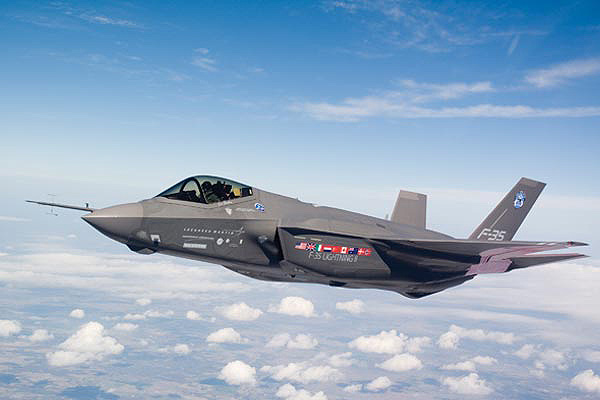
F-35 program shows promise under Defense Secretary Gates


Over the last year, one of the major and more controversial decisions the Defense Department made has been to scrap the F-22 fighter jet program in favor of F-35s. Cost and functionality seemed to underlie the decision: the F-22s are extremely expensive ($350 million each) and most suitable for aerial dogfights while the F-35s are less expensive ($122 million each) and focus more on attacking ground targets. The decision also represented a shift in military procurement from seeking to build today for projected future needs to a greater preparedness for today’s wars.

The F-35 Joint Strike Fighter represents the Pentagon’s largest military procurement program. An estimated 2,456 planes will be produced at costs expected to total $300 billion over the next 25 years. The planes will be used by Air Force, the Navy, and the Marines, with modest design alterations for the individual branches. The F-35 will essentially replace the Air Force’s F-16 and A-10, along with the Navy’s F-18, as they are phased in over the next several years.

In light of the projections of the F-35 program, there is not going to be a major reduction in military spending as some analysts predicted under Obama’s democratic administration, but rather a more targeted approach with a greater emphasis on contractor accountability. Defense Secretary Robert Gates, one of the few holdovers from the Bush administration, has shown his unwillingness to accept the status quo on completion delays and cost overruns. He recently fired Maj. Gen. David Heinz of the Marine Corps, the general in charge of the program, and announced $614 million in performance fees would be withheld from Lockheed Martin. It is expected that Vice Admiral David Venlet of the Naval Air Systems Command will be assigned to run the program in the future.

While some F-35s must reach our military servicemen in the immediate future, Gates has added a year to the F-35 development phase to allow Lockheed extensive time for flight testing and troubleshooting software systems. This should reduce cost overruns in the future. For its part, Lockheed, the nation’s largest military contractor, has also agreed to absorb part of future cost overruns, should they occur.

It appears that with the F-35 program, the Defense Department and Secretary Gates has made a realist assessment of resources and budget, selected a versatile aircraft expected to assist in modern conflicts, and has imposed effective oversight on our military contractors.

Saturday, February 20, 2010

When your mom told you it didn't matter what others think about you, she was wrong.


I have had this thought on several occasions in reaction to the plethora of bad news streaming our way regarding both current US offensives. However, The Defense of Jisr Al-Doreaa has really driven this opinion home. Why is it that our soldiers are not getting any kind of cultural training prior to deployment? In this I am not implying that we have to send sensitive multi-lingual soldiers into combat as this would require not only a strategic change in military training but also a change at the very core of the American education system—and that is a battle which will far outlast any military engagement in which this country could find itself. We should, however, give our soldiers the basic knowledge needed to avoid cultural faux pas which will inevitably acquire them more enemies.

I propose the incorporation of cultural sensitivity and language training into any pre-deployment program, especially given the COIN doctrine. If a soldier will interact with the locals of their “host country” (which means all infantry given COIN), the lesson that the left hand is considered impure should be as standard as weapons instruction. There has been some element of this in past US military endeavors, most recently for those who served in Bosnia. For whatever reason, this “customs and language” aspect of pre-deployment training is absent from the repertoire of most serving in Iraq and Afghanistan. I have come across documentation displaying some remnant of this idea implemented in certain divisions by a select leadership, but nothing system wide.

If the situations described through dreams in The Defense of Jisr Al-Doreaa are any kind of accurate representation of the real issues experienced by troops combating insurgency, a very basic understanding of the local language and customs can go a long way in averting complications like those experienced by Second Lieutenant Phil Connors’ Red Platoon. The difficulties faced in each dream were caused (and in later dreams) or at least complicated by the general lack of understanding (of the people and the language) by 2nd LT Connors and his men.

Some might hesitate as to the additional time customs and language training would add to a soldier’s pre-deployment checklist. Two weeks of part-time classroom training would be sufficient. Fluency or the ability to communicate making a translator obsolete is not the objective. Rather the goal is the ability to pick up on key words and extend greetings without offending the sensibility of those locals with whom one might interact on the ground. On more than one occasion, as a student traveling to a developing country, I received just a week of intensive customs and phrase training (granted I was not traveling to such a hostile situation). The few niceties I had learned allowed me to gain the respect of those with whom I interacted as they were often impressed that I was interested enough in their culture to stumble through my poorly annunciated phrases.

True insurgents will not lay down their weapons because one day at the market a US soldier asks him how he and his family are doing. However after that insurgent leaves, the man in the market stall may just let that soldier know to whom exactly he was talking. Learning the basics of a host culture is a way we, as an occupying force, can earn the trust and respect of the most valuable assets in counterinsurgency: the people.

Thursday, February 18, 2010

Fast Times at Mujahideen High


As part of their Afghanistan exit strategy, the United States is strongly considering transforming a Mujahideen training course into one suited for the Taliban. The offer would see current Talibani fighters given an 8 week training course to enter into the Afghan Army. But the offer would only extend to Taliban with a little 't' which General McKiernan described as those fighters not ideologically motivated, i.e. accidental guerillas. The program resembles a current effort by the U.S. to beef up the Afghan Officer Corps with experienced personnel from the Soviet raised Afghan military of the '80s.
Should the deal be announced and negotiations actually occur, the Afghan army could see more seasoned fighters entering into the ranks. It would create less resistance in battle hardened areas and help ease up on security concerns. The latter would be more important in the long run as when NATO forces leave a town to Afghan security forces who need to be trusted as able.
Currently, NATO forces are engaged in Marjah located in Helmand Province. The offensive is hoped to last no more than 30 days according to British Commander of NATO forces Nick Carter, but more than 3 months could be needed to assess the security situation in the aftermath. NATO forces hope to continue a six month long sweep eastward toward Kandahar after the push through Marjah is completed. All of this is seen optimistically as the beginning of the end of securing Afghanistan; throw in a recruitment program for the Taliban and the odds of secure and stable Afghanistan could increase. Could.

Wednesday, February 17, 2010

Yes I Am Being A Realist

Ok. I am going to be honest here – the joys of anonymity for our blogs right. I want to talk about this recent discussion over potential civil war in Iraq and leaving 30,000ish troops. Maybe I am alone on this, but I have never thought we would pull all the troops out. Sorry. And I do not mean simply the support aspects. There is too much at stake. Iraq is not Vietnam – there are resources.

Granted, the troop levels have just now gone below 100,000 since 2003, but the current withdraw plan will not have all the troops out until the end of 2011. Basically two years away. You can read it yourself but the schedule is to keep 98,000 until after the elections, have only 50,000 remaining by August 31, and all out by the end of the 2011. Can we just say wiggle room is abundant?

The elections are already getting dirty. Sunnis banned, killed, continued Iranian influence, etc… Yes yes I know some of the Sunnis are back in the running now due to an appeal, and maybe some of them should be banned (Go read Duelfer again). That is not really my point. Clearly there is a strong case for a disintegration of the fragile stability if all the troops are pulled out. Then again I would argue that even if things were fairly stable arguments can still be made for leaving bases in Iraq.

Nevertheless, correlating the civil war theory with the long-and-loose withdraw schedule, I think there is ample room for Obama to continue hammering withdraw without hurting domestic polling and safeguarding for alternate scenarios. Why should he admit that there are other stakes on the table right now when he can show progress in withdraw and divert attention elsewhere? Do I think Obama wants to leave troops in Iraq? No. Do I think we will end up leaving a contingent for ‘peacekeeping’? Yes. It is just too vital a geopolitical location not to. I am even willing to argue that a strong strategic-diplomatic policy could have Arab states supporting continued US presence in Iraq for regional stability, based on the fact Iran is pushing its regional influence. Feel free to disagree but, like I said, I have never envisioned an Iraq without US ‘bases’ since the 2003 invasion. Not to say I agreed with the invasion, but the geopolitical moves just seemed apparent. After all, we have already built the largest US embassy there.

Tuesday, February 16, 2010

COIN in Iraq: Strategy or Operation?

In this week’s readings for Defense Statecraft, Gian P. Gentile laments the US military’s emphasis on population-centric COIN for placing tactics ahead of strategy, and fears it will lead to even more “never-ending campaigns of nation-building and attempts to change entire societies in places like Afghanistan.” If one listens to Tom Ricks, as my fellow Patterson students should have last night, it becomes apparent that this is not the real problem, especially in Iraq. I would suggest that Gentile confuses strategic failures with the absence of strategy entirely.

Afghanistan represents the war the US should have fought following 9/11. That we did not follow up our initial routing of the Taliban with earnest nation building was a tremendous failure that allowed the Taliban to regain footholds throughout the country. This failure, coupled with the loss of resources to the Iraq quagmire made Afghanistan a conflict whose future is very much in doubt.

This week’s offensive on Marjah represents the way the US should have fought the war in Afghanistan following our early successes and the creation of the provisional government. A unified assault by Coalition and Afghan security forces on a Taliban stronghold designed to minimize civilian casualties and secure and hold the population center represents the apotheosis of the Army’s field manual on COIN (FM 3-24). Such efforts at the outset might have forged a stronger government, preventing the suffering endured by Afghanis at the hands of the Taliban and their own corrupt state. But for Gentile, Marjah represents only the latest localized application of an overall COIN grand strategy.

If Gentile is to be believed, this one-size-fits-all strategy has been laid over both Iraq and Afghanistan, despite their significant differences, and will be used again in future. It seems to have already failed in Iraq. Ricks believes that a force of about 35,000 American troops will have to remain in Iraq indefinitely to prevent the country from devolving into civil war. Officials within the State Department and various intelligence agencies have even less optimism, and feel that an Iraqi civil war is inevitable. Either way, it seems that COIN in Iraq is broken, whether our troops remain or not. If the Surge can be seen as the last wave of COIN, it has been broken upon the Iraqi rocks. COIN has failed in that conflict, and its future success in Afghanistan is uncertain at best.

Gentile’s worst fears seem to be confirmed. But is it really true that the US has subordinated its other military concerns in favor of a global COIN strategy? Gentile’s concerns seem to be overblown. He is worried that conventional capabilities are being subordinated or treated as less complex than COIN. This does not seem to be the case. The US military needs to be more versatile than ever before, and for the present conflicts population-centric COIN (for better or worse) has been seen as the ideal operation for the task at hand. If the QDR is actually indicative of military strategy, the move from a “two-war doctrine” to a more flexible system of response for a wide variety of contingencies demonstrates this point. Prior to 2001 the US military was prepared for large conventional conflicts that were unlikely to come. Failures in Iraq and Afghanistan led to the swing in favor of COIN as we awoke to the fact that our conventional war machine was ill suited to the present conditions and opponents. But this does not suggest that a present emphasis on COIN comes at the expense of other levels of military effectiveness.

For one, COIN has not even been the sole strategy employed in the amorphous “War on Terror.” For example our recent love affair with drone attacks has little to do with population centers and it certainly does nothing to “win hearts and minds.” As Gentile suggests the British did in the nineteenth century, American commanders indeed see our current war making as a “means to an end,” and not a tactic run amok over policy. American strategy is one of nation building and providing security for Iraqis and Afghanis while seeking to destroy the fundamentalist terrorists and insurgents who would target Americans and our allies in the Middle East. One can certainly take issues with the means we have selected, but there are certainly desirable ends.

The real problem is, at least with Iraq, that it was the wrong war. Based upon false pretenses, with minimal analysis of what would happen after the initial fighting, Iraq II has been marked by its lack of clear objectives and strategy. This has left us to pick up the pieces and figure it out as we went along. Clearly this has not gone well. Gentile confuses the military’s embrace of COIN with the larger failures of strategy during our conflicts in the Middle East.

It is difficult to make a coherent strategy when our initial objectives in Iraq were ambiguous. Seeking to shutdown (ultimately nonexistent) WMD programs through pre-emptive war was a strategy without precedent. Without even the WMD to justify the conflict in hindsight, the Bush Administration made the issue “Iraqi Freedom.” The viable, democratic Iraq so beloved by Cheney and company has yet to arise from the blood and rubble, and it is unlikely it ever will. Most Americans would agree that a war to provide democracy to Iraqis would not have been worth the significant expense and bloodletting of both sides.

Gentile’s inability to find a coherent strategy or set of objectives for the American misadventure in Iraq is not due to our being COIN-happy, but the fact there was nothing of interest to the US there other than the contained despot Saddam Hussein and his phantom weapons programs. When Iraqi democracy became our incomprehensible objective, things unraveled because Iraq is an arbitrarily delineated, artificial state encompassing three ethnic groups that hate each other. The US should not be in the habit of remaking authoritarian states as some sort of humanitarian gesture. Sadly, an authoritarian dictator or significant military force is necessary to hold such a state together, and the US refuses to allow the former and lacks the will to provide the latter.

In the meantime, recent developments suggest the US hasn’t completely lost sight of larger, if not “conventional” conflicts. Recent investments in cyber security and ABM systems—one failed, one successful, with lasers no less!—demonstrate concern about threats beyond terrorism, particularly a possible showdown with China. Gentile is right that COIN should be seen as a tool in our military toolbox, but is wrong to believe that it has ascended anywhere beyond that. He seizes upon COIN being the official strategy, because our initial objectives and strategies were incomprehensible in Iraq and initially ineffective in Afghanistan.

Wednesday, February 10, 2010

The End of LORAN-C


Once again the U.S. has made itself more vulnerable by increasing its dependence on exposed technology systems. February 8 marked the termination of LORAN-C (Long Range Navigation) signals, a navigation system that uses multiple radio transmitters to determine location and speed. Due to the development of modern satelittes and GPS, LORAN has become an antiquated system that the transportation sector and military no longer rely on. However, LORAN has been a cheap and effective backup to GPS and could continue to fulfill that role with minimal funding.

LORAN’s funding was cut by Congress, but that cut in funding was conditional on certification from the Secretary of Homeland Security that the LORAN system is not needed as a backup to GPS. Nobody likes redundancy and wasteful spending, but LORAN was a technically different system from GPS that provided the U.S. an alternative accurate navigation system.

In the event of a disruption to GPS the U.S. would be vulnerable to potentially huge economic damage and our increasingly technology-dependent military would be less effective. Relying on a single exposed system makes our transportation and military sectors more vulnerable. Widespread GPS failure caused by enemy jammers, cyber attackers, a solar storm, software malfunction, electromagnetic pulse, satellite loss, or a natural reversal of the polarity of the earth’s magnetic field could leave the U.S. literally “flying blind.”

Friday, February 05, 2010

Military Effectiveness – now for pwning noobs! 1337!

Recently, much has been made of the convergence of consumer electronics and the world’s militaries. The iPod is an increasingly common part of the kit a soldier must lug around, acting as translator, weapons training, and perhaps occasionally, a form of entertainment. Xbox controllers have been modified to control UAVs. Recognizing the collusion between military and consumer industries yields benefits both in the fields and in budgetary spreadsheets, the recent 2010 QDR calls for the Department of Defense to “broaden and deepen relationships with other nations and private firms to create mutually beneficial partnerships to share capabilities, systems, technology, and personnel, while ensuring that we also protect sensitive sources and methods.”

This focus on harnessing the innovative power of the private sector is not unique to the DoD. To ease the burden of refocusing our nation’s space program, NASA is to have greater cooperation with private rocket developers. I hear our nuclear stockpile is need of modernization, perhaps we can get some private firms on that too, while we’re at it.

And yet little has been made of some basic elements of military effectiveness working their way back into consumer culture. Specifically, the current generation of war-themed video games has required players to—at least subconsciously—take into consideration the elements key to military effectiveness in order to succeed. Players, primarily males aged 12-30, are passively learning what is necessary for a successful military engagement by nights spent on games like Modern Warfare 2 or MAG.

Scenarios in war games are moving further and further away from simple “run n’ gun” deathmatch action in favor of more objective-based game types where players must work together to hold points, plant explosives, or establish a headquarters. Clans—teams that practice and play competitively against other clans together online—tend to work out specific roles for each player in order to operate more efficiently in securing objective. War games ever since Counter-Strike have required a team to balance themselves with different weapons and capabilities to improve their chances of victory. Snipers and machine gunners lay down suppressive fire so that light infantry may advance. Players with riot shields may take the place of armor, punching through enemy lines and providing cover for an advance of infantry. A well-balanced team thus replicates the technical skills and weapons handling necessary for success in the real field.

But things have become even more complex. With the advent of headsets (by no means a recent occurrence), information sharing has made the dominance of teams even greater. With the ability to identify and communicate the state of targets or the placement of enemy weapons and personnel, the cohesive team will make short work of casual gamers paired with strangers. Unit cohesion is key, as those that move systematically together on a target are the most likely to take it. In most games, players in close proximity will make recorded announcements that they are throwing a flashbang, reloading, or have taken down an enemy. Elements of the heads up display (HUD) such as radar showing target, enemy, and friendly locations, a running scoreboard, and the amount of ammunition available are a vital source of (albeit unrealistic) information for players. Anyone who has suffered an enemy EMP in Modern Warfare 2 can attest to what an impact the loss of this information can have on players.

Games have been seeking greater integration of different weapons systems, with the ability to call in airstrikes, use UAV missiles, or even call in a game-ending tactical nuke. The more arcade-style Battlefield series allows players to hop from airplane to landing craft to tank to anti-aircraft gun. The integration of these weapons systems has proven unrealistic and rather clumsy, often as a reward for success in the field. Similarly, the ranks players earn through taking checkpoints or killing opponents have had little relevance in the actual heat of battle.

But that appears to be changing. The new Playstation 3 game MAG allows battles of up to 256 players on massive online maps. There are objectives to be held, but other strong points such as pillboxes must be held or destroyed in order to make victory possible. To manage this mass of digital humanity, the game’s designers have made tactical leadership central to the game. Before each match, players interested in an officer’s position may enter their name in the running. Units of eight are each assigned an officer who decides what targets the unit should go after, and based on unit performance may earn the right to call in air strikes or other support. Though it may seem that players would quickly ignore their officer’s commands those that stay close to their leader get benefits such as faster reloading and greater accuracy, providing an incentive for greater tactical play.

As the games support ever larger fields of players, it seems that this sort of tactical leadership will have to be expanded, perhaps to the level of actual generalship where a few players get to decide the overall strategy the lower officers must pursue. Whether this will prove enticing to casual gamers such as myself remains to be seen. Nevertheless, it is interesting that both game developers and players are quickly realizing that basic rules of military effectiveness—unit cohesion, information management, tactical leadership, and perhaps even one day generalship—are just as vital to victory in the virtual world as they are on our modern battlefields. Perhaps greater cooperation between industry and the military will prove better for all involved (it is worth noting that the Navy SEALS have provided technical advice to both the Modern Warfare and SOCOM series). Let’s just hope no one in the field decides a tactical nuke after a twenty-five kill streak is actually a good idea.

Saturday, January 30, 2010

A sneak peak at the 2010 QDR


A draft of the 2010 Quadrennial Defense Review is out in the wild, and it hold some interesting changes from the 2006 QDR.

The new QDR modifies the "We can fight two wars at once" concept previously central to U.S. military spending, cuts some programs and moves away from a enemy-centric focus to the goal of countering threatening capabilities.

No, there's no catchy way to put that, even in the acronym happy Department of Defense.

Or, as a Pentagon official told the Washington Independent, as reported by Spencer Ackerman (Attackerman):

“We’ll take some hits for not having a bumper-sticker force planning construct, but screw it,” the Pentagon official said. “The world is complicated.”

Programs to be cut include the Navy's CG(X) cruiser and further purchases of the Air Force's C-17 transport aircraft. It also includes a delay of the Navy's LCC command ship roll-out. Ackerman quotes a DoD official who says the Pentagon cuts of last year allowed the QDR to shift spending priorities instead of adding many more program cuts.

The Navy was anticipating the loss of perhaps two carrier battle groups, but the draft doesn't contain such cuts. It does call for a move of forces from the Atlantic to the Pacific (pleasing those in Hawaii and Guam), an "alternative port" on the East Coast for a carrier (although it doesn't mention where) and more DDG-51 destroyers with the Aegis package as part of the call for ballistic missile defense around Europe.

The Air Force is eying continued endorsement of unmanned aircraft and long-range strike capability, as well as an emphasis on sensors "over older manned fighters and large-bus space assets," according to Aviation Week.

In another interesting move, the 2010 QDR will likely address the need to "green" the military. The 2006 QDR barely address the issue, says Wired Magazine's Danger Room blog.

Among other things, the draft QDR suggests the military will have to start planning for operations in which rising sea levels, an ice-free Arctic and higher overall global temperatures may be an important factor. What’s more, it suggests that military planners will have to prepared for the knock-on effects of climate change: forced migration, resource scarcity and the spread of disease.

Ackerman also sees the leaked QDR as a preview of the Obama's National Security Strategy.

Note that there is still a possibility of surprises in the final QDR release on Mon., Feb. 2. In some ways, this QDR is surprising in what it doesn't cut. Or as one think tanker says:

"You have to wonder whether the tough year is ever going to come," said Loren Thompson, chief operating officer of the Lexington Institute, a defense think tank.

Regardless, this QDR appears to be the Pentagon setting its house in order and changing how it thinks, particularly compared to the 2006 QDR.

Friday, January 29, 2010

Blair Defends Decision to Support the US

Former British Prime Minister Tony Blair appeared in front of the Chilcot Inquiry on Friday, his first appearance in front of the commission set up by Great Britain to investigate the 2003 Iraqi War. Blair, facing tough questions over the legality of the war and the lack of WMD’s found in Iraq, admitted and apologized that his decision had been so divisive. Yet, Blair defended his government’s final conclusion to support the US, stressing that Saddam posed a threat not only to the region but to the world. He said it was important to analyze where Saddam and his Ba’athist regime would be today vis-à-vis their neighbors, particularly Iran, given that country’s current pursuit of nuclear weapons and support for terrorist groups.

Particularly relevant comments to the idea of a just or unjust war were the British and American governments’ attitude to the post-9/11 threat environment. Blair said that, despite there not being a direct link between the Iraqi regime and al-Qaeda, the threat matrix changed demonstrably by the existence of an agent, Islamist terrorists, who sought to kill as many people as possible. He contrasted them with the IRA, a group seeking to achieve a short-term and narrowly defined political goal.

Blair’s comments make a distinction between threats constituted by intentions and those constituted by resources. Did Iraq have the capability to threaten the US or Europe with WMD’s? Did they have the intention? If an intention to act also requires the capabilities, we can have a subset category, desire or the desire to gain the capabilities. Blair seems to be throwing in this third category which he combines with the new terrorism Weltanschauung to ask: How does the new threat environment change the capabilities and the intentions of Iraq? Walzer also makes the distinction but says we not only have to come down on the side of intentions, but that “it isn’t really prudent to assume the malign intent of one’s neighbors; it is merely cynical…”. He goes on to clarify what constitutes an intention to attack and therefore can legally allow a pre-emptive strike: “a manifest intent to injure, a degree of active preparation that makes that intent a positive danger, and a general situation in which waiting, or doing anything other than fighting, greatly magnifies the risk”.

According to Walzer’s definition, it’s probably difficult to come down on the side of legality based on the arguments made by Blair at the commission. Delving in to the murky water of pre-war intelligence may bring up some golden chest of exoneration, but those treasures will always be hotly disputed. Much focus was also placed on the British Attorney General and his decision to declare the war legal. I think Blair was operating on a different level of analysis than Walzer because he felt the threat contained an emergency clause he was forced to exercise. Such situational arguments always bring up difficult questions because they leave space for others to break well-defined principles in similar situations. For Mr. Blair, his justifications will likely be ill-received by the British public at large, some of whom protested at the commission, calling him a liar and war criminal. While Blair’s credentials as a prophet may be a matter for the commission to decide, he’s already being received without honor in his home country.

Friday, January 22, 2010

SecDef- Pentagon needs a fashion makeover

The New York Times reported on Monday that Secretary Gates reverted the Pentagon’s dress code to Service Dress, at least for his staff. After 9-11 Secretary Rumsfeld mandated that day-to-day uniform for all US service personnel should be fatigues and combat boots. This especially included those serving at the Pentagon. The idea was a reminder that the Pentagon itself was a terrorist target, that the nation was at war and that even the most senior servicemen should be battle ready (at least out of solidarity with their subordinates stationed in combat zones). Call it symbolic, psychological or political even—regardless there was little controversy when the change to fatigues was made. Then again, in the days following 9-11 little policy change was questioned and the dress code certainly would not have made the top-ten questionable administration decisions.

Monday’s announcement was very low key and only applied to the Secretary’s immediate professional staff. The intention is to reinforce the professional atmosphere of the Pentagon as it is the official headquarters of national defense. This should be intuitive as most of those employed in the Pentagon are career soldiers—professionals. And yet, the complaint is that Mr. Gates has overstepped his “civilian role” by impeding on officer prerogative. Never mind that this is unofficial policy that only the Secretary’s staff is obliged to follow, but the initial fatigue-only policy was also a civilian decision.

In what reality is the dress code of non-combat personnel stationed at home anything but a matter of Political/grand strategy? Aside from the amount of time needed to arrange every medal and shine one’s shoes to regulation, a pencil pusher’s attire has no strategic, operational or tactical implications to make meddling in it a politician’s overstep. Had the Pentagon been battle ready, decked out in fatigues and combat boots on September 11, 2001 AA flight 77 still would have impacted killing 125 inside this national fortress. Desert camouflage does not exactly make chameleons of the 26,000 employees against the 6.5 million sq ft of fluorescent lit concrete and limestone. Shinned brass makes no more a target of the Pentagon and its employees than its symbolic and practical value.

Whether a change in professional military dress code is big or little “p” politics, no one is more vested in the implications than the Secretary of Defense. The perceptions of our nation’s military personnel at home and abroad as well as morale are his imperatives as SecDef. If Mr. Gates decides that the presentation of the U.S. armed forces needs to be less cowboy and more business man, he would know.

Will this evolve into widespread policy change for the Uniformed Services? It might not be necessary. Apparently peer pressure around the Pentagon is enough to make officers concerned as to whether their staff should follow suit…

Monday, May 04, 2009

Defense Statecraft Spring 2009 Final Exam

Please answer one of the following three questions.

  1. Secretary of Defense Gates recently announced severe cuts to several major defense programs. How do these cuts affect the defense posture of the United States? What do they mean in the context of the larger US defense budget?
  2. The term "hybrid wars" has recently become popular with military analysts. Discuss the utility (or lack thereof) of this term, and its relationship to the phrase "revolution in military affairs." Do these terms illuminate the discussion, or muddy it?
  3. President Obama recently restated the hope that nuclear weapons could be eliminated from world arsenals. With the chemical weapon comparison in mind, discuss the practicality of nuclear abolition. Who would most benefit from such a project?

Answers are due by 11:15am.

Sunday, May 03, 2009

Pakistan: Where Education Could Pay...


Recent Taliban offensives in Pakistan have lead to increased concern from the U.S.. Fears that the government of Pakistan will be overthrown or that the Pakistani nuclear arsenal or fuel will fall into the hand of the extremist group have been seen in the media and in releases from both the Pakistani government as well as Washington. Now it seems that some concessions on behalf of the Pakistani government will lead to an end in hostilities for the time being.

The big problems are still present. The government has little to no control or influence in a good portion of the country. A recent NY Times article points out that basic needs are not being met in many areas and that this has created a vacuum that is being more and more occupied by the Taliban. It is tough to say that Pakistan should spend less on fighting and more on providing basic services when it is already struggling to keep the Taliban out of Islamabad. But the Taliban is able to create schools that are not going to provide an education that is conducive to creating productive members of society at least in terms of supporting the Pakistani government. The sympathy for militants and extremists is only going to grow in communities and regions where these schools are present. Obviously a certain amount of control in a military sense needs to be present before Pakistan can hope to provide a more well-rounded education, but Pakistan does need to pay attention to these needs in order to form a more stable solution to the current conflict within its borders.

It is admittedly naive to say that building schools will be the water to the Taliban's Wicked Witch of the West but I still think attention needs to be paid by both the U.S. and Pakistan to the medium and long term campaigns to bring an end to the violence in the region. Basic services have an important role to play and investment now will pay dividends down the road.

America's Army's Giant Waste of Money


The recent cuts to various military programs got me playing Monday morning quarterback. After all, what fun is living in a democracy if you don't explain how you would do everything better? So with the loss of the F-22 for the time being and other cutbacks, I started to think about other ways that the military could trim some fat. And then I remembered one of the more interesting uses of American taxpayer's money: America's Army.

Originally just a computer game, America's Army was created as a "global initiative to help with recruitment". It has always been a free download for any aspiring virtual soldier but has expanded in recent years to become available on other video game platforms.

The problem is two-fold: First, it cannot be an effective recruitment tool. Just as 99.99999999999% of the target audience is able to distinguish reality from games enough to know that shooting someone in real life is a bad idea, that same percentage of people are aware that a game about the army is different than actually joining up (for one thing, the respawn time in real life is much longer). In addition, the public perception of such a program is problematic. Not only is there the argument that taxpayer dollars should not be spent on game development, but there is also a backlash against the blurring of the line between violence in entertainment and actual violence.

The development of virtual training tools is a great idea, it is cost effective and inherently less risky than live training. So on that particular front, I cannot help but endorse spending money. In terms of using similar programs as recruitment tools, I think money could be put to better use in other areas though and the costs of maintaining the program has hurt the military's PR more than it has helped.

Saturday, May 02, 2009

Aaaaand.....BOOM goes conventional wisdom!


Conventional US foreign policy says we don't negotiate with terrorists. But, as this TIME article points out, conventional wisdom may need to be shown the door. The Obama administration has learned, from its experience from AfPak that the only thing worse than talking to terrorists is not talking to them.

The line that the Bush administration drew in the sand in 2001 is no longer and we currently talk to North Korea, Lebanon (whose government is heavily-laden with Hizbollah) and are studying our options concerning the Taliban. Why has our policy changed? The author states two reasons: 1) Our policy just wasn't working to eradicate or even moderating terrorism and 2) we view groups like Hizbollah and the Taliban as fundamentally different from Al-Qaeda because their goals and ambitions are regionally-based and not globally based. Basically, though we may not agree with their goals, we can deal with it better than we can deal with AQ wanting to send us back to the 7th Century.

The central theme of the article is that we need to talk to Hamas. As the most popular Palestinian party, Hamas may soon be joining forces with Fatah to form a coalition government in the West Bank. This will make it impossible for the US to ignore Hamas. Despite the pummeling that Israel gave Hamas in December and January of this year, the party remains firmly entrenched making it difficult to disband the party. Bottom line: they aren't going anywhere.

So this leaves the US in a predicament. Follow the path of the past and never, ever talk to "terrorists"? Or suck it up and try to work things out. I, for one, hope the latter is the case.

Friday, May 01, 2009

Backing off DADT

Is President Obama backing off of his campaign promise to repeal don't ask don't tell?

New language posted on the White House website this week indicates that the President might be taking a weaker stance on allowing gays to serve in the military.

The changes were reported by AMERICAblog yesterday.

Previously, the White House website included an entire section dedicated Obama's plan to increase civil rights for gays, one point of which included the line, "Repealing Don't Ask Don't Tell." The line has since been removed. Another section had noted "[President Obama] supports repealing Don’t Ask Don’t Tell..." and now says "[President Obama] supports changing Don’t Ask Don’t Tell in a sensible way that strengthens our armed forces and our national security."

Throughout his campaign, Obama stated unequivocally that if elected, he would work to repeal Dont Ask Don't Tell. So, has Obama changed his mind about repealing the rule?

The timing seems to be a little strange. A poll was just released this week that showed the majority of Americans now support repeal of DADT.

The military is still sharply divided on the issue. An article from the New York Times says that in military circles, which have previously been more opposed to repealing DADT than the civilian population, the debate is gaining steam. Still, many top officials in the DoD, including Secretary Gates, would rather just put any decision making. Critics suggest that repealing the rule would undermine military recruitment, solidarity and morale. This argument has been losing ground, however, as the U.S. military been stretched thin by the wars in Afghanistan and Iraq. Repealing DADT, which has led to the dismissal of more than 10,000 people from the military, would inevitably increase enlistment.

Why, then, would President Obama choose to back down now?

Maybe his plate is pretty full, what with the mess in Pakistan, the increasing violence in Iraq and the overhaul of defense spending that was announced in April. Still, there are going to be some pretty angry Obama voters if he drops the ball on this one.

Mr. Medvedev Has A Full Plate…


Russia’s been busy the past couple of days. Here’s a quick recap:

-At a meeting of the Arctic Council (what an awesome name!) Russian Foreign Minister Sergei Lavrov insisted that his country had no plans to boost its military presence in the Arctic. He said that existing conventions in the Law of the Sea Treaty could resolve disputes in the region, and that Russia would commit no more troops that it has already allocated to the region (back in March Russia said that it would commit army units and establish a Federal Security Service coastal guard presence in the region).

-Russia has taken formal control over the de-facto borders of South Ossetia and Abkhazia. President Medvedev signed formal agreements with both countries to administer the border regions for five years. Neither South Ossetia or Abkhazia have any authority over the troops that Russia sends.

-Political desk chief Viktor Kochukov and mission attache and executive secretary Vasily Chizhov were stripped of their credentials and expelled from Russia's mission to NATO on accusations of espionage. Talks between NATO and Russia resumed this past Wednesday for the first time since the August War last year. The Russian Foreign Ministry issued a statement calling the expulsions "provocative" especially given the increased tensions caused by NATO plans to hold military exercises in Georgia next week.

-On Wednesday Russia launched what is believed to be a spy satellite with a high-resolution optical camera. Analysts believe that it is a Kobalt-class satellite with several retrievable film canisters.

- The Russian Defense Ministry announced on Tuesday that it plans to reduce its armed forces by 130,000 soldiers, which would put its total number of military personnel at 1,000,000 troops. And its not just the lower ranks who are getting axed; the Defense Ministry issued a statement saying that one fifth of Russia’s senior officers will be dismissed because they failed a military aptitude test.

So what does all this mean? Russia is staking territory out in the Arctic circle presumably because its estimated that up to 13 percent of the world's undiscovered oil reserves and 30 percent of the world’s undiscovered natural gas lay under the icecap. Its contesting part of the Arctic Circle with Denmark (which was part of the reason why it planted a flag 4,000 feet under the pole back in 2007). Its streamlining its military by cutting out all of the deadwood either because it wants a leaner, more efficient fighting force for the 21st century or it wants to save money (its suffering quite a bit from falling oil prices). The spying case and the satellite launch seem suspiciously timed to me. The NATO military exercises were planned more than a year ago, so Russia may have chosen this time to launch this satellite (on the same day that talks with NATO began) just to show that it was still keeping its military hardware in good shape. The spying charge seems odd too; this is the first time that Russia and NATO have talked in almost a year. Why would Russia risk worsening relations by spying? But then again, maybe they just think having a good relationship with NATO was all that important in the first place.

The US has largely been discounting Russia as a marginal global power since the USSR’s collapse two decades ago. Russia is obviously doing some serious strength-training, and wants to carve out its own niche in the international system. I seriously doubt that there is anything that the US or Europe can do about that.

Racism Reborn

While many counterterrorism operations focus on threats from abroad, there is a growing danger presented by right-wing white supremacist groups. In early April, a Homeland Security intelligence report meant for local law enforcement was leaked to the press. The report described Operation Vigilant Eagle, a plan to target white supremacists and “militia/sovereign-citizen extremist groups.” The DHS plan also focuses on veterans of the wars in Iraq and Afghanistan. While Homeland Security Officials are right to focus on the more militant white supremacists, a recent Newsweek article indicates the threat may be a bit more insidious.

These are not your grandparent’s white supremacists…
The Newsweek article quotes Thomas Robb, leader of a KKK offshoot called the Knights Party: “Do you know why people are so afraid of us? Because we’re so normal.” White supremacist groups have long found the Internet to be a powerful recruiting tool to spread their ideology, connect disparate groups and plan events. Now, it seems, they have gotten smarter about it.

In a strategic move (one that the Republican party should mimic to increase membership – ed), white supremacist leaders have encouraged members to tone down the rhetoric and extremist speech online so as not to frighten off potential new members. From the Newsweek article: “During the Knight’s event in Arkansas, Roy, a guest speaker, advised white recruiters to ‘keep it subtle. Don’t hit ‘em with anything too hard right off the bat or you will shock them. Find a chink in their armor and make friends. If you are too radical, they won’t listen.’”

Why now?
The reasons for the increased focus on white supremacist groups are neatly summed up in the DHS report. “...the economic downturn and the election of the first African-American president present unique drivers for right-wing radicalization and recruitment.” Additionally, blogs and message boards are buzzing with the possibility of backlash against Mexican immigrants over the Swine Flu H1N1 virus epidemic. The debate over the replacement of U.S. Supreme Court Justice David Souter will also be a likely source of rage for hate groups.

So now what?
The scariest part of this problem is that President Obama’s election may have shifted focus away from education about racism. We can’t allow the problem to fall off America’s radar. We can’t let our wake-up call be a white supremacist terrorist attack on American soil.

. . .But Can it Cure Swine Flu?


One of the more interesting aircraft of the past 20 years may be headed to Afghanistan. While not the most attractive of aircraft, the V-22 Osprey is definitely one of the more ambitious vehicles currently in use. Combining the manuverability and hovering capacity of a helicopter with the speed and range of a fixed-wing aircraft, the Osprey has been seen by many in the military as a jack of all trades and seems to be an ideal fit for the Marines specifically.

But the V-22 Osprey has had a checkered past and has been used as a poster child for over-budget military projects. In 1986 the projected budget for the development of a tiltrotor aircraft was about $2.5 billion, a large amount of money by most standards but in the context of military toys it was relatively small. Soon after the budget was increased to about $30 billion and as of 2008 the amount spent on the Osprey was close to $28 billion. Estimates on how much will be needed before the project can be considered complete put the final total somewhere in the ballpark of $60 million. On many occasions (usually following a high profile accident) the program was put on the chopping block. However the Osprey has managed to keep its head above water and has become the subject of praise by military officials especially in the discussion of deploying the Osprey in Afghanistan.

The case of the Osprey may make the decision to cut over-budget programs more difficult. Between the mishandling of the program and the high profile accidents, the Osprey seemed to be going the way of the Dodo (sorry, couldn't help myself) just a few years ago. The Marines have continued to voice their support for the project and recent success in Iraq as a troop transport seems to have resuscitated the program. Even President Obama's ride in an Osprey during a trip to Iraq during the presidential campaign helped to put the Osprey in a better light. So should the program have been axed years ago? Based on what we saw at the time, I would have said yes without much hesitation. As it becomes more integrated into the current operations in Iraq and Afghanistan I think it becomes clear that it has a role to play in U.S. military operations. Bottom line: I just don't know what to think about DoD continuing to fund programs that are troubled. It is difficult to know whether the program will turn out as a marginal success like the V-22, or a Davincian failure.

Jane Harmon explained

The Daily show does a job on Harmon - funny stuff, especially since I am pretty sure they don't have much time to make jokes; just the facts of the situation are so absurd that just presenting it is funny.

Well, except strangling a manatee will probably not get you in the EPA.