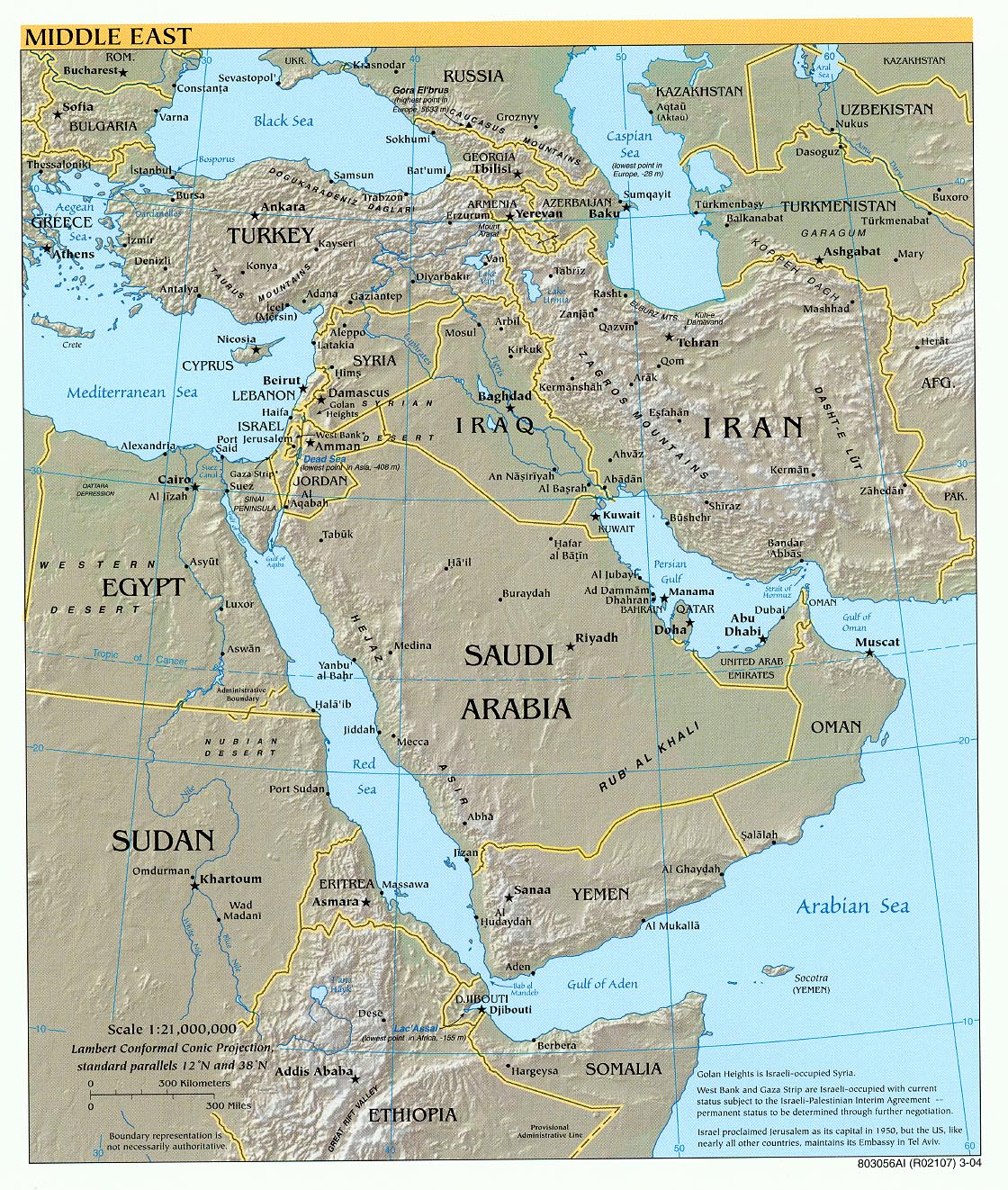
This weekend, a conference on fostering democracy in the Middle East was held in Bahrain with foreign ministers from the Middle East, the G-8, and others. This conference, set in motion by the US, was intended to culminate in the adoption of a plan to support democracy in the Middle East, including financial backing to democratic groups. At the last minute Egypt demanded wording that would give the state the power to decide what democratic groups would receive funding, co-opting the entire point of the plan to encourage the growth of democracy without interference.
With Egypt as the second highest recipient of US foreign aid, being second only to Israel, one has to wonder if this is truly money well spent. While aid has been essential in establishing peace between Israel and Egypt and keeping some calm in the Middle East, we have to wonder how effective our relationship with Egypt really is. The sinking of this weekend’s Middle Eastern democracy initiative raises the question of whether or not so much financial aid should be given to Egypt if it is not willing to cooperate with international democratic initiatives in the region. All other states at the summit were willing to adopt the plan as it stood, even other states which had supported Egypt’s desire for control of the money being filtered into democratic groups ultimately dropped this request and were willing to adopt the document. Egypt has previously shown its unwillingness to be fully cooperative with those seeking democracy in the Middle East, refusing to allow international observers for their recent “multi-party” elections. With support for democracy being a pre-condition for US aid and support in other states across the globe, perhaps stricter requirements or less support should be imposed on Egypt.
It is now a US value to see democracy spread, however it seems a higher priority value to have allies in the fight against terrorism. Egypt, Pakistan, and Saudi Arabia among others are examples of such relationships. With Egypt having been considerably cooperative in the US-led charge against global terrorism, it seems likely that no matter how much foot dragging and difficulty Egypt should kick up in the US-led initiative for democracy in the Middle East, we won’t be willing to threaten to tighten the purse strings. For now we’re getting support where we need it most from Egypt, combating terrorism, and as long as such cooperation continues, we will likely be wiling to overlook Egypt’s transgressions against democracy. While I am not advocating cutting Egypt off, I believe it would be best to play hardball with Egypt and threaten reduced aid if it continues to threaten democratic initiatives and openness in the region. If we continue to allow our friends to co-opt our values and initiatives, we will continue to lose legitimacy in the international community and especially in the Middle East were we so desperately need to fix our tarnished image.
Sunday, November 13, 2005


Saturday, November 12, 2005
Values
So we go to war to defend our values. So my question is, what do we do when our values conflict? We value economic stablity and liberal democracy. We used to value stopping communism. That's why we supported the shah in Iran, South Vietnam, and South Korea. The problem is, those regimes weren't democratic. In the case of South Vietnam and Iran, we failed partially because we were too dependent on the leaders. In South Korea, we forced the leaders to reform, which is partially why South Korea has turned out so well. Was sacrificing our belief in liberal democracy part of the reason we grew so dependent on a particular regime? And if so, doesn't that bode ill for our support for Saudi Arabia (among others)? We support an undemocratic regime there for economic reasons, and we lack the power (or will) to force them to reform.
Friday, November 11, 2005
HOOAH! on Veterans Day
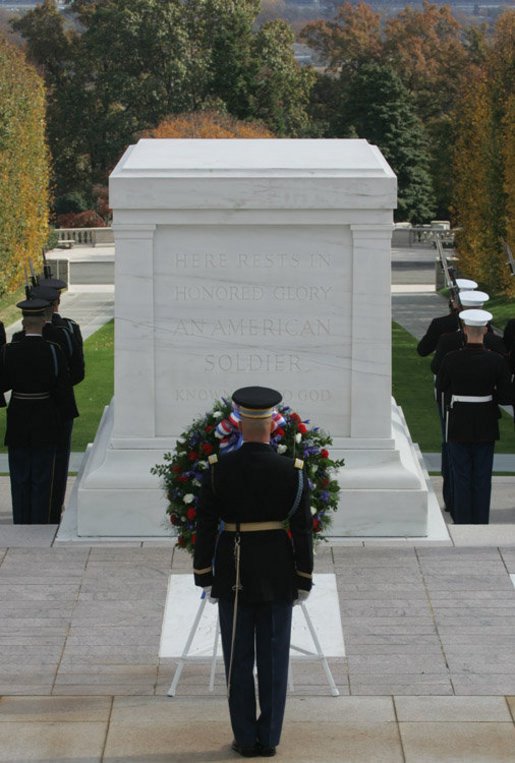
The USA Today reports that the Army exceeded its military recruiting goals for October, the first month of the new fiscal year. Read more! The photo above (courtesy of www.whitehouse.gov) is from today's Veterans Day ceremony at the tomb of the unknown soldier at Arlington National Cemetery.
Seeds of Change in Iraq Strategy?
Krepinevich's argument may be getting some traction; see this Washington Post article.
For Ultimate Control of your Military
http://www.cnn.com/2005/TECH/10/25/human.remote.control.ap/
Don't feel like you have enough control of your military? Well, Nippon has designed a revolutionary product for the truly discriminating dictator who cherishes absolute control. No longer worry about coups or whether your soldiers will follow your orders to the 'T'. The Human Remote Control puts command and control directly at your fingertips. Be the first to order ten thousand units and get free synchronization of your units into a single remote control (comes in midnight black or faux cherry finish. Looks great on your coffee table!) The Human Remote Control will make your other dictator pals green with envy.
Don't feel like you have enough control of your military? Well, Nippon has designed a revolutionary product for the truly discriminating dictator who cherishes absolute control. No longer worry about coups or whether your soldiers will follow your orders to the 'T'. The Human Remote Control puts command and control directly at your fingertips. Be the first to order ten thousand units and get free synchronization of your units into a single remote control (comes in midnight black or faux cherry finish. Looks great on your coffee table!) The Human Remote Control will make your other dictator pals green with envy.
Grand Theft Auto: Paris
Porte Dauphine to Sacre Coure in 9 minutes in a Ferrari 275. Big download. Worth it.
Thursday, November 10, 2005
US-China Commission
Next Tuesday, the Honorable Patrick Mulloy will visit the University of Kentucky to speak on China. He is a commissioner on the US-China Economic and Security Review Commission, which earlier this week released its annual report. The general conclusion is that the United States lacks a single, unified China policy and that is harming our interests.
For more analysis of its conclusions, see:
For more analysis of its conclusions, see:
Why join the military when you can fake it?
The number of people who lie about, exaggerate, or otherwise obfuscate their military history is growing. Sometimes it is just lower ranked soldiers that inflate what they did and which rank they achieved, but some guys just fake it completely. For example...In 2004, no less than six women revealed that they were romanced by a so-called Navy SEAL. The man was an insurance claim adjuster.
Although the Dept. Of Veterans Affairs does keep track of people who commit fraud while claiming veterans' benefits, it has no idea how many military impersonators are roaming the streets.
If the military is having difficulty recruiting, this does not help. If the military services want to maintain a good image, this does not help. Between Abu Gharib, Guantanamo Bay, and impostors running around, is the military's image in trouble?
Want to read about it...
Although the Dept. Of Veterans Affairs does keep track of people who commit fraud while claiming veterans' benefits, it has no idea how many military impersonators are roaming the streets.
If the military is having difficulty recruiting, this does not help. If the military services want to maintain a good image, this does not help. Between Abu Gharib, Guantanamo Bay, and impostors running around, is the military's image in trouble?
Want to read about it...
Defense Budget
CBO recently released its FY 06 report on long term defense budget implications. Read it here. This may be a good addition to our readings for next week's class.
Wednesday, November 09, 2005
Jarhead Field Trip, Mark II
Because of the India-China talk on Thursday night, I think Saturday afternoon would be the best time to see Jarhead. A matinee would be ideal. Will make plans tomorrow in class.
Police Action vs. Military Action
There is a good editorial in the Financial Times today. It is behind the subscription wall, so I'll paste the best parts. If you want the entire text I'm sure it is in the Van Room.
Judging from official rhetoric, not just in France but elsewhere in Europe and America, many political leaders believe the solution for dealing with Muslim disaffection and Islamic extremism is to encourage moderate, liberal forms of Islam. But failure is inherent in this approach.
...
However noble in conception, Islamic liberalism is today at its lowest ebb since the 19th century. This is not because Muslims generally are more militant than before, but because the moderation hawked to anxious governments by Muslim notables is itself redundant. For one thing, their analyses of Islam’s problems are way out of date, concentrating on reinterpreting the Koran and reforming Sharia law to liberalise Islam in a systematic and collective way. The Koran, for example, had been read by traditional specialists in an indirect and unsystematic way.
...
Like other global movements, al-Qaeda possesses a moral autonomy beyond its political or economic causes. Its minions have already been exposed to liberal Islam and rejected it for something far more modern...This is why the “war on terror” should be conducted as a police operation rather than an ideological or even military struggle, as its enemy is not some external power but exists inside liberal as well as illiberal societies.
!!!This Week's installment of The Miseducation of Xerxes!!!
Mr. Burns: "Smithers, land the plane."
Smithers: "But Mr. Burns, you're the one flying."
Mr. Burns: "Excellent."
Judging from official rhetoric, not just in France but elsewhere in Europe and America, many political leaders believe the solution for dealing with Muslim disaffection and Islamic extremism is to encourage moderate, liberal forms of Islam. But failure is inherent in this approach.
...
However noble in conception, Islamic liberalism is today at its lowest ebb since the 19th century. This is not because Muslims generally are more militant than before, but because the moderation hawked to anxious governments by Muslim notables is itself redundant. For one thing, their analyses of Islam’s problems are way out of date, concentrating on reinterpreting the Koran and reforming Sharia law to liberalise Islam in a systematic and collective way. The Koran, for example, had been read by traditional specialists in an indirect and unsystematic way.
...
Like other global movements, al-Qaeda possesses a moral autonomy beyond its political or economic causes. Its minions have already been exposed to liberal Islam and rejected it for something far more modern...This is why the “war on terror” should be conducted as a police operation rather than an ideological or even military struggle, as its enemy is not some external power but exists inside liberal as well as illiberal societies.
!!!This Week's installment of The Miseducation of Xerxes!!!
Mr. Burns: "Smithers, land the plane."
Smithers: "But Mr. Burns, you're the one flying."
Mr. Burns: "Excellent."
Tuesday, November 08, 2005
Set your phasars to stun!
No this isn't Star Trek...this could be the future weaponry of the American fighting man. Read more! If I were a grunt, I'd still favor the M-16 and an old "1911" anyday.
If you are interested in these futuristic high-tech weapons, Dr. Zimet's 2002 article on high energy laser (HEL) weapons is also must read!
If you are interested in these futuristic high-tech weapons, Dr. Zimet's 2002 article on high energy laser (HEL) weapons is also must read!
Biddle on Iraq
In Defense News:
The conventional assumption that speed and precision weapons allowed U.S. forces to rapidly defeat the Iraqi Army in early 2003 demands reassessment in light of the large numbers of close combat battles fought by invading U.S. forces against unbroken Iraqi defenders, a U.S. Army War College expert said.
During a Nov. 2 Army War College conference, “U.S. Military Operations in Iraq: Planning, Combat and Occupation,” Stephen Biddle said all of the Iraqi cities were defended along the U.S. Army’s line of advance, which forced commitment of the American reserve, the 101st and 82nd Airborne divisions, to clear the cities and secure the transportation routes.
Biddle said the Iraqis’ poor fighting skills and inadequate defenses, particularly in the cities, allowed U.S. forces to exploit their armored protection and precision firepower. He believes the same tactics employed by American ground forces, armored raids inside Baghdad, likely would have resulted in much higher casualties against a more determined and better prepared foe.
Monday, November 07, 2005
Notes on Grading
The grades for the second memo set is in, and shows a significant improvement from the first set. The first set average was 3.31, and the second set average 3.48.
Thus far, the presentation grades have average 3.59. I haven't yet made any grading decisions regarding participation or blogging.
Thus far, the presentation grades have average 3.59. I haven't yet made any grading decisions regarding participation or blogging.
Jarhead Field Trip
Anyone interested in a field trip to see Jarhead? If so, respond in comments, and we'll try to put something together.
UPDATE: Besides Jacob, can anyone who's interested not make it after class? That would probably be the most convenient for me, although Saturday afternoon is another alternative. Can people make it on Saturday afternoon?
UPDATE: Besides Jacob, can anyone who's interested not make it after class? That would probably be the most convenient for me, although Saturday afternoon is another alternative. Can people make it on Saturday afternoon?
Hollywood & the Military: Established Jointness
This week’s movie release of Jarhead once again revisits the relationship between Hollywood filmmakers, the Department of Defense, and the American public. Written and based upon former Marine Anthony Swofford’s best-selling book about his training and experience in Operation Desert Storm, this film explores more so the individual’s dilemmas of warfare than the operation itself. Although the DOD did not provide any assistance towards the movie’s production, there still exists a complimenting relationship between filmmakers and the U.S. military.
For Hollywood, war movies have been the moneymakers from the beginnings of silent films. The portrayal of war on the big screen seems to naturally attract viewers due to the suspense, action, historical relevance, and more often than not, the love stories (which by the way runs the risk of ruining movies such as Pearl Harbor for the sake of satisfying a larger, more female oriented audience). Movies such as Saving Private Ryan and Men of Honor not only proved to be box office hits, but they also portrayed historical events in a realistic manner.
For the U.S. military, war movies and TV series can either become a recruiting powerhouse tool or a media nuisance. Classic films such Top Gun and Full Metal Jacket proved to be the most successful recruiting tools ever for the Navy and Marines respectively. In addition, they are often the cheapest ways of letting young America know what it is like to part of the military because such films are almost entirely financed by Hollywood but advertise the military for free. In fact, former Secretary of Defense William Cohen actively worked to support the film industry and once praised, “The film industry is important in shaping what people think about our military and supporting them. We in the Pentagon wanted to say 'Thank you' to Hollywood." (Cohen)
However, films that portray strong political views and often more realistic images of military events and service can produce negative identity effects. The DOD can and frequently does actively influence war film images and production by either offering or denying assistance. Assistance comes in the form of either by technical assistance on operational protocol or asset usage such as equipment, real soldiers, and on-site filming locations on military property. Director and publicly self-described political activist Oliver Stone was denied military assistance for his war movies Platoon, Born on the Fourth of July, and Heaven and Earth. Stone comments, “They [DOD] make prostitutes of us all because they want us to sell out to their point of view. They want a certain kind of movie made” (Stone). The script for Tom Clancy’s Clear and Present Danger was changed several times by the DOD to better portray the involvement of the State Department and national sovereignty recognition of Colombia before assistance was guaranteed (Stone).
Jarhead is Hollywood’s latest attempt to portray U.S. military involvement in the Middle East. Previous works have been hit and miss such as the profitable Gunner Palace and FX’s soon to be cancelled TV series Over There (AOL). Perhaps Jarhead will be more successful in the box office because it doesn’t have to compete with the daily, 24 hour news outlets. Nevertheless, this film is sure to get people thinking more about the changing realities of war and perhaps positively influence Marine recruitment. However, it will be hard to beat the line, “I feel a need, a need for speed”.
For Hollywood, war movies have been the moneymakers from the beginnings of silent films. The portrayal of war on the big screen seems to naturally attract viewers due to the suspense, action, historical relevance, and more often than not, the love stories (which by the way runs the risk of ruining movies such as Pearl Harbor for the sake of satisfying a larger, more female oriented audience). Movies such as Saving Private Ryan and Men of Honor not only proved to be box office hits, but they also portrayed historical events in a realistic manner.
For the U.S. military, war movies and TV series can either become a recruiting powerhouse tool or a media nuisance. Classic films such Top Gun and Full Metal Jacket proved to be the most successful recruiting tools ever for the Navy and Marines respectively. In addition, they are often the cheapest ways of letting young America know what it is like to part of the military because such films are almost entirely financed by Hollywood but advertise the military for free. In fact, former Secretary of Defense William Cohen actively worked to support the film industry and once praised, “The film industry is important in shaping what people think about our military and supporting them. We in the Pentagon wanted to say 'Thank you' to Hollywood." (Cohen)
However, films that portray strong political views and often more realistic images of military events and service can produce negative identity effects. The DOD can and frequently does actively influence war film images and production by either offering or denying assistance. Assistance comes in the form of either by technical assistance on operational protocol or asset usage such as equipment, real soldiers, and on-site filming locations on military property. Director and publicly self-described political activist Oliver Stone was denied military assistance for his war movies Platoon, Born on the Fourth of July, and Heaven and Earth. Stone comments, “They [DOD] make prostitutes of us all because they want us to sell out to their point of view. They want a certain kind of movie made” (Stone). The script for Tom Clancy’s Clear and Present Danger was changed several times by the DOD to better portray the involvement of the State Department and national sovereignty recognition of Colombia before assistance was guaranteed (Stone).
Jarhead is Hollywood’s latest attempt to portray U.S. military involvement in the Middle East. Previous works have been hit and miss such as the profitable Gunner Palace and FX’s soon to be cancelled TV series Over There (AOL). Perhaps Jarhead will be more successful in the box office because it doesn’t have to compete with the daily, 24 hour news outlets. Nevertheless, this film is sure to get people thinking more about the changing realities of war and perhaps positively influence Marine recruitment. However, it will be hard to beat the line, “I feel a need, a need for speed”.
Sunday, November 06, 2005
Magic Shield
For years, there has been talk of a new Chinese ship protection system similar in capabilities to the American Aegis combat system. I, for one, have been skeptical. Whenever someone describes something as the "Chinese version of" something else, it is wise to be skeptical. Betel nuts (a nasty carcinogen) are commonly described as "Chinese chewing gum," for example. You can rest assured that any food described as "Chinese hamburger" or "Chinese pizza" will taste like your left shoe. If it tasted good, they would be proud enough of its Chinese origins as to tell you its Chinese name and encourage you to pronounce it (wrongly) at least ten or eleven times.
Why is all this nonsense relevant to this course, you might wonder? It turns out the reason the weapon system in question, the "Magic Shield," is described as Aegis-like because IT IS AEGIS! It was built using American blue prints. Four people out on the left coast have been selling China such defense secrets since 1990, according to this Washington Times article.
Also revealed were secrets about the Virginia-class attack submarine and they may have revealed information that would help China attack American aircraft carriers.
Why is all this nonsense relevant to this course, you might wonder? It turns out the reason the weapon system in question, the "Magic Shield," is described as Aegis-like because IT IS AEGIS! It was built using American blue prints. Four people out on the left coast have been selling China such defense secrets since 1990, according to this Washington Times article.
Also revealed were secrets about the Virginia-class attack submarine and they may have revealed information that would help China attack American aircraft carriers.
Welcome To The (Real) Suck
One of the original justifications for the war in Iraq was that Saddam was a bloody dictator who ruled with an iron fist. However, there were other countries in the world where that reasoning would have made more sense. Pre-war Iraq, even after a decade of sanctions, was a better place to wake up in the morning than in North Korea, Burma, Congo, Nepal or Sudan. Can we do anything to improve the lot of people who live in these countries? It is an important question to ask because we are the most powerful country in the world, and with our inherent power comes a great sense of responsibility.
Of those countries that I just listed, the one where we could make the most difference and be most effective is Sudan. I believe that the U.S., and any country that has the power, should intervene when a genocide occurs. This does not have to mean that we wage all-out war, but it does mean that we get involved, and more than diplomatically if need be. It is important that the U.S. is associated as a power for good, not the face behind Guantanamo Bay and Abu Gharib. Most importantly, if there ever is a justification for war it is to protect the innocent from slaughter, as Thomas Aquinas said. Plus, we've all heard that "Evil only triumphs when good men do nothing," to parapharase an Irish philospher.
What actions can we take with Sudan? Sudan's only real export is oil, and even if we don't buy it the Chinese will be more than happy too. Sanctions therefore won't work. Right now we have a proxy peacekeeping force there in the African Union (AU) troops. Yet, the AU is underfunded and not as effective as a U.S. force or European one. If America were to get involved in Sudan you would not hear cries of American imperialism since we are there to stop a genocide. No one would say that we are there to take their oil because we won't go any further from the Chadian border than 150 miles. This should be enough space to create a buffer between the refugees and the janjaweed. This type of operation would not require a large troop level if we use our technology well. Aviation could monitor potential janjaweed and let us know where we need to move. Meanwhile, the military would be given a clear mandate to actively protect the refugees, and target any janjaweed groups that come within the buffer zone. It is politically and operationally impossible at this point to deploy more than 10,000 troops, if that many. That is why we use diplomacy to get our NATO allies involved in order to share the burden. We would also use diplomacy to get the Darfurian resistance groups to lay down their arms and negotiate. They need to know we won't provide protection forever.
The most difficult issue is one of timeline. NATO forces should look to protect the buffer for a year to a year and a half, at which point NATO will begin to scale down. During that year and a half, the AU troops should receive training with NATO forces so that they can resume peacekeeping when NATO leaves. They probably won't have as aggressive a mandate, but they can still be effective if they are taught how to do their job well. The U.N. might also provide peacekeeping troops if it sees the good NATO has done.
Thoughts on the MacGyver Doctrine? Use up valuable bandwidth.
Of those countries that I just listed, the one where we could make the most difference and be most effective is Sudan. I believe that the U.S., and any country that has the power, should intervene when a genocide occurs. This does not have to mean that we wage all-out war, but it does mean that we get involved, and more than diplomatically if need be. It is important that the U.S. is associated as a power for good, not the face behind Guantanamo Bay and Abu Gharib. Most importantly, if there ever is a justification for war it is to protect the innocent from slaughter, as Thomas Aquinas said. Plus, we've all heard that "Evil only triumphs when good men do nothing," to parapharase an Irish philospher.
What actions can we take with Sudan? Sudan's only real export is oil, and even if we don't buy it the Chinese will be more than happy too. Sanctions therefore won't work. Right now we have a proxy peacekeeping force there in the African Union (AU) troops. Yet, the AU is underfunded and not as effective as a U.S. force or European one. If America were to get involved in Sudan you would not hear cries of American imperialism since we are there to stop a genocide. No one would say that we are there to take their oil because we won't go any further from the Chadian border than 150 miles. This should be enough space to create a buffer between the refugees and the janjaweed. This type of operation would not require a large troop level if we use our technology well. Aviation could monitor potential janjaweed and let us know where we need to move. Meanwhile, the military would be given a clear mandate to actively protect the refugees, and target any janjaweed groups that come within the buffer zone. It is politically and operationally impossible at this point to deploy more than 10,000 troops, if that many. That is why we use diplomacy to get our NATO allies involved in order to share the burden. We would also use diplomacy to get the Darfurian resistance groups to lay down their arms and negotiate. They need to know we won't provide protection forever.
The most difficult issue is one of timeline. NATO forces should look to protect the buffer for a year to a year and a half, at which point NATO will begin to scale down. During that year and a half, the AU troops should receive training with NATO forces so that they can resume peacekeeping when NATO leaves. They probably won't have as aggressive a mandate, but they can still be effective if they are taught how to do their job well. The U.N. might also provide peacekeeping troops if it sees the good NATO has done.
Thoughts on the MacGyver Doctrine? Use up valuable bandwidth.
Saturday, November 05, 2005
I know jointness is the big thing. The question I have is this: how much jointness is a good thing? Nothing is free. The more jointness there is, the less specialization the services will enjoy. For instance, say the Air Force became really good at providing the Army with close air support. If the fighter-bomber pilots spend most of their time practicing supporting the Army (an unlikely prospect, but bear with me), how proficient will they be at the fighter role? Isn't there a point when the costs of jointness outweigh the benefits? While I don't see it happening soon, I'm concerned that the US may eventually sacrifice the benefits inherent in specialization for lesser benefits from jointness.
Friday, November 04, 2005
For Xerox, Parmesan, and the Rest of the Family: A Recipe for Jointness
Since in a few years time (approximately 20-25 years from now) we will be taking over the world, I think it's high-time we started conceptualizing how we want to structure our armed services.
In yesterday's class we discussed the merits and demerits of jointness. On the plus side, jointness involves the seamless integration of air, land, and sea forces to holistically combat an enemy. This approach has the potential to completely overwhelm our enemies, preventing them an opportunity to compete with our forces by crushing them from every angle at once.
On the downside, jointness may result in, as one future SecDef stated, "The lowest common denominator" of forces. Jointness could cut down on specialization, resulting in a lower quality military, potentially increasing a service's dependence and decreasing its dominance in a particular area. (Given our military's absolute advantages over every other military, this may not matter much.)
Besides the downsides of jointness itself, there are myriad problems in designing and implementing jointness, including beauracratic impediments. The questions remain: Is jointness necessary? Do the benefits outweigh the potential problems? If jointness is essential, how can we best design and implement it?
Now, I'm operating under the assumption that jointness is essential to our nation's continued superiority (hey, I'm a Renaissance man alright) and I'd like to provide you with my recipe for it.
The basic ingredients:
1 Part Army
1 Part Navy
1 Part Airforce
1 Part Marines
1 set of toys specifically designed for joint operations
Now, here's the secret ingredient that will truly make jointness work:
You take these individual ingredients (confiscate them from their current commands) and make them their own separate force. That's right, you make a rapid reaction joint force of say 40,000 men (a la the EU) that is, perhaps, semi-autonomous under the army's command. They will train together, practicing littoral warfare and close-in air support operations. They would be called in for such missions as those in Afghanistan. This will allow the other services to maintain their autonomy (and dominance) and concentrate on the big picture: war with Mother Russia, China, etc. It wouldn't be easy (it would take a pretty strong SecDef), but it could work. And in the end, the services may be happier with that than with jointness as it stands now.
Of course, I haven't taken account of all the pesky details, but those can be ironed out when we're in charge of things. So brainstorm with me here. How are you going to improve on the family recipe?
In yesterday's class we discussed the merits and demerits of jointness. On the plus side, jointness involves the seamless integration of air, land, and sea forces to holistically combat an enemy. This approach has the potential to completely overwhelm our enemies, preventing them an opportunity to compete with our forces by crushing them from every angle at once.
On the downside, jointness may result in, as one future SecDef stated, "The lowest common denominator" of forces. Jointness could cut down on specialization, resulting in a lower quality military, potentially increasing a service's dependence and decreasing its dominance in a particular area. (Given our military's absolute advantages over every other military, this may not matter much.)
Besides the downsides of jointness itself, there are myriad problems in designing and implementing jointness, including beauracratic impediments. The questions remain: Is jointness necessary? Do the benefits outweigh the potential problems? If jointness is essential, how can we best design and implement it?
Now, I'm operating under the assumption that jointness is essential to our nation's continued superiority (hey, I'm a Renaissance man alright) and I'd like to provide you with my recipe for it.
The basic ingredients:
1 Part Army
1 Part Navy
1 Part Airforce
1 Part Marines
1 set of toys specifically designed for joint operations
Now, here's the secret ingredient that will truly make jointness work:
You take these individual ingredients (confiscate them from their current commands) and make them their own separate force. That's right, you make a rapid reaction joint force of say 40,000 men (a la the EU) that is, perhaps, semi-autonomous under the army's command. They will train together, practicing littoral warfare and close-in air support operations. They would be called in for such missions as those in Afghanistan. This will allow the other services to maintain their autonomy (and dominance) and concentrate on the big picture: war with Mother Russia, China, etc. It wouldn't be easy (it would take a pretty strong SecDef), but it could work. And in the end, the services may be happier with that than with jointness as it stands now.
Of course, I haven't taken account of all the pesky details, but those can be ironed out when we're in charge of things. So brainstorm with me here. How are you going to improve on the family recipe?
Thursday, November 03, 2005
Cheese-Eating Surrender Monkeys
Paris burns, and I don't feel bad for the French government. If you didn't know, for the last few days there has been rioting in some of the poor, immigrant neighborhoods in Paris http://www.nytimes.com/2005/11/03/international/europe/03paris.html. The rioting started over the death of two immigrant muslims who may or may not have been indirectly killed by police. I'm not pro-rioting but...
I don't feel bad. I could not stand the self-righteous coming from France after Hurricane Katrina. I read an editorial at that time in Le Monde which basically went, "Here in France, we should be thankful that our government views all its citizens as equals." Hey France, where's your "liberté, égalité, fraternité" this week?
In fact, western Europe has a bigger problem with migrant poverty than the U.S. does. Migrants in Europe overwhelmingly live in poverty. Second generation immigrants aren't seen as European and when they visit their home countries they aren't seen as the nationality of their parents. They are alienated and therefore become radicals that bomb London buses or sneak into Iraq. American muslims aren't becoming violent radicals. Our government enriches immigrants faster than any other country in the world. If you got a decent job and don't live in squalor, you're satisfied enough not to take on the life of a jihadist. France should take a page from our playbook.
I don't feel bad. I could not stand the self-righteous coming from France after Hurricane Katrina. I read an editorial at that time in Le Monde which basically went, "Here in France, we should be thankful that our government views all its citizens as equals." Hey France, where's your "liberté, égalité, fraternité" this week?
In fact, western Europe has a bigger problem with migrant poverty than the U.S. does. Migrants in Europe overwhelmingly live in poverty. Second generation immigrants aren't seen as European and when they visit their home countries they aren't seen as the nationality of their parents. They are alienated and therefore become radicals that bomb London buses or sneak into Iraq. American muslims aren't becoming violent radicals. Our government enriches immigrants faster than any other country in the world. If you got a decent job and don't live in squalor, you're satisfied enough not to take on the life of a jihadist. France should take a page from our playbook.
A Baathist Revival?
The Iraqi government has recently asked many former junior officers from Saddam Hussein’s army to return to the ranks. After Saddam’s regime was toppled the US purged the army of Baathist elements. However, this was seen as a mistake by many. Although many Shi’ites, include Chalabi, encouraged this measure, the loss of so many experienced officers meant the Iraqi armed forces had to be developed from scrap.
The question still remains whether this is a good idea. On one side having experienced officers would without a doubt improve the effectiveness of the Iraqi Armed Forces. This move may be a political ploy from the Shi’ite majority government to reach out to the Sunnis before the elections in December. However, a political ploy or not, this A balance should be struck between the factions in the armed forces so that no one group will have a preponderance in the military. However, despite possible reservations from some Shi’ite and Kurdish groups, getting Sunnis involved in the government and the army is critical.
The last question revolves around giving incentives for many of these former officers to rejoin the army. Many of these officers have spent the last 2 plus years fighting against the Americans in Iraq, and now they are expected to switch sides. On one hand, the return of the junior officers should enhance the army’s ability to provide security and therefore could expedite the removal of US troops. However, if these officers are unwilling to come back and fight with the Americans then the US will probably be involved in Iraq for a longer period of time.
So then, I ask, what is the best way to recruit these officers back into the army? Or, have I overstated the value of these officers both politically and militarily? Do we really need them and are there viable reasons why these officers should not be involved in Iraq’s new army like Chalabi argued?
The question still remains whether this is a good idea. On one side having experienced officers would without a doubt improve the effectiveness of the Iraqi Armed Forces. This move may be a political ploy from the Shi’ite majority government to reach out to the Sunnis before the elections in December. However, a political ploy or not, this A balance should be struck between the factions in the armed forces so that no one group will have a preponderance in the military. However, despite possible reservations from some Shi’ite and Kurdish groups, getting Sunnis involved in the government and the army is critical.
The last question revolves around giving incentives for many of these former officers to rejoin the army. Many of these officers have spent the last 2 plus years fighting against the Americans in Iraq, and now they are expected to switch sides. On one hand, the return of the junior officers should enhance the army’s ability to provide security and therefore could expedite the removal of US troops. However, if these officers are unwilling to come back and fight with the Americans then the US will probably be involved in Iraq for a longer period of time.
So then, I ask, what is the best way to recruit these officers back into the army? Or, have I overstated the value of these officers both politically and militarily? Do we really need them and are there viable reasons why these officers should not be involved in Iraq’s new army like Chalabi argued?
Wednesday, November 02, 2005
A Brave New World or: How I Learned to Stop Worrying and Love Secret Detention Facilities
We've heard bits and pieces about secret detention/interrogation facilities for suspected terrorists since the WOT began, but today's Washington Post article was the most informative I've seen to date. According to Dana Priest, the CIA has been operating secret detention facilities in various Eastern European countries, Morocco, Egypt and Jordan (among others) where it keeps suspected terrorists and uses its "enhanced interrogation techniques" to (hopefully) obtain actionable intelligence.
Critics have alleged that the US is rendering (transferring) people suspected of terrorism to states where they will be subjected to harsh interrogation techniques prohibited in the United States, including torture (see a Congressional Research Service Report on the topic of rendition). While the Bush Administration has not disputed charges that persons have been rendered to foreign states believed to practice torture, officials have denied rendering persons to states for the purpose (italics added) of torture.
Clearly, these people are being held and interrogated abroad in order to avoid pesky domestic legal constraints like the US Constitution and Supreme Court and perhaps international legal constraints like the Geneva Convention. Even some US intelligence officials question the legality and, I daresay, the morality of such actions. I certainly understand the need for gathering intelligence, but is this the best way? Does this concern anybody other than me? What does a person have to do in order to land in one of these detention centers? And how long can they be kept there? For the rest of their lives? And who decides all of this? Is it acceptable for the most powerful nation in the international system to behave this way? Or do the Ends justify the Means in this Brave New World? I don't know, but there's something rather unsettling about all of this. Thoughts?
Critics have alleged that the US is rendering (transferring) people suspected of terrorism to states where they will be subjected to harsh interrogation techniques prohibited in the United States, including torture (see a Congressional Research Service Report on the topic of rendition). While the Bush Administration has not disputed charges that persons have been rendered to foreign states believed to practice torture, officials have denied rendering persons to states for the purpose (italics added) of torture.
Clearly, these people are being held and interrogated abroad in order to avoid pesky domestic legal constraints like the US Constitution and Supreme Court and perhaps international legal constraints like the Geneva Convention. Even some US intelligence officials question the legality and, I daresay, the morality of such actions. I certainly understand the need for gathering intelligence, but is this the best way? Does this concern anybody other than me? What does a person have to do in order to land in one of these detention centers? And how long can they be kept there? For the rest of their lives? And who decides all of this? Is it acceptable for the most powerful nation in the international system to behave this way? Or do the Ends justify the Means in this Brave New World? I don't know, but there's something rather unsettling about all of this. Thoughts?
An even more different approach to military recruiting
In class last week we discussed the draft and whether it should be implemented to help waning recruit numbers in the military. Although most people probably disagree with the draft, is there no other option than the current plan which is basically throwing money at the problem? In Charles Moskos’s article Saving the All Volunteer Force he states that there is another option to improve military recruitment and that is a 15 month short-term enlistment.
With this option, short-term soldiers would serve in jobs that the incredibly taxed Army Reserves are doing now. These jobs would require only short-term or on the job training. Moskos gives the example of Military Police officers that could be trained in a 14 week period. And it just so happens that MP’s are a highly needed occupation in Iraq now.
One of the benefits of short-term enlistment is that it uses a previously untapped pool of qualified recruits: college students and recent graduates. A recent survey done at local universities found that 23% of college students would consider going into the military for a 15 month service, where as only 2% would consider it for the full four years. Short-term enlistment would offer soldiers $15,000 in educational benefits. This would allow the student the chance to pay back their student loans and it gives those who may not be exactly sure what they want to do right out of college more time to think about their career path.
Finally, by targeting college graduates and graduate-level students the army is no longer praying on the underprivileged. And it is giving the chance for more people to have a rewarding military experience that they can share in the civilian sector.
It makes me want to adorn myself in camoflauge and strap on some combat boots, what about you all?
With this option, short-term soldiers would serve in jobs that the incredibly taxed Army Reserves are doing now. These jobs would require only short-term or on the job training. Moskos gives the example of Military Police officers that could be trained in a 14 week period. And it just so happens that MP’s are a highly needed occupation in Iraq now.
One of the benefits of short-term enlistment is that it uses a previously untapped pool of qualified recruits: college students and recent graduates. A recent survey done at local universities found that 23% of college students would consider going into the military for a 15 month service, where as only 2% would consider it for the full four years. Short-term enlistment would offer soldiers $15,000 in educational benefits. This would allow the student the chance to pay back their student loans and it gives those who may not be exactly sure what they want to do right out of college more time to think about their career path.
Finally, by targeting college graduates and graduate-level students the army is no longer praying on the underprivileged. And it is giving the chance for more people to have a rewarding military experience that they can share in the civilian sector.
It makes me want to adorn myself in camoflauge and strap on some combat boots, what about you all?
Reading Change
The Hoffman reading is unavailable. Please read this article on Desert One by Charles Cogan instead.
Also, this JFQ article may help you interpret the CSIS Beyond Goldwater-Nichols report. It's short, and summarizes many of the major findings.
The Weiner article is available in the computer room.
Also, this JFQ article may help you interpret the CSIS Beyond Goldwater-Nichols report. It's short, and summarizes many of the major findings.
The Weiner article is available in the computer room.
Tuesday, November 01, 2005
Sports Diplomacy
First there was ping pong in China. Then came wrestling in Iran. Now sports diplomacy is leading the way in thawing another cold relationship: the Koreas. According to the Beeb, North and South Korea are taking the first step toward reunification on the sports field. Who knows? Maybe they can soon end that pesky war going on between them.
Postscript: Did you know that the U.S. State Department has an Office of Sports Diplomacy?
Postscript: Did you know that the U.S. State Department has an Office of Sports Diplomacy?
Monday, October 31, 2005
What's To Be Done with Syria?
With the release of the UN Report alleging that high members of the Syrian regime played a role in planning the assassination of Lebanese Prime Minister Hariri, Syria has come under even more intense international scrutiny. Today, the U.N. Security Council unanimously adopted a resolution demanding Syria's full cooperation with a U.N. investigation into the assassination of Lebanon's former prime minister and warning of possible further actions if it doesn't (AP article). The US, France and Britain pressed for the resolution but agreed to drop a direct threat of sanctions against Syria in order to get support from Russia and China, which opposed sanctions while the investigation is still under way. The chance of Assad cooperating fully enough to satiate the US, France and Britain are low, and sanctions are unlikely to force Syria's hand. As well, there is the very real possibility that destabilizing the regime too much could eventually topple it, leading to even bigger problems for the US.
A quick primer on the UN report may be helpful: While the report stopped short of directly blaming President Bashar Assad or members of his inner circle, it bluntly said that the investigation's leads pointed directly at involvement by Syrian security officials in the assassination and insisted that Syria clarify unresolved questions. The report implied that individuals at the top of the Syrian and Lebanese political systems were aware of the Hariri plot: "Given the infiltration of Lebanese institutions and society by the Syrian and Lebanese intelligence services working in tandem, it would be difficult to envisage a scenario whereby such a complex assassination plot could have been carried out without their knowledge." This is important since Assad's powerful brother-in-law, Assef Shawkat, heads Syria's military intelligence. One witness also pointed to the involvement of Assad's brother, Maher, who is commander of the Republican Guard. While Maher's name was removed in the official version of the report, in the initial Word document released to the media, the deletion was plainly visible after activating the "track changes" option; this has led to speculation that the investigator allowed the name to be conspicuous as a warning to the Syrians that the investigation could climb very high (see an article by Michael Young).
It seems that Syrian "cooperation" with the UN investigation will necessitate handing over those suspected of involvement in the assassination (e.g. Assad's brother-in-law Shawkat or perhaps Assad's brother, Maher); this may be extremely unrealistic (see an article by Andrew Tabler). Assad is a relatively weak autocrat, and autocrats need the support of an inner circle to stay in power. Turning over his brother-in-law and/or brother could seriously erode Assad's internal support and perhaps lead to a coup. As well, it could undermine his domestic support since many Syrians see the UN report as politcally motivated and less than reliable. Still, Assad has attempted to consolidate his power; he retired several high-ranking Ba'ath Party officials in June, and a possible rival to Assad, Interior Minister Ghazi Kanaan, recently died in a highly questionable "suicide."
What seems more likely is that Assad will simply "button up" and effectively ignore the UN and its threats of sanctions. As the Tabler article points out, the regime has plenty of experience surviving sieges: Syria has been under U.S. sanctions since 1979, and it has become skilled at sneaking around them. It also has approximately $18 billion in cash reserves, the equivalent of about three years of current imports. Additionally, Assad knows that if he avoids addressing Mehlis's demands, the Security Council will move into a debate over sanctions and retribution; how hard can the US, France and Britain push given Russian and Chinese reluctance and the current American commitments in Iraq?
Another very real concern is whether political forces inside Syria will sit by if the regime takes the country into a period of prolonged political and economic uncertainty. Syria is full of competing sects and ethnicities, and the Muslim Brotherhood is already an extremely popular organization among Sunnis within Syria. Syria's high population growth rate and low labor and capital productivity could increase the current unemployment rate of 11-20 percent, something that could fuel Islamic radicalism in Syria and the region. An unstable Syria, or a stable Syria with conservative Islamist tendencies, is surely not in the United States' interests.
Perhaps the US should engage Syria behind the scenes (ala Libya) and offer carrots (maybe open up the oil pipeline between Iraq and Syria) in exchange for resumed cooperation in closing down the rather porous Iraq-Syria border to insurgents/Islamists operating in Iraq and resuming intelligence-gathering activities on said Iraqi fighters.
I've tried to illuminate some of the constraints of the Syrian issue in order to spark discussion. There's plenty more to be said, but this is already long enough. For more info, there's a fairly good blog concerning Syria called SyriaComment.com. So, what's to be done?
A quick primer on the UN report may be helpful: While the report stopped short of directly blaming President Bashar Assad or members of his inner circle, it bluntly said that the investigation's leads pointed directly at involvement by Syrian security officials in the assassination and insisted that Syria clarify unresolved questions. The report implied that individuals at the top of the Syrian and Lebanese political systems were aware of the Hariri plot: "Given the infiltration of Lebanese institutions and society by the Syrian and Lebanese intelligence services working in tandem, it would be difficult to envisage a scenario whereby such a complex assassination plot could have been carried out without their knowledge." This is important since Assad's powerful brother-in-law, Assef Shawkat, heads Syria's military intelligence. One witness also pointed to the involvement of Assad's brother, Maher, who is commander of the Republican Guard. While Maher's name was removed in the official version of the report, in the initial Word document released to the media, the deletion was plainly visible after activating the "track changes" option; this has led to speculation that the investigator allowed the name to be conspicuous as a warning to the Syrians that the investigation could climb very high (see an article by Michael Young).
It seems that Syrian "cooperation" with the UN investigation will necessitate handing over those suspected of involvement in the assassination (e.g. Assad's brother-in-law Shawkat or perhaps Assad's brother, Maher); this may be extremely unrealistic (see an article by Andrew Tabler). Assad is a relatively weak autocrat, and autocrats need the support of an inner circle to stay in power. Turning over his brother-in-law and/or brother could seriously erode Assad's internal support and perhaps lead to a coup. As well, it could undermine his domestic support since many Syrians see the UN report as politcally motivated and less than reliable. Still, Assad has attempted to consolidate his power; he retired several high-ranking Ba'ath Party officials in June, and a possible rival to Assad, Interior Minister Ghazi Kanaan, recently died in a highly questionable "suicide."
What seems more likely is that Assad will simply "button up" and effectively ignore the UN and its threats of sanctions. As the Tabler article points out, the regime has plenty of experience surviving sieges: Syria has been under U.S. sanctions since 1979, and it has become skilled at sneaking around them. It also has approximately $18 billion in cash reserves, the equivalent of about three years of current imports. Additionally, Assad knows that if he avoids addressing Mehlis's demands, the Security Council will move into a debate over sanctions and retribution; how hard can the US, France and Britain push given Russian and Chinese reluctance and the current American commitments in Iraq?
Another very real concern is whether political forces inside Syria will sit by if the regime takes the country into a period of prolonged political and economic uncertainty. Syria is full of competing sects and ethnicities, and the Muslim Brotherhood is already an extremely popular organization among Sunnis within Syria. Syria's high population growth rate and low labor and capital productivity could increase the current unemployment rate of 11-20 percent, something that could fuel Islamic radicalism in Syria and the region. An unstable Syria, or a stable Syria with conservative Islamist tendencies, is surely not in the United States' interests.
Perhaps the US should engage Syria behind the scenes (ala Libya) and offer carrots (maybe open up the oil pipeline between Iraq and Syria) in exchange for resumed cooperation in closing down the rather porous Iraq-Syria border to insurgents/Islamists operating in Iraq and resuming intelligence-gathering activities on said Iraqi fighters.
I've tried to illuminate some of the constraints of the Syrian issue in order to spark discussion. There's plenty more to be said, but this is already long enough. For more info, there's a fairly good blog concerning Syria called SyriaComment.com. So, what's to be done?
Saturday, October 29, 2005
Goldwater-Nichols
All,
You only need read the first part of the Murdoch CSIS report. It amounts to about 73 pages, including the executive summary.
You only need read the first part of the Murdoch CSIS report. It amounts to about 73 pages, including the executive summary.
Restructuring US Forces in Japan
American forces in Japan are currently in a state of flux. Unlike South Korea, reductions in the number of American forces stationed in Japan were not envisioned as part of the Global Posture Review.
It does appear, however, that the number of Marines stationed on Okinawa will decrease. Almost half of those men and women will be relocated to Guam and others to another base on Okinawa (thus allowing the closure of one Marine base on the island). Both moves will please the people of Okinawa, who unlike their countrymen on the larger islands, would generally prefer to see the Americans leave town.
Less likely to please the locals is the recent announcement that the United States will bring home the USS Kitty Hawk (CV-63) (which currently proudly wears the designation of being America's only permenantly forward deployed aircraft carrier). It will be replaced by a more capable Nimitz-class carrier. Defense experts have long seen this day coming, as the Kitty Hawk is the oldest ship in active service in the US Navy and is due for decommissioning in 2009. The reason that this is significant to many Japanese is that the Kitty Hawk is non-nuclear. With the exception of the Kitty Hawk and the USS John F. Kennedy (CV-67), all the rest of America's carriers, including the Nimitz-class carrier that will replace the Kitty Hawk in Japan, are nuclear. The Japanese government has given its go-ahead but protests can be expected.
As if this wasn't enough change for the military posture of Japan and the US forces stationed therein, the ruling Liberal Democratic Party (LDP) has just endorsed revisions to Article IX of Japan's Constitution. For those of you not familiar with the article, it is the one that prohibits Japan from raising a military. (Yes, Japan currently has a substantial military, but it is called a "self-defense force" and that seems to fool some people.) This will likely lead to mass protests in Japan and China (possibly South Korea as well).
Update: This Asahi Shimbun article says the locals feel this deal is leaving the wrong Marines on the island.
It does appear, however, that the number of Marines stationed on Okinawa will decrease. Almost half of those men and women will be relocated to Guam and others to another base on Okinawa (thus allowing the closure of one Marine base on the island). Both moves will please the people of Okinawa, who unlike their countrymen on the larger islands, would generally prefer to see the Americans leave town.
Less likely to please the locals is the recent announcement that the United States will bring home the USS Kitty Hawk (CV-63) (which currently proudly wears the designation of being America's only permenantly forward deployed aircraft carrier). It will be replaced by a more capable Nimitz-class carrier. Defense experts have long seen this day coming, as the Kitty Hawk is the oldest ship in active service in the US Navy and is due for decommissioning in 2009. The reason that this is significant to many Japanese is that the Kitty Hawk is non-nuclear. With the exception of the Kitty Hawk and the USS John F. Kennedy (CV-67), all the rest of America's carriers, including the Nimitz-class carrier that will replace the Kitty Hawk in Japan, are nuclear. The Japanese government has given its go-ahead but protests can be expected.
As if this wasn't enough change for the military posture of Japan and the US forces stationed therein, the ruling Liberal Democratic Party (LDP) has just endorsed revisions to Article IX of Japan's Constitution. For those of you not familiar with the article, it is the one that prohibits Japan from raising a military. (Yes, Japan currently has a substantial military, but it is called a "self-defense force" and that seems to fool some people.) This will likely lead to mass protests in Japan and China (possibly South Korea as well).
Update: This Asahi Shimbun article says the locals feel this deal is leaving the wrong Marines on the island.
Friday, October 28, 2005
Leave the Gun...
The Washington Post has a great article today about Syria's ruling family http://www.washingtonpost.com/wp-dyn/content/article/2005/10/27/AR2005102702342.html. After reading the article it feels like Syria is run by the Sopranos or the Corleones. Imagine, a family runs a country, not a strip club or a casino. The Assads don't have powerful senators or judges on their payroll, they actually sign the paychecks of those guys. Its a fascinating story. Let's run with it.
Bashar Assad (the current leader) never was expected to come to power, but because his brother died in a car accident in 1994, he would ascend to the throne after his father died. Bashar was in England studying opthalmology, and living the good life of financially secure young man. Does anybody see a relation with Michael Corleone? Michael was the one son who wanted to go out and be his own man, outside of his father's shadow. So he joined the Army and went and fought for his country. He had a saucy Diane Keaton and was doing just fine until Vito was shot. Then, with the death of a hotheaded older brother, he became the head of the family. So is Bashar Michael Corleone?
I'm not sure. Their respective backgrounds correlate but their personalities don't seem to. Bashar definitely doesn't seem like Sonny, that honor goes to his other brother. The way people in Syria talk, he acts more like Fredo. He is unsure and does not exactly fit the mold of an autocratic leader. They even say "he's weak."
Whats best for our interests? The most dangerous scenario is that Bashar is like Michael: cruel, calculating, and cunning. Equally as dangerous is if Bashar is like Fredo, because if he really is so weak, then he won't have the strength to act against "the family." Therefore leaving his Michael-like brother in law the de facto ruler of Syria. For our interests, it would be best if he's like Sonny, because America knows how to deal with Sonny's, we have a lot of experience with them. Its probably too much to ask that he's like Tom Hagen.
Bashar Assad (the current leader) never was expected to come to power, but because his brother died in a car accident in 1994, he would ascend to the throne after his father died. Bashar was in England studying opthalmology, and living the good life of financially secure young man. Does anybody see a relation with Michael Corleone? Michael was the one son who wanted to go out and be his own man, outside of his father's shadow. So he joined the Army and went and fought for his country. He had a saucy Diane Keaton and was doing just fine until Vito was shot. Then, with the death of a hotheaded older brother, he became the head of the family. So is Bashar Michael Corleone?
I'm not sure. Their respective backgrounds correlate but their personalities don't seem to. Bashar definitely doesn't seem like Sonny, that honor goes to his other brother. The way people in Syria talk, he acts more like Fredo. He is unsure and does not exactly fit the mold of an autocratic leader. They even say "he's weak."
Whats best for our interests? The most dangerous scenario is that Bashar is like Michael: cruel, calculating, and cunning. Equally as dangerous is if Bashar is like Fredo, because if he really is so weak, then he won't have the strength to act against "the family." Therefore leaving his Michael-like brother in law the de facto ruler of Syria. For our interests, it would be best if he's like Sonny, because America knows how to deal with Sonny's, we have a lot of experience with them. Its probably too much to ask that he's like Tom Hagen.
Thursday, October 27, 2005
Time to Throw in the Towel?
A report in the October 22, 2005 issue of the Economist reports on the US lack of success in stopping terrorist financing (sorry, the article is premium content, but it’s pp.73-75 if you can get the print edition). After the September 11 attacks the US Congress pushed through legislation aimed at taking away the source of funding for terrorists. However, after 4 years reports have shown that this endeavor has not been successful. Many terrorist activities do not require large amounts of money. Further, hawalas are used often in the Middle East as a way to move money.
There are other problems with the system as well. There is a lot of dirty money floating around in the financial system. The Economist reports that only about 1% of all dirty money is used for terrorism purposes. A lot of money that finances terrorism isn’t actually “dirty” (laundered) anyway, coming in the form of donations from wealthy families and/or charities. Banks are filing a lot more reports than they used to, but only because they have the incentive to not be put out of business by foreign governments. The end result is a whole lot more cases that go practically nowhere.
So what is to be done? Is attacking counterterrorist financing a losing battle and if so should the whole practice be scrapped? This the position the author takes. I’m not sure what the answer is, but I do believe that if the current method isn’t working something should be done. I’m not sure the goal of cutting off terrorists from resources and funding should be done away with. The problem is I can’t think of any way to solve the problem. Maybe the whole counterterrorist financing angle should be done away with and then resources could be moved to another area to better combat terrorism. But would the American people accept this defeat? Also, is Bush ready to say “this is not working” with his approval ratings falling and the War on Terrorism his strongest issue in terms of public support.
There are other problems with the system as well. There is a lot of dirty money floating around in the financial system. The Economist reports that only about 1% of all dirty money is used for terrorism purposes. A lot of money that finances terrorism isn’t actually “dirty” (laundered) anyway, coming in the form of donations from wealthy families and/or charities. Banks are filing a lot more reports than they used to, but only because they have the incentive to not be put out of business by foreign governments. The end result is a whole lot more cases that go practically nowhere.
So what is to be done? Is attacking counterterrorist financing a losing battle and if so should the whole practice be scrapped? This the position the author takes. I’m not sure what the answer is, but I do believe that if the current method isn’t working something should be done. I’m not sure the goal of cutting off terrorists from resources and funding should be done away with. The problem is I can’t think of any way to solve the problem. Maybe the whole counterterrorist financing angle should be done away with and then resources could be moved to another area to better combat terrorism. But would the American people accept this defeat? Also, is Bush ready to say “this is not working” with his approval ratings falling and the War on Terrorism his strongest issue in terms of public support.
Wednesday, October 26, 2005
The Swarming Scenario: Threat or Hype?
Two of America's most expensive aircraft acquisitions, the F/A-22 and the F-35 (aka Joint Strike Fighter) have run into major problems during development and procurement. The F/A-22 is now pushing twenty years old and should have been operational nine years ago. Upon its conception in 1986, the F-22 was supposed to guarantee America air to air superiority against the Soviets. Initially, the military envisioned buying 750 F-22s. That number has been cut to 178 and is continuing to drop. Although the JSF is a much younger program (started in 1996), many are predicting a similar outcome to the F-22. JSF reported a Nunn-McCurdy unit cost breach to Congress in 2004 when its unit cost rose 19.4%. The military envisioned buying 2800 JSFs but will most likely not be able to buy anywhere near that number by the time the program is finished.
All of this is concerning when you begin to think about how competitors may challenge our air dominance in the future. One tactic may be to swarm our fighters. John Tirpak points out that
Ultimately, however, if our future enemies attempt to swarm our F/A-22s and JSFs, I think they will meet a harsh end to their own surprise. The sitational awareness (radar, visual detection systems, avionics) of these "fifth generation" fighters are vastly superior to other fighters. These aircraft are super fast and stealthy meaning if they got into real trouble they could disengage and escape. Finally, our pilots are the best in the world. No doubt taking on additional aircraft would be challenging but our pilots would be up to the task. While a swarming threat sounds like something to be scared of, we should not stay awake at night worrying. Our pilots and technology will still be able to dominate the skies.
All of this is concerning when you begin to think about how competitors may challenge our air dominance in the future. One tactic may be to swarm our fighters. John Tirpak points out that
"initial squadrons sent to a crisis zone may be outnumbered in the air by a factor of 20. Facing such swarms, and flying against a new generation of advanced, double-digit surface-to-air missiles, Air Force fighters will have to be not merely superior but far superior to prevail in the early days of a future conflict."This would be a challenge American pilots have never fully experienced.
Ultimately, however, if our future enemies attempt to swarm our F/A-22s and JSFs, I think they will meet a harsh end to their own surprise. The sitational awareness (radar, visual detection systems, avionics) of these "fifth generation" fighters are vastly superior to other fighters. These aircraft are super fast and stealthy meaning if they got into real trouble they could disengage and escape. Finally, our pilots are the best in the world. No doubt taking on additional aircraft would be challenging but our pilots would be up to the task. While a swarming threat sounds like something to be scared of, we should not stay awake at night worrying. Our pilots and technology will still be able to dominate the skies.
Tuesday, October 25, 2005
Syllabus and Readings
All,
The syllabus works again, and all of the noted readings are on the web. The Millett reading will be in the box shortly. In order to avoid confusion, I've taken out all of the old copies; check with me if you need to look at them.
The syllabus works again, and all of the noted readings are on the web. The Millett reading will be in the box shortly. In order to avoid confusion, I've taken out all of the old copies; check with me if you need to look at them.
Friday, October 21, 2005
Readings
The Asch article is on the disk of PDF files in the box in the computer room.
I'm still trying to track down the Millett article from Parameters.
Although only the noted Bender is required, I recommend reading the entire book.
I'm still trying to track down the Millett article from Parameters.
Although only the noted Bender is required, I recommend reading the entire book.
Thursday, October 20, 2005
Scoop Jackson
The Scoop Jackson National Security and Freedom Act of 2005 aims to force China to treat refugees from North Korea better. Every year countless refugees from the "Democratic" "People's Republic" of Korea escape across the border to China where, if caught, they are sent back to the DPRK. The refugees are trying to make it to international embassies or schools from where they can then be ferried to South Korea and freedom. This bill, in the spirit of the Jackson-Vanik Amendment of 1974, is named for Senator Henry "Scoop" Jackson who fought for the rights of the refuseniks.
For more on the bill, see this article in the Digital Chosunilbo or this outstanding blogpost on the subject.
For more on the bill, see this article in the Digital Chosunilbo or this outstanding blogpost on the subject.
Wednesday, October 19, 2005
Nuclear Lollipops
I'm feeling downright positive today, so in that vein I thought I'd give the nuclear optimists a chance. Since it's so bright in here let me put on my rose colored glasses. Ahhh... now I can better see how the spread of nuclear weapons to the Middle East can serve to stabilize the region.
Suppose we give a nuclear bomb to the Saudis. Now, for this to work in its entirety (and to stem the onslaught of criticism aimed at the United States) we have to play a bit of a con game. We will have the Saudis announce that they have been working on the bomb in private for some time and wanted to wait until they successfully completed the project before going public. The public will believe the statement for the following reasons: 1) The high level of secrecy the Saudis are able to maintain. Thus it should come as no surprise to the people; 2) From a cultural stand point the Saudis are intent on saving face. An announcement of failure or prolonged setbacks would have caused the regime to lose face, hence the delay in the announcement also makes sense; and 3) Because the people want to believe it.
So what positive, stabilizing effects would this announcement generate? It would equalize the Palestinian-Israeli playing field. The likelihood of an amicable (or do-able) agreement greatly increases when your patrons are known to be powerful too. (No time for mechanics now, I'm on a roll.) Second, it would box-in Iran. That is, Iran would much more carefully consider its future courses of action in the region, prompting a more conciliatory approach in its foreign policy. Third, it would stregthen the Al Saud family by stifling internal dissent (which would evaporate upon hearing this joyous news), and also ensure a continued supply of cheap oil imports for the US. And finally, the Arab world would rejoice. The potential gain in national (and daresay, regional) self-esteem would be immense, creating an optimism which would reverberate in economic and political spheres.
OK, it's taken me awhile to write this and now the sun is starting to set. That shining optimism I had earlier (polarized for your benefit by my rose colored glasses) isn't so bright anymore. I hope it doesn't get dark. I'm kinda scared of the dark, where the nuclear pessimists roam.
Suppose we give a nuclear bomb to the Saudis. Now, for this to work in its entirety (and to stem the onslaught of criticism aimed at the United States) we have to play a bit of a con game. We will have the Saudis announce that they have been working on the bomb in private for some time and wanted to wait until they successfully completed the project before going public. The public will believe the statement for the following reasons: 1) The high level of secrecy the Saudis are able to maintain. Thus it should come as no surprise to the people; 2) From a cultural stand point the Saudis are intent on saving face. An announcement of failure or prolonged setbacks would have caused the regime to lose face, hence the delay in the announcement also makes sense; and 3) Because the people want to believe it.
So what positive, stabilizing effects would this announcement generate? It would equalize the Palestinian-Israeli playing field. The likelihood of an amicable (or do-able) agreement greatly increases when your patrons are known to be powerful too. (No time for mechanics now, I'm on a roll.) Second, it would box-in Iran. That is, Iran would much more carefully consider its future courses of action in the region, prompting a more conciliatory approach in its foreign policy. Third, it would stregthen the Al Saud family by stifling internal dissent (which would evaporate upon hearing this joyous news), and also ensure a continued supply of cheap oil imports for the US. And finally, the Arab world would rejoice. The potential gain in national (and daresay, regional) self-esteem would be immense, creating an optimism which would reverberate in economic and political spheres.
OK, it's taken me awhile to write this and now the sun is starting to set. That shining optimism I had earlier (polarized for your benefit by my rose colored glasses) isn't so bright anymore. I hope it doesn't get dark. I'm kinda scared of the dark, where the nuclear pessimists roam.
China and U.N. Reform
In doing unrelated research, I found this very good, relatively short, and quite recent article about China's role in U.N. reform. It also addresses other key players: Japan, India, Brazil, and Germany. For those interested (Devon!):
"Security Council Reform: China Signals Its Veto" by J. Mohan Malik in World Policy Journal Vol. 22 Issue 1 (available via EBSCOhost on the UK Libraries website)
"Security Council Reform: China Signals Its Veto" by J. Mohan Malik in World Policy Journal Vol. 22 Issue 1 (available via EBSCOhost on the UK Libraries website)
Tuesday, October 18, 2005
Getting Schelled?
Keeping with the theme of Nobel Prize winner Thomas Schelling, an article in (Slate) discusses his "little-known role" in the Vietnam War. Schelling was working on his pain theory of bombing at the time and he had the ear of policy-makers in Washington. Therefore, his studies punitive damage from bombings and of incremental risk increases was influential in convincing the Johnson administration to attempt to bomb the Vietcong into submission.
As history would tell us now, Operation Rolling Thunder was a complete failure. This incident is important in many different aspects even today. Of particular importance is the gap between the academic world and the professional world. There is an enormous difference between something working in theory and working in practice. Social sciences can be studied empirically but where are always caveats. Is the actor rational? What are the stakes? Each situation is different. Schelling's original analysis was devised for how the US should interact with Russia where the fear of nuclear warfare was a distinct possibility. Was there reason to believe that punitive bombing would work in a completely different situation in Vietnam?
Social sciences are rarely exact and those in charge of policy would do well to remember this. The lesson of failed US bombing campaign may be the most important aspect of Schelling's early work. Today the idea of punitive bombing is basically dead because 1) it doesn't work and 2) moral/human reasons. Don't feel too bad for Schelling though. He still got his Nobel Prize, albeit 40 years later.
As history would tell us now, Operation Rolling Thunder was a complete failure. This incident is important in many different aspects even today. Of particular importance is the gap between the academic world and the professional world. There is an enormous difference between something working in theory and working in practice. Social sciences can be studied empirically but where are always caveats. Is the actor rational? What are the stakes? Each situation is different. Schelling's original analysis was devised for how the US should interact with Russia where the fear of nuclear warfare was a distinct possibility. Was there reason to believe that punitive bombing would work in a completely different situation in Vietnam?
Social sciences are rarely exact and those in charge of policy would do well to remember this. The lesson of failed US bombing campaign may be the most important aspect of Schelling's early work. Today the idea of punitive bombing is basically dead because 1) it doesn't work and 2) moral/human reasons. Don't feel too bad for Schelling though. He still got his Nobel Prize, albeit 40 years later.
Bundeswhere?
It looks like the CDU will hold the defense portfolio under the grand coalition. Previous CDU Chancellors have pushed for increased involvement of the Bundeswehr in international peacekeeping, etc., as a "policy of habituation," that is, weaning the German public off of the idea that they should still harbor guilt from WWII. Should the German army match the German state in stature? Does the "grand coalition" preclude a troop commitment to Iraq? Also, John Mersheimer suggests that, as America pulls assets out of Europe and concentrates them in Asia, Germany will necessarily increase the size and scope of the Bundeswehr (much to the chagrin of Britain and France). Do you see destablization in Europe any time soon?
Rumsfeld Goes to China
Yesterday, Donald Rumsfeld began a two day visit to China to discuss chinese military capabilities and relations with the United States. Rumsfeld is visiting with some of China's top leaders including President Hu Jintao and Defense Secretary Cao Gangchuan. The Defense Department hopes that these meetings will shed some light on China's elusive military.
US officials are guarding against overt optimism for Rumsfeld's trip. Many DOD leaders continue to have a realistic/pessimistic attitude towards China. China also views Rumsfeld's DOD with caution. Nevertheless, Rumsfeld must capitalize on this opportunity to gain intelligence on China's current and future military capabilities and possibly even insights on their motivations.
Before the US can improve relations with China militarily, US policymakers must know more about China's capabilities and intentions. If China calms American fears that China's expanding military power will not be focused on America, then perhaps an improvement of relations could slowly commence. Rumsfeld's goals in this visit are dead on; the US must learn more before we can determine our course of action towards China's military. In the meantime, the US must continue to keep China a high priority in our strategic thinking. America cannot ignore the possible China threat.
US officials are guarding against overt optimism for Rumsfeld's trip. Many DOD leaders continue to have a realistic/pessimistic attitude towards China. China also views Rumsfeld's DOD with caution. Nevertheless, Rumsfeld must capitalize on this opportunity to gain intelligence on China's current and future military capabilities and possibly even insights on their motivations.
Before the US can improve relations with China militarily, US policymakers must know more about China's capabilities and intentions. If China calms American fears that China's expanding military power will not be focused on America, then perhaps an improvement of relations could slowly commence. Rumsfeld's goals in this visit are dead on; the US must learn more before we can determine our course of action towards China's military. In the meantime, the US must continue to keep China a high priority in our strategic thinking. America cannot ignore the possible China threat.
Koizumi's Yasukuni Shrine Visit
Japanese Prime Minister Junichiro Koizumi has recently made his annual visit to the Yasukuni Shrine. For those not familiar with the significance of the Yasukuni Shrine, there are two possible explanations:
Koizumi visits the shrine every year in accordance with his election promise to do so. Countries that suffered at the hands of the Japanese complain every year, with China leading the way. These annual visits and the annual approval by the Japanese government of textbooks that overlook and/or minimize Japanese war crimes ensure that the issue of Japan's war guilt is never far from the minds of Asian leaders and peoples.
Some questions for discussion:
- It houses Japanese war dead and thus would be the equivalent of Arlington National Cemetary.
- It is the resting place of numerous Class A war criminals from the Second World War and thus it represents all of the crimes committed by the Japanese in that war.
Koizumi visits the shrine every year in accordance with his election promise to do so. Countries that suffered at the hands of the Japanese complain every year, with China leading the way. These annual visits and the annual approval by the Japanese government of textbooks that overlook and/or minimize Japanese war crimes ensure that the issue of Japan's war guilt is never far from the minds of Asian leaders and peoples.
Some questions for discussion:
- Why does Koizumi visit every year? I have read somewhere (I can't find it now) that these visits aren't all that popular with the Japanese people. Why do it? [There is an interesting discussion on this very topic at The Peking Duck]
- Are China, South Korea, etc. justified in complaining about Koizumi's visits? He claims to be visiting as a private citizen, not as prime minister.
- If Japan stopped having a government body approve kids textbooks (thus removing the government's responsibility for its content) and the Prime Minister stopped visiting Yasukuni, would the issue of Japan's aggression in the Second World War fade in importance in East Asian politics?
Monday, October 17, 2005
Watch Out Now!
The Economist reports that a North Korean official "warn[ed] that his country would 'mercilessly crush' American and Japanese forces if they threatened it."
Does anyone else feel like North Korea is the feeble heel in a wrestling match?
Does anyone else feel like North Korea is the feeble heel in a wrestling match?
Return of the Great Game
From yesterday's Chicago Tribune comes this article. Excerpt:
Any Central Asia pundits in the readership with comments?
In the early 19th Century, czarist Russia and the British Empire shadowboxed over Central Asia in an exercise of diplomatic brinkmanship that historians would later dub the Great Game. The U.S. insists it has no designs on replaying that game.
"We do not look at Central Asia as an object in a Great Game," Daniel Fried, a top State Department envoy for Eurasian affairs, said recently in Washington. "We do not look at this as a zero-sum contest between the United States, the Russians and the Chinese."
There is just one problem. Whether Washington likes it or not, Russia and China indeed have brought back the Great Game to the steppes and snowcapped peaks of Central Asia, a region blessed with oil but struggling with rampant poverty, corruption and Islamic extremism.
Any Central Asia pundits in the readership with comments?
Thursday, October 13, 2005
Logical Fallacy
This is a page that all bloggers (and, really, writers in any sort of argumentative field) ought to read.
WWSD or What Would Schelling Do?
Since this week is on nukes, and the most recent Nobel laureate won for his work on game theory...Here is something to "bake your noodle."
What should be our strategy in regards to Iran's development of nuclear weapons?
Everyone remembers the prisoners' dilemma, and in case you don't here is a quick recap.
When the US and USSR were deciding on whether to cheat on nuclear weapons disarmament (remember SALT?), this a reasonable example of the payoffs each country faced. (C stands for cooperate and D for defect)
USSR
C D
United C 3,3 -3,10
States D 10,-3 -1,-1
Given that the USSR is going to cooperate, the US should... Defect because 10 is better than 3
Given that the USSR is going to defect, the US should... Defect because -1 is better than -3
This implies the U.S. should cheat and build nukes regardless of which strategy the Soviets pursue. But does this same set up work for US and Iranian relations?
Here the set up is different...
In the C,C cell (US cooperates, Iran defects) everybody gets something out of the deal whoopee. Payoff is 4,4.
C,D We sign treaty and the US says be a good boy to Iran. And then Iran screws us. They have nukes, and we don't have a way to stop them. We take it. In addition, they can have a much more aggressive foreign policy -5, 10
D,C The US invades and they don't have weapons or a program. Iraq redux if we're lucky. Domestic and international community is pissed. Iran likely becomes a long term problem. -3, -3
D,D The US and Iran both try to undercut each other, we invade but they were screwing us and had plans to use 'em. 10, -5
Iran
C D
United C 3,3 -5,10
States D -3,-3 10,-5
Given that Iran is going to cooperate, the US should...
Cooperate because 3 is better than -3
Given that Iran is going to defect, the US should...
Defect because 10 is better than -5
The prisoners' dilemma has a equilibriumlibruim, that makes policy choices easy, ie defect. But in the case of Iran, there is no cleequilibriumibruium.
So given those outcomes, the new question is how likely is Iran to cooperate?
Even if we assume they are rational, are they believable?
What should be our strategy in regards to Iran's development of nuclear weapons?
Everyone remembers the prisoners' dilemma, and in case you don't here is a quick recap.
When the US and USSR were deciding on whether to cheat on nuclear weapons disarmament (remember SALT?), this a reasonable example of the payoffs each country faced. (C stands for cooperate and D for defect)
USSR
C D
United C 3,3 -3,10
States D 10,-3 -1,-1
Given that the USSR is going to cooperate, the US should... Defect because 10 is better than 3
Given that the USSR is going to defect, the US should... Defect because -1 is better than -3
This implies the U.S. should cheat and build nukes regardless of which strategy the Soviets pursue. But does this same set up work for US and Iranian relations?
Here the set up is different...
In the C,C cell (US cooperates, Iran defects) everybody gets something out of the deal whoopee. Payoff is 4,4.
C,D We sign treaty and the US says be a good boy to Iran. And then Iran screws us. They have nukes, and we don't have a way to stop them. We take it. In addition, they can have a much more aggressive foreign policy -5, 10
D,C The US invades and they don't have weapons or a program. Iraq redux if we're lucky. Domestic and international community is pissed. Iran likely becomes a long term problem. -3, -3
D,D The US and Iran both try to undercut each other, we invade but they were screwing us and had plans to use 'em. 10, -5
Iran
C D
United C 3,3 -5,10
States D -3,-3 10,-5
Given that Iran is going to cooperate, the US should...
Cooperate because 3 is better than -3
Given that Iran is going to defect, the US should...
Defect because 10 is better than -5
The prisoners' dilemma has a equilibriumlibruim, that makes policy choices easy, ie defect. But in the case of Iran, there is no cleequilibriumibruium.
So given those outcomes, the new question is how likely is Iran to cooperate?
Even if we assume they are rational, are they believable?
You Can't Stop the Signal
The Washington Post has a story today (http://www.washingtonpost.com/wp-dyn/content/article/2005/10/12/AR2005101202206.html) about how following the earthquake, U.S. aid in Pakistan will do a lot to improve public sentiment towards the U.S. The article cites how Indonesia, the biggest Muslim nation in the world, changed its attitude towards the U.S. following the tsunami response. The article showed a large drop in support for Bin Laden after our response, and a large increase in public feelings about America. However, I don't think the aid we're giving Pakistan will do much to increase our support there.
I absolutely believe in our current mission in Pakistan. It is important that the people there get help, and while they're getting help that they are fully aware it is from the U.S. When they turn off the lights in their temporary housing, I hope the lightbulbs have "From the people of the U.S." written on it. When they're opening a bag of rice, I hope it is emblazoned with our flag. There is no reason that while we are helping them, we can't try to improve our image. It worked in Indonesia, right?
Maybe immediately after the tsunami it did, but the polls cited in the article were from one week after the disaster. I would be interested to see how high our approval ratings are there now. I hope they are still high, but I don't know. To me, responses to natural disasters such as these only relates to short-term improvements in image.
I don't think disaster response will work in the long-run in Pakistan because we don't share the same views as its citizens. Best example, our support for President Musharraf. People in Pakistan know that we give their government a ton of military aid, and support their President. We support their President even though he took power by a coup, and subsequently has never ran for election. Pakistanis see us a big hypocrites as we promote democracy everywhere that is convienent. We support Musharraf because we don't need a democratically elected fundamentalist party winning control of their government, and having control of a nuclear arsenal.
Fine, whatever. Just know our aid will never amount to a hill of beans if we don't do things to improve our long-term image.
I absolutely believe in our current mission in Pakistan. It is important that the people there get help, and while they're getting help that they are fully aware it is from the U.S. When they turn off the lights in their temporary housing, I hope the lightbulbs have "From the people of the U.S." written on it. When they're opening a bag of rice, I hope it is emblazoned with our flag. There is no reason that while we are helping them, we can't try to improve our image. It worked in Indonesia, right?
Maybe immediately after the tsunami it did, but the polls cited in the article were from one week after the disaster. I would be interested to see how high our approval ratings are there now. I hope they are still high, but I don't know. To me, responses to natural disasters such as these only relates to short-term improvements in image.
I don't think disaster response will work in the long-run in Pakistan because we don't share the same views as its citizens. Best example, our support for President Musharraf. People in Pakistan know that we give their government a ton of military aid, and support their President. We support their President even though he took power by a coup, and subsequently has never ran for election. Pakistanis see us a big hypocrites as we promote democracy everywhere that is convienent. We support Musharraf because we don't need a democratically elected fundamentalist party winning control of their government, and having control of a nuclear arsenal.
Fine, whatever. Just know our aid will never amount to a hill of beans if we don't do things to improve our long-term image.
Gimme Back My Troops
South Korea is now asking for operational control of their own troops during wartime. Under the current system, in peacetime South Korea leads but in the event of war command reverts to an American. For more information, see this article.
Is this a good thing (South Korea showing greater interest in their own defense) or a bad idea (attempts to appease North Korea, as the South has tried often since the start of the Sunshine Policy)?
Is this a good thing (South Korea showing greater interest in their own defense) or a bad idea (attempts to appease North Korea, as the South has tried often since the start of the Sunshine Policy)?
Wednesday, October 12, 2005
Taiwan just won't buy it
The Economist and Washington Times recently reported that Taiwan continued to delay discussions on a budget to purchase submarines and anti-missile batteries from the United States. The Bush administration made it a priority since its first term to not only defend Taiwan, but to arm the island itself. Internal Taiwanese politics in the parliament have been blamed for the delay in the acceptance of a budget to procure the weapons from the United States, as well as the possibility that weapons acquisition might aggravate China. It seems, however, that a completion of the transaction has not been a main priority for the Taiwanese government.
The US has made it clear that it is losing interest in defending Taiwan if it is not willing to defend itself. However, it is also questionable if the DoD is not putting a higher value on arming Taiwan as a means of deterrence from China attacking as opposed to guaranteed US military involvement. It may indicate the desire of the United States to "defend" Taiwan through providing weapons, realizing that it may be unrealistic or extremely undesirable for it to become involved if conflict with China should arise, given the already strapped US military. No hardware, however, could truly be sufficient to allow Taiwan to protect itself alone should China try to reclaim it by force. Taiwan may likely see the sales of these arms as the first among many future capabilities improvements to Taiwan via the United States, which it may see as an abandonment of the direct protection which the United States has promised. With US troop commitments in Iraq and Afghanistan and with hot zones around the world, Taiwan may fear that its status as a virtual American protectorate may be diminishing. As we've seen with countries acquiring advanced weaponry from other countries, such acquisitions are often of limited use if the receiving countries are unable or unaware of how to use or maintain the weapons. This move is certainly not a smoking gun for a change in American policy towards Taiwan, but it may indicate a slow shift away from full commitment to the island.
The US has made it clear that it is losing interest in defending Taiwan if it is not willing to defend itself. However, it is also questionable if the DoD is not putting a higher value on arming Taiwan as a means of deterrence from China attacking as opposed to guaranteed US military involvement. It may indicate the desire of the United States to "defend" Taiwan through providing weapons, realizing that it may be unrealistic or extremely undesirable for it to become involved if conflict with China should arise, given the already strapped US military. No hardware, however, could truly be sufficient to allow Taiwan to protect itself alone should China try to reclaim it by force. Taiwan may likely see the sales of these arms as the first among many future capabilities improvements to Taiwan via the United States, which it may see as an abandonment of the direct protection which the United States has promised. With US troop commitments in Iraq and Afghanistan and with hot zones around the world, Taiwan may fear that its status as a virtual American protectorate may be diminishing. As we've seen with countries acquiring advanced weaponry from other countries, such acquisitions are often of limited use if the receiving countries are unable or unaware of how to use or maintain the weapons. This move is certainly not a smoking gun for a change in American policy towards Taiwan, but it may indicate a slow shift away from full commitment to the island.
Do it Yourself
I want to say a couple things about how our fed intends to take care of us in time of nuclear threat. In Katrina, FEMA's fumble would have been less of a disaster if local people and plans had been stronger than New Orleans' levees.
The reading this week from Quillen explained that nuclear terror, as part of domestic anti-terror operations, is primarily an enforcement operation. That means we are banking on preventing a terror attack. When asked about nuclear terror at home in July Scott McLellan responded simply that fighting terror and nuclear proliferation abroad would hopefully make it a non-issue. FBI at home and DoD et al abroad, preventing a domestic terror attack, that is a grand idea. I like that.
Quillen goes on to argue, however, that DoD should be given more leverage to assist ‘moment-after’ relief efforts, even to the extent of being allowed to declare “National Defense Areas.” I’m wary about that idea. The fed should not be too anxious to insert itself in moment after relief efforts.
We need to implement this lesson from Katrina (bad example) and 9/11 (good example): when disaster strikes, moment after relief is most effective from the local level up. Ted Cieslak asserted this at the Fall Conference by showing us the action plan Katrina relief was meant to have followed. It is dangerous for the fed to set a precedent of co-opting local fire-chiefs in every disaster the nation faces. Community self-sufficiency seems to me the way to go. Homeland security and FEMA under its auspices work through local agencies to help them prepare emergency plans. We don’t need to plan for tossing them out the window just yet.
DoD may need to help, but they are not the only organized people living in America. I say keep it local.
The reading this week from Quillen explained that nuclear terror, as part of domestic anti-terror operations, is primarily an enforcement operation. That means we are banking on preventing a terror attack. When asked about nuclear terror at home in July Scott McLellan responded simply that fighting terror and nuclear proliferation abroad would hopefully make it a non-issue. FBI at home and DoD et al abroad, preventing a domestic terror attack, that is a grand idea. I like that.
Quillen goes on to argue, however, that DoD should be given more leverage to assist ‘moment-after’ relief efforts, even to the extent of being allowed to declare “National Defense Areas.” I’m wary about that idea. The fed should not be too anxious to insert itself in moment after relief efforts.
We need to implement this lesson from Katrina (bad example) and 9/11 (good example): when disaster strikes, moment after relief is most effective from the local level up. Ted Cieslak asserted this at the Fall Conference by showing us the action plan Katrina relief was meant to have followed. It is dangerous for the fed to set a precedent of co-opting local fire-chiefs in every disaster the nation faces. Community self-sufficiency seems to me the way to go. Homeland security and FEMA under its auspices work through local agencies to help them prepare emergency plans. We don’t need to plan for tossing them out the window just yet.
DoD may need to help, but they are not the only organized people living in America. I say keep it local.
Mass Fire
So after reading Lynn Eden's chapter, "Complete Ruin", I now understand that damage from a nuclear explosion is much greater than typically accounted for, due to mass fire. But, I ask myself, what is the practical side of this knowledge? How does this affect planning? Does this necessitate that we follow Chris Quillen's recommendation of "granting DOD expanded authority to declare National Defense Areas..." because there won't be any local response to a nuclear attack? (Does anyone know what plausible kiloton ranges exist for a suitcase bomb? Could a nuclear terrorist attack create a mass fire, or is that unlikely?)
We are not going to reinforce our buildings to withstand such an attack, and we probably won't upgrade our aircraft carriers either. So what good does this knowledge serve, other than that we may have to modify our response to a nuclear attack? Does the increased severity of a nuclear strike necessitate that we stress the doctrine of preemption? What changes on the offensive side? Other than doing a fine job of illuminating the details, I want to know what, if anything, Lynn Eden's telling us. Ladies and Gentlemen?
We are not going to reinforce our buildings to withstand such an attack, and we probably won't upgrade our aircraft carriers either. So what good does this knowledge serve, other than that we may have to modify our response to a nuclear attack? Does the increased severity of a nuclear strike necessitate that we stress the doctrine of preemption? What changes on the offensive side? Other than doing a fine job of illuminating the details, I want to know what, if anything, Lynn Eden's telling us. Ladies and Gentlemen?
Tuesday, October 11, 2005
Good ole Israel
The Saban Center at the Brookings Institution recently held a symposium called "How to Win the War Against Terrorism". The keynote speaker was Avi Dicter, formally of Israel's Shin Bet. He made the following statement, which I find very interesting:
Now it seems to me that Mr. Dicter's portrayal of Israel is a tad too rosy. I certainly do not condone terrorism, but to solely lay blame for civilian deaths on the Palestinians and absolve Israel of all guilt is ridiculous. Why is it that Palestinians who use suicide bombings are terrorists, but Israelis who use missiles fired from helicopters are not?
We've all seen that terrorists are hiding within neighborhoods, refugee camps, surrounding themselves with civilians, part of them willingly, part of them unwillingly. And they use those civilians as, simply, human shields. Nevertheless, Israel never attacked a target that was an innocent person. Although, I must admit, that in some cases we did things wrongly and innocent people got killed or injured due to the fact that they were surrounded by or surrounding prominent terrorists, generators of terror.
In one case I remember – a tough operation - we dropped a bomb on a very senior terrorist in Gaza. We postponed this special operation for about three or four times because we knew that his daughter was together with him at his home. And only when the intelligence said that the daughter was not going to be at his home, we dropped the bomb. But we were wrong. She was there.
Many civilians, Palestinian civilians, got killed and injured due to accidents within which an Israeli hand hadn’t participated. It was pure Palestinian terrorists that decided to build their laboratories, their factories, their whole R and D system within neighborhoods, refugee camps, houses in the middle of Gaza City. In all of those accidents, dozens of Palestinians got killed, hundreds got injured. Nothing has been done until now by the PA, by the Palestinian Authority against those terrorists, against those generators of terror that deliberately build their factories within neighborhoods and refugee camps (p. 10).
Now it seems to me that Mr. Dicter's portrayal of Israel is a tad too rosy. I certainly do not condone terrorism, but to solely lay blame for civilian deaths on the Palestinians and absolve Israel of all guilt is ridiculous. Why is it that Palestinians who use suicide bombings are terrorists, but Israelis who use missiles fired from helicopters are not?
UN: Reform or Die
Japan is one of four countries that applied for membership on the United Nations Security Council (UNSC) as part of the latest round of proposed reforms. While the chances of expanding the UNSC were small, the proposition was basically doomed when the four countries vowed to support each other’s membership bids. (Hat Tip: Peking Duck)
Japan does not plan to take its rejection sitting down—or not sitting down since it lacks a seat. Earlier this week the Nihon Keizai Shimbun reported that Japan plans to cut its UN due payments by five percent. This is most likely just an attempt to draw attention to its UNSC bid, but the effects would be real all the same.
Case for Japan
Japan is currently the second biggest donor (dues are basically option, so the word donor seems appropriate here) to the UN paying almost twenty percent of its operating budget. Japan points out that the other four members of the UNSC behind the United States--France, Britain, Russia, and China--combined pay less than it does (they total 15%). Some have responded that the UNSC is
Effect on UN
If Japan enacts the proposed funding change, that would reduce the UN’s funding from dues by almost one percent. To quote Martin of Peking Duck:
Since the UN recently lost its funding from the Oil for Foodpillaging program with the fall of Saddam Hussein’s Iraq, the UN has lost out on its windfall from that (the UN got a 2.2% cut for ‘administrative costs).
How is the UN going to make up for the budget cuts? Turning to America wouldn’t be a good idea. Representative Henry Hyde has introduce legislation which has already passed the House that would reduce America’s contribution unless the UN reforms. It seems that the UN has a choice ahead of it: Reform or whither and possibly follow the path of the League of Nations.
Japan does not plan to take its rejection sitting down—or not sitting down since it lacks a seat. Earlier this week the Nihon Keizai Shimbun reported that Japan plans to cut its UN due payments by five percent. This is most likely just an attempt to draw attention to its UNSC bid, but the effects would be real all the same.
Case for Japan
Japan is currently the second biggest donor (dues are basically option, so the word donor seems appropriate here) to the UN paying almost twenty percent of its operating budget. Japan points out that the other four members of the UNSC behind the United States--France, Britain, Russia, and China--combined pay less than it does (they total 15%). Some have responded that the UNSC is
not a board of directors whose importance is decided according to financial contributions from its members. [source]While that may be true, Japan also has a better claim than many of those members in other realms. What measure of national strength/influence would give France a right to be on the United Nations but not Japan, or India for that matter? The UNSC is an old-boys club and should be reformed.
Effect on UN
If Japan enacts the proposed funding change, that would reduce the UN’s funding from dues by almost one percent. To quote Martin of Peking Duck:
it leaves quite a sizeable hole to be filled.
Since the UN recently lost its funding from the Oil for Food
How is the UN going to make up for the budget cuts? Turning to America wouldn’t be a good idea. Representative Henry Hyde has introduce legislation which has already passed the House that would reduce America’s contribution unless the UN reforms. It seems that the UN has a choice ahead of it: Reform or whither and possibly follow the path of the League of Nations.
Monday, October 10, 2005
Accurately Defining Torture
Since the real argument now is about torture, let us expand on the topic. First of all, Sullivan greatly simplifies the issue of torture. His illustration seems to indicate that there is a black and white answer to the question of torture and that President Bush’s signal to military personnel was “strangely nuanced.” Maybe if Sullivan had delved a little deeper into the discussion of torture he would have found that it is in fact a “strangely nuanced” subject. Instead what he should have written was, “President Bush’s really, really ridiculously qualified legal advisors (and DOJ attorneys) insisted that torture is defined as.….(insert very detailed, accurate legal explanation) Additionally, it is very clear from the President’s public statements that US personnel not engage in acts of torture. (DOJ Memo, 2) This fact is detailed in the following Memo’s introduction and various footnotes.
Many issues can not be separated into black and white. And it just so happens that torture is not one of those black and white issues. The issue has very complicated legal components. For an accurate description the legal explanation/definitions of “torture” see the Department of Justice Office of Legal Counsel Memo for James B. Comey Deputy Attorney General.
Legally the argument is about the definition of “torture.” As one of our former Presidents so aptly stated, “It depends on what the definition of “is”…is.” His logic also applies to the current argument. What “is” the definition of torture? Is it simply “inhumane” treatment such as being deprived of sleep? Or is it a “degrading” act such as being forced to stand nude in the close proximity of a female? For even the most astute attorneys, appropriately defining “torture” is a very difficult task. As this memo describes, “The critical issue is the degree of pain and suffering that the alleged torturer intended to, and actually did, inflict upon the victim. The more intense, lasting, or heinous the agony, the more likely it is to be torture.” (DOJ Memo, 9) Thus as the memo’s discussion indicates there is a “progression of seriousness” from forms of “ill-treatment” that are “degrading” to those that are “inhumane” and then to “torture.” Not all forms of “ill-treatment” can be defined as torture.
Therefore, it is apparent that accurately defining torture can be a major problem. Additionally it shows that some forms of “ill-treatment” may be allowed and even necessary in specific situations. But “torture” in its strict legal interpretation is never acceptable. That does not mean that US personnel can have their way with detainees, but it is very important to illustrate what constitutes torture and what does not.
Presentations
All,
The presentation links are temporarily out of order. I'll try to get them back up (and updated) as soon as possible.
The presentation links are temporarily out of order. I'll try to get them back up (and updated) as soon as possible.
Friday, October 07, 2005
McCain vs. Bush again?
Today, the Senate approved more funding for US military operations in Afghanistan and Iraq (see post article). Most would believe this is not too controversial (maybe Cindy Sheehan would disagree) but an added amendment promises to create a political firestorm. Sen. John McCain added an amendment to the defense spending bill that restricts US military personnel from engaging in any "cruel, inhuman or degrading treatment or punishment" to prisoners detained under US supervision. President Bush has threatened a veto of the legislation on grounds that it would limit America's ability to conduct the War on Terrorism.
Of course, no one supports the use of torture. This is not the issue. The President seeks broad authority to conduct operations and this bill puts a limit on that authority. Sen. McCain's own service is well known to most Americans. Enduring five years in a Vietnamese prison, McCain was subjected to brutal torture that impairs his ability to move his arms even today. While we could debate McCain's motivations for writing this amendment, the fact remains McCain is not ultimately responsible for protecting the nation's security, President Bush is.
We must also ask ourselves if this will have an effect on actually stopping torture or just give us a moral pat on the back. The amendment says nothing about what is expected of US private defense contractors, so hypothetically they would not be responsible to what is in the amendment. The US code of military law already harshly punishes soldiers who commit such attrocious acts. Simply observe the proceedings of those responsible for Abu Grab and the fate which awaits them. What results will this amendment ultimately create? I argue McCain's rhetoric will have little effect, even if it is commendable. What will have an effect is personal accountability and focused training of our soldiers.
Of course, no one supports the use of torture. This is not the issue. The President seeks broad authority to conduct operations and this bill puts a limit on that authority. Sen. McCain's own service is well known to most Americans. Enduring five years in a Vietnamese prison, McCain was subjected to brutal torture that impairs his ability to move his arms even today. While we could debate McCain's motivations for writing this amendment, the fact remains McCain is not ultimately responsible for protecting the nation's security, President Bush is.
We must also ask ourselves if this will have an effect on actually stopping torture or just give us a moral pat on the back. The amendment says nothing about what is expected of US private defense contractors, so hypothetically they would not be responsible to what is in the amendment. The US code of military law already harshly punishes soldiers who commit such attrocious acts. Simply observe the proceedings of those responsible for Abu Grab and the fate which awaits them. What results will this amendment ultimately create? I argue McCain's rhetoric will have little effect, even if it is commendable. What will have an effect is personal accountability and focused training of our soldiers.
Smart Bombs vs. Coalition Warfare
I would like to amplify something said in class yesterday. It is interesting that, despite advances made in precision guided munitions(PGM), the rules of engagement (ROE) have become more restrictive. Or does this make perfect sense? Even PGMs have a tough time hitting small, mobile, hidden targets; rates of attrition on this class of targets is not good. Look at the after-action reports from Operation Allied Force (OAF). Why do smart munitions function poorly outside of theatres involving large units operating on flat terrain, e.g., Iraq? Should Iraq, especially the first Gulf War, be a test case for the technological dominance of air power? During the Gulf War, the makers of the Patriot Missile turned off the missile's feedback system because they knew it was a substandard munition.
Warfare is highly political. OAF offers a great example of how ROE can limit the coercive power of military force. The Dutch refused to permit the bombing of the Presidential Palace in Belgrade because it houses an original Rembrandt. The French were adamant that destruction of infrastructure be kept to a minimum; they contested hotly the use of munitions that incapacitated Serbia's power grid, not destroyed, but incapacitated.
PGMs are great. They can minimize collateral damage and are very effective against large, stationary targets. They have limitations, however, and improvements remain imperfect. Therefore, politicans cannot wipe their hands of the fact that war remains the business of coercive violence: it is, as Dr. Tsuboi said, politically incorrect. Nevertheless, should we let them micromanage warfare, or demand they admit in a non-political way that "surgical strike" remains a problematic and essential means of coercive force?
Warfare is highly political. OAF offers a great example of how ROE can limit the coercive power of military force. The Dutch refused to permit the bombing of the Presidential Palace in Belgrade because it houses an original Rembrandt. The French were adamant that destruction of infrastructure be kept to a minimum; they contested hotly the use of munitions that incapacitated Serbia's power grid, not destroyed, but incapacitated.
PGMs are great. They can minimize collateral damage and are very effective against large, stationary targets. They have limitations, however, and improvements remain imperfect. Therefore, politicans cannot wipe their hands of the fact that war remains the business of coercive violence: it is, as Dr. Tsuboi said, politically incorrect. Nevertheless, should we let them micromanage warfare, or demand they admit in a non-political way that "surgical strike" remains a problematic and essential means of coercive force?
A serious shift in the Middle East?
Jerusalem Post, October 7
Following Israel's withdrawal from Gaza, Hamas sent a salvo of Kassam rockets at IDF troops in Sderot at the end of last month. In response, Sharon used targeted assassinations, massive arrests, and bombings of terrorist warehouses and workplaces, as well as firing artillery shells into empty spaces to convince the Palestinians to "cry uncle."
This tactic (certainly pertinent to our class discussion) seems to have worked. Mahmoud al-Zahar of Hamas called off operations against IDF troops. Hamas's operational capabilities seem to have been weakened. The Palestinian people have spoken out against Hamas. Abbas and the PA have incentive to crack down on terrorist activity to not appear weak. And Egypt has shown strong desire for Israel and Palestine to maintain the ceasefire and has also tried to make sure Islamic Jihad does so as well.
It seems to me that Israel's use of air power has been successful. Decapitation of Hamas, destroying infrastructure, civil unrest within the Palestinians, and risk aversion by the Palestinians all seem to have strengthened the Middle East peace process. Thoughts?
Following Israel's withdrawal from Gaza, Hamas sent a salvo of Kassam rockets at IDF troops in Sderot at the end of last month. In response, Sharon used targeted assassinations, massive arrests, and bombings of terrorist warehouses and workplaces, as well as firing artillery shells into empty spaces to convince the Palestinians to "cry uncle."
This tactic (certainly pertinent to our class discussion) seems to have worked. Mahmoud al-Zahar of Hamas called off operations against IDF troops. Hamas's operational capabilities seem to have been weakened. The Palestinian people have spoken out against Hamas. Abbas and the PA have incentive to crack down on terrorist activity to not appear weak. And Egypt has shown strong desire for Israel and Palestine to maintain the ceasefire and has also tried to make sure Islamic Jihad does so as well.
It seems to me that Israel's use of air power has been successful. Decapitation of Hamas, destroying infrastructure, civil unrest within the Palestinians, and risk aversion by the Palestinians all seem to have strengthened the Middle East peace process. Thoughts?
An Argument for Martial Law in Iraq
Bing West at Slate argues that the Iraqi police have not been able to control the insurgents backed by the Sunni clerics in Ramadi and Fallujah. Therefore, "[t]he Iraqi government should declare martial law in many Sunni cities, place the police under the army, and insist on ID cards for every military-aged male. These steps will hasten the withdrawal of American forces under militarily prudent circumstances." Is he right? Would this work? He doesn't seem to be a fan of "winning the hearts and minds"...at least not until the insurgent leadership is decapitated.
Thursday, October 06, 2005
Thoughts on Grading
All,
The average for the first set of papers was 3.318, a B+. Overall, I was pleased with the arguments made and the presentation.
Some thoughts:
The presentations thus far have earned an average grade of 3.425. Thoughts:
The average for the first set of papers was 3.318, a B+. Overall, I was pleased with the arguments made and the presentation.
Some thoughts:
Paraphrase. Long quotations disrupt the flow of a paper, and should be used only in the most extreme circumstances. When the author has used particularly compelling language, or when the language itself is at stake, long quotations are justified. Typically, only Abraham Lincoln, Johnny Cash, and possibly William Shakespeare deserve such treatment. In other cases, lean heavily toward the paraphrase.
Edit. People don't like reading memos, and look for a reason not to take you seriously. Errors in spelling, grammar, and punctuation give them the excuse that they need. It is helpful to read a paper out loud to yourself in order to catch such errors.
Economize. Memos are short for a reason. They are designed to pack a large amount of information into a small amount of space, largely because policymakers don't have the time to read dissertations. Every sentence you write needs to have a purpose. Every paragraph needs to lead somewhere. The use of active voice helps economize on language. Similarly, the exclusion of unnecessary adjectives and, especially, of qualifiers shortens a paper up and increases its impact.
The presentations thus far have earned an average grade of 3.425. Thoughts:
Focus. Make sure that people know what question you're trying to answer. This will focus your presentation, and will focus the minds of the audience on your problem. This leads to better questions and a more positive audience reaction.
Economize. Nobody likes sitting around and listening to someone talk, especially during the baseball playoffs. Try to make sure that your presentation doesn't exceed the fifteen minute neighborhood.
Anticipate. The question and answer period is probably the most interesting part of the presentation for me. Have a sense of what kind of questions you expect people to ask, and have a notion of what your answers to those questions will be. When you receive unexpected, ill-informed, or out-to-lunch questions, think about how you can answer such that the main points return to your basic topic. Be prepared.All that said, I have been pleased thus far with both the papers and the presentations. Good work, all.
Wednesday, October 05, 2005
Tuesday, October 04, 2005
Nuclear Venezuela
Venezuela's President Hugo Chavez recently stated during his weekly presidential address that his country is looking to acquire nuclear energy. From the Tehran Times:
That seems a little fishy to me. I don't have the numbers here in front of me but it seems to me that oil, which Venezuela has plenty of, is a much cheaper source of energy than nuclear power. The idea, as Venezuela tries to sell it, is identical to Iran's rationale for nuclear energy. They will use nuclear power to power their country thus allowing them to export the oil they had been consuming and make money off of that additional export.
There is one problem with that. In addition to the fixed cost of building a nuclear reactor, neither Iran nor Venezuela produces much in the way of uranium ore. That means they would have to import the know-how and the uranium to build and operate the nuclear reactor. I'm willing to guess that would more than compensate for the added oil exports.
If you are Japan, for example, you might make the argument on security terms instead of economic terms. Reducing their dependence on oil imports reduces the threat that a blockade or embargo could harm our economy so they are willing to pay more. That is clearly not the case with Iran and Venezuela, both of which rank in the top five oil producers in the world. To quote a friend of mine:
As if this wasn't troubling enough, there is more. If you are a medium-sized economy seeking nuclear power, who would you turn to? The United States or even France come to mind, but no! IRAN! From the same article:
Keep in mind that Iran does not have the know-how to accomplish this task itself and had to rely on Russia, France and others to achieve its "peaceful" nuclear program. Does that sound like the people you would turn to?
So you may be asking yourself: "Self, is this a light water reactor (LWR) or are they going heavy?" Let me explain to you why you are asking the wrong question. The common perception, acquired from watching too much CNN, is that heavy water reactors help a country accomplish nuclear weaponry while those of the light water variety do not. This is not the case. In fact both reactors are equally capable of producing the desired goodies. The difference is that switching a reactor from energy production to weapon production is much easier to detect with LWRs. For that reason we prefer countries to have LWRs because we have faith that our intel guys (or the IAEA) will detect such things. They would need centrifuges to process the uranium, but Iran has already demonstrated how easily such facilities can be built and hidden.
So I ask you all, should we be worried that Venezuela is building LWRs? Should we be worried that they are turning to Iran for help doing so?
"Brazil has advanced in its nuclear research, nuclear power, and that's valid. Argentina too, and we also are starting to do research and projects in the area of nuclear energy, with peaceful aims of course," Chavez said during his weekly radio and TV program "Hello President."
That seems a little fishy to me. I don't have the numbers here in front of me but it seems to me that oil, which Venezuela has plenty of, is a much cheaper source of energy than nuclear power. The idea, as Venezuela tries to sell it, is identical to Iran's rationale for nuclear energy. They will use nuclear power to power their country thus allowing them to export the oil they had been consuming and make money off of that additional export.
There is one problem with that. In addition to the fixed cost of building a nuclear reactor, neither Iran nor Venezuela produces much in the way of uranium ore. That means they would have to import the know-how and the uranium to build and operate the nuclear reactor. I'm willing to guess that would more than compensate for the added oil exports.
If you are Japan, for example, you might make the argument on security terms instead of economic terms. Reducing their dependence on oil imports reduces the threat that a blockade or embargo could harm our economy so they are willing to pay more. That is clearly not the case with Iran and Venezuela, both of which rank in the top five oil producers in the world. To quote a friend of mine:
It's like the Governor of Nebraska saying that they are going to hire some fishermen in Alaska to catch salmon that will then be shipped to Nebraska. Then, the government will hire chefs who specialize in preparing salmon in order to provide all the meals for the Nebraska residents, just so that Nebraska can sell the corn they produce to other states rather than have their own people consume it.
As if this wasn't troubling enough, there is more. If you are a medium-sized economy seeking nuclear power, who would you turn to? The United States or even France come to mind, but no! IRAN! From the same article:
Chavez, whose country is the world's fifth largest oil exporter, has said he is interested in working with Iran to explore peaceful nuclear energy. Chavez has insisted that Iran has the right to develop nuclear energy despite opposition from the U.S.
Keep in mind that Iran does not have the know-how to accomplish this task itself and had to rely on Russia, France and others to achieve its "peaceful" nuclear program. Does that sound like the people you would turn to?
So you may be asking yourself: "Self, is this a light water reactor (LWR) or are they going heavy?" Let me explain to you why you are asking the wrong question. The common perception, acquired from watching too much CNN, is that heavy water reactors help a country accomplish nuclear weaponry while those of the light water variety do not. This is not the case. In fact both reactors are equally capable of producing the desired goodies. The difference is that switching a reactor from energy production to weapon production is much easier to detect with LWRs. For that reason we prefer countries to have LWRs because we have faith that our intel guys (or the IAEA) will detect such things. They would need centrifuges to process the uranium, but Iran has already demonstrated how easily such facilities can be built and hidden.
So I ask you all, should we be worried that Venezuela is building LWRs? Should we be worried that they are turning to Iran for help doing so?
Not Exactly Aquafina...?
At its annual convention later this week, the Association of the US Army plans to showcase a new technology that promises to turn fuel exhaust into water. The Army has invested $3 million dollars in contracts for two technologies: one a powerful dehumidifier that extracts water vapor from air (even in the desert) and water producing Humvees. Some of the research began right here in Lexington at UK's Center for Applied Energy Research.
The Army hopes that these additions would account for no more than 20% of the vehicles costs. Current costs will have to decline in order for this to be a reality. Of course, there are numerous challenges in utilizing this new technology, but if it works, water producing Army vehicles could drastically aid in the logistics behind providing soldiers with water. Currently, the Army utilizes deployed soldiers in transportation of water and other essentials...utilizing this new technology could perhaps reduce those logistical resources.
Read more about this very interesting new technology: J. Lynn Lunsford, "Alchemy in the Desert?" Wall St. Journal, Tuesday Oct 4. A17.
The Army hopes that these additions would account for no more than 20% of the vehicles costs. Current costs will have to decline in order for this to be a reality. Of course, there are numerous challenges in utilizing this new technology, but if it works, water producing Army vehicles could drastically aid in the logistics behind providing soldiers with water. Currently, the Army utilizes deployed soldiers in transportation of water and other essentials...utilizing this new technology could perhaps reduce those logistical resources.
Read more about this very interesting new technology: J. Lynn Lunsford, "Alchemy in the Desert?" Wall St. Journal, Tuesday Oct 4. A17.
Turkish Accession into the EU
The European Union has begun major discussions with both Turkey and Croatia over the issue of EU membership. The subject of Turkish accession has been on the minds of Europeans for years. Now Europe is actually taking steps toward action. Countries such as France, Germany and especially Austria have expressed doubts on whether the Muslim nation could ever really be European. Austria sites the Ottoman invasion as reason enough to keep Turkey out. Austria's fears represent legitimate security concerns.
If the EU whole heartedly admits Turkey into "the European club", Europe's new neighbors would include Syria and Iraq. Europeans would have to face tense issues of Kurdish nationalism and increased Islamism. Europeans have struggled to deal with the creation of a European rapid reaction force; would this force be ready to deal with possible crises that may erupt in Europe's new backyard?
By allowing Turkish accession, the EU would be asking for a closer seat to one of the world's major hot spots. Considering that most Europeans want nothing to do with promoting democracy in the Middle East or truly solving Arab Israeli problems, the EU may be in need of a major reassessment of its foreign policy if it decides to include Turkey. No longer would Europeans enjoy a buffer from the dangers of Middle East extremism, which makes this decision of Turkish membership perhaps the most important European political issue of the new century. Europe's fate and destiny rests on a sound decision on this issue.
If the EU whole heartedly admits Turkey into "the European club", Europe's new neighbors would include Syria and Iraq. Europeans would have to face tense issues of Kurdish nationalism and increased Islamism. Europeans have struggled to deal with the creation of a European rapid reaction force; would this force be ready to deal with possible crises that may erupt in Europe's new backyard?
By allowing Turkish accession, the EU would be asking for a closer seat to one of the world's major hot spots. Considering that most Europeans want nothing to do with promoting democracy in the Middle East or truly solving Arab Israeli problems, the EU may be in need of a major reassessment of its foreign policy if it decides to include Turkey. No longer would Europeans enjoy a buffer from the dangers of Middle East extremism, which makes this decision of Turkish membership perhaps the most important European political issue of the new century. Europe's fate and destiny rests on a sound decision on this issue.
Punishment-One Can't Win a War Cheaply
I do not believe that "punishment" by conventional weapons is an effective form of air power, as categorized in the "Coercive Air Power" readings. The belief is that "punishment", as stated by the Douhet model, will inflict high costs that will destroy civilian morale; thus leading to political pressure on the government to end the war. Since planes flying with bombs is a relatively new phenomenon, it is easy to look back at history to see if such a model holds up.
First, let's disregard the bombings of Hiroshima and Nagasaki; which are special cases in which attacking civilian morale worked (even though it took a second nuclear bomb!). A nuclear strike is absolutely devasting to the morale of a society, and is the only case in which the Douhet model works for me. Moreover, these bombings were by a country with a nuclear arsenal against a country that did not have one. The Japanese possessed no counter-strike ability, making the "punishment" that much more damaging to morale.
The Douhet model especially loses relevance when you only look at cases involving conventional weapons. Maybe the best examples are the attacks on London by Germany in both World Wars. Germany attacked civilians because they hoped to cause mass panic and unemployment. All that happened was the hardening of the resolve of the public and policy-makers. "The British public generally supported the idea of an air force designed to punish an enemy's population centers" (61). So the Brits actually didn't cower, but instead said "Let's go do it to them." I'm sure the opposite of what the Germans wanted. Also, it could probably be argued that if a society has a motivational leader (Churchill) the effects of an air siege are even further reduced.
When civilians are attacked soley by airpower, they seem to bond together and support their government even more. There are no popular revolts and social disintegration does not take place. In regards to conventional air weapons, the Douhet model is crap. Thoughts?
First, let's disregard the bombings of Hiroshima and Nagasaki; which are special cases in which attacking civilian morale worked (even though it took a second nuclear bomb!). A nuclear strike is absolutely devasting to the morale of a society, and is the only case in which the Douhet model works for me. Moreover, these bombings were by a country with a nuclear arsenal against a country that did not have one. The Japanese possessed no counter-strike ability, making the "punishment" that much more damaging to morale.
The Douhet model especially loses relevance when you only look at cases involving conventional weapons. Maybe the best examples are the attacks on London by Germany in both World Wars. Germany attacked civilians because they hoped to cause mass panic and unemployment. All that happened was the hardening of the resolve of the public and policy-makers. "The British public generally supported the idea of an air force designed to punish an enemy's population centers" (61). So the Brits actually didn't cower, but instead said "Let's go do it to them." I'm sure the opposite of what the Germans wanted. Also, it could probably be argued that if a society has a motivational leader (Churchill) the effects of an air siege are even further reduced.
When civilians are attacked soley by airpower, they seem to bond together and support their government even more. There are no popular revolts and social disintegration does not take place. In regards to conventional air weapons, the Douhet model is crap. Thoughts?
Monday, October 03, 2005
Michel
For this week, the only Michel selection you need to read is 277-295. The chapter is available in the computer room.
DHS and Katrina
Sure the Katrina response didn't go as well as the American public expected. But let us not forget that when you dial 911 you don't get the White House. The majority of disasters are handled by local first responders and managed by mayors, judge executives, or incident commanders. The Army Colonel at this weekend’s conference reiterated exactly this point. It is up to communities to train individuals in disaster response and incident management.
Additionally, as in the Commonwealth of Kentucky, state and federal governments do not have massive warehouses that store resources. In the event of a massive disaster, these bureaucracies must mobilize a large amount of resources that they do not have on hand. Private industries must be contacted and the logistical details must be arranged. This takes time. And by time I mean days, not hours.
This is exactly why adequate management is crucial in disaster situations. Since its formation The Department of Homeland Security has tried to streamline disaster response by using proven best practices recommended by first responders. Through the National Incident Management System (NIMS), DHS has attempted to improve federal, state, and local disaster management and coordination. The new system is being implemented by states nationwide, but many states have not welcomed the new “federal” system. Because of this opposition a number of states remain vulnerable to catastrophic disasters. This should not be the case. Coordination and management of disasters can be improved.
As we witnessed in Louisiana, politics can play a major role in the management of disasters especially when the National Response Plan is enacted. Under the Stafford Act, the President can declare a disaster an Incident of National Significance and enact the National Response Plan. But this can only be facilitated with significant consultation between state governors and the President of the United States. For example, in Mississippi, Republican Governor Haley Barbour (and Bush ally) allowed the federal government to pre-mobilize its resources. By allowing the President to pre-position resources closer to the affected area the initial response went much better. But in Louisiana, Democratic Governor Blanco was reluctant to grant the President this authority. Without the consent of the state, the President is unable to take a significant amount of control. This can also be catastrophic.
Thus we have the appropriate structures and plans in place, but it will take time to perfect the new system. Once again, coordination between the federal, state, and local authorities will largely determine the success of future responses. Unfortunately for Americans, partisan politics may also play a role.
Additionally, as in the Commonwealth of Kentucky, state and federal governments do not have massive warehouses that store resources. In the event of a massive disaster, these bureaucracies must mobilize a large amount of resources that they do not have on hand. Private industries must be contacted and the logistical details must be arranged. This takes time. And by time I mean days, not hours.
This is exactly why adequate management is crucial in disaster situations. Since its formation The Department of Homeland Security has tried to streamline disaster response by using proven best practices recommended by first responders. Through the National Incident Management System (NIMS), DHS has attempted to improve federal, state, and local disaster management and coordination. The new system is being implemented by states nationwide, but many states have not welcomed the new “federal” system. Because of this opposition a number of states remain vulnerable to catastrophic disasters. This should not be the case. Coordination and management of disasters can be improved.
As we witnessed in Louisiana, politics can play a major role in the management of disasters especially when the National Response Plan is enacted. Under the Stafford Act, the President can declare a disaster an Incident of National Significance and enact the National Response Plan. But this can only be facilitated with significant consultation between state governors and the President of the United States. For example, in Mississippi, Republican Governor Haley Barbour (and Bush ally) allowed the federal government to pre-mobilize its resources. By allowing the President to pre-position resources closer to the affected area the initial response went much better. But in Louisiana, Democratic Governor Blanco was reluctant to grant the President this authority. Without the consent of the state, the President is unable to take a significant amount of control. This can also be catastrophic.
Thus we have the appropriate structures and plans in place, but it will take time to perfect the new system. Once again, coordination between the federal, state, and local authorities will largely determine the success of future responses. Unfortunately for Americans, partisan politics may also play a role.
Sunday, October 02, 2005
Conference
Thoughts on the conference?
I'm particularly interested in thoughts on how the issues developed by the conference might matter for hard security concerns. I think that even a narrow definition of security leaves a lot of room for global health concerns.
I'm particularly interested in thoughts on how the issues developed by the conference might matter for hard security concerns. I think that even a narrow definition of security leaves a lot of room for global health concerns.
Subscribe to:
Posts (Atom)


 Posts
Posts