Thursday, February 20, 2020

355 Ships!


As President Trump’s first term reaches its conclusion and he prepares to run again, his administration focuses on fulfilling promises from the 2016 campaign. One concrete point is Trump’s goal to expand the US Navy’s fleet to 355 ships, an ambition confirmed in several subsequent statements. Congress cemented his aspirations into law in Section 1025 of the 2018 National Defense Authorization Act. 

However, the possibility of building and maintaining 355 manned ships appears increasingly impossible given projected budgets and the Navy’s current rate of development. In the face of an increasingly unachievable goal, many argue that numbers are not the most important metric. For instance, one way out of the numerical dilemma would be to change the way that ships are counted. Technology has provided improved capabilities for unmanned ships; in fact, the Navy has several times attempted to expand the counting methodology but failed in the face of congressional opposition. Defense hawks worry that such changes are merely artifices designed to undercut the Navy.

Some critics argue that the value placed on numbers is wholly misleading, and that capabilities of ships could be a better way to measure the quality of the fleet. However, ship count is more easily understood than fleet capability. Defense hawks cling to the concept of safety and strength in numbers, and so numerical methodology remains the ultimate measure of the size and strength of the Navy, to its detriment.

Criticism and vacillation within the methodology of ship-counting can seem irrelevant; however, the Navy’s inability to meet or circumvent the administration’s demand for 355 ships a worryingly critical failure. Most importantly, by delaying the announcement of the new FSA until the spring, the Navy missed an opportunity to include its results in the new 2021 budget and forfeited the ability to reshape the fleet and meet the standards of the modern national defense strategy. The American fleet risks losing its superior position the longer it struggles to define technicalities of how its forces should be structured.


Monday, February 17, 2020

Operation Martillo and US Southern Command


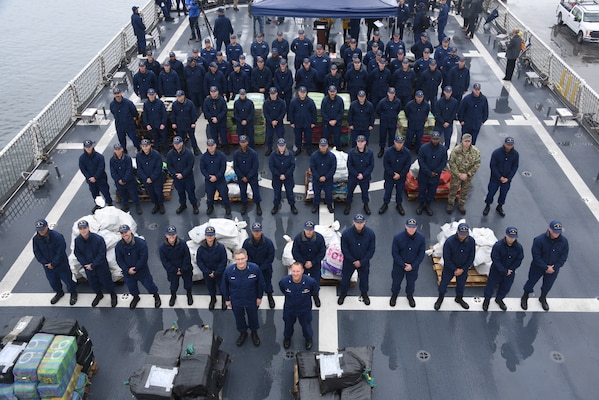
Early last week, the US Coast Guard offloaded 20,000 pounds (worth almost $340 million) of cocaine in San Diego, California. Over the course of eight cases across a two-month period, four Coast Guard cutters seized the contraband from drug-transit zones in the Eastern Pacific Ocean. The seizures were carried out by numerous US agencies within the Departments of Defense, Homeland Security, and Justice, as well as jointly with allied and international partner agencies, in support of Campaign Martillo.

 Coast Guardsmen assemble before preparing bails of cocaine to be offloaded from the Coast Guard Cutter Munro.

Thursday, February 13, 2020

Iranian War Powers Resolution and Special Forces Operations


On February 13, 2020 the United States Senate passed the Iranian War Power Resolution by a vote of 55-45. This resolution is aimed at “reining in President Donald Trump’s ability to use military action against Iran without prior Congressional approval.” (ABC) This bill was proposed after Iranian general Soleimani was killed in a drone strike on January 3, 2020.


Despite Soleimani being killed by a drone strike, however, the passing of this resolution raises a few more questions. One of those questions being what does this resolution mean for the operation of United States special forces in Iran.


Historically, the United States president has been able to mobilize special forces without prior congressional approval or even before notifying congress that the raid has happened until after it has been carried out. This has been seen in the Obama administration’s raid that killed Osama Bin Laden and more recently the Trump administration’s raid on Abu Bakr Al Baghdadi.

Now, what this resolution means, should it be passed, is that the United States Congress would have to approve any further special forces operations against Iran. The time of Congress not knowing about covert operations until after they are carried out, at least in Iran, would end. This severely limits President Trump's authority and could possibly lead to necessary operations not being carried out in time.

However, this resolution also means that planned operations against Iran will be more carefully scrutinized, and should they be deemed too hostile or too dangerous, will not be approved. This could lead to a severe reduction of United States special forces operations in the Middle East.

The resolution now goes to the United States House of Representatives, who is expected to pass it, then to the desk of President Trump, who is expected to veto it. As of right now, the Senate does not have the majority needed to override the veto.

https://abcnews.go.com/Politics/senate-poised-pass-resolution-curb-trumps-war-authority/story?id=68943735


New Weapons, New Problems

The Department of Defense has requested $111.2 million USD from Congress to develop their next-generation squad weapon by 2023. The request includes funding to procure prototypes for a next-generation weapons system, as well as funding for new 6.8mm ammunition for this weapon. This is intended to replace the traditionally used 5.56mm ammunition. Interestingly, the ammunition has been chosen, but the carbine itself has yet to be decided upon. Several models are being designed to fit this new caliber. While it has not been outright stated, Special Forces operators are almost certainly testing these new prototypes.

A Texas-based ammunition company designed this new cartridge in an effort to provide soldiers with "significant logistical and operational advantages over traditional brass-cased ammunition, including substantially increased effective range and muzzle energy, drastic reduction in cartridge weight and enhanced capacity."

This cartridge features a polymer casing, which is claimed to be approximately 30% lighter than brass casing. In practical terms, this has huge implications for Operators as the total ammunition they can carry will be increased. However, it is still subject to the issues that have traditionally occurred with polymer casings.

This cartridge is advertised as having a reduced heat transfer, which is technically true, but not without its own set of issues. The short-term heat-transfer will be less to the chamber area because the polymer will not transfer heat to the chamber area. In theory, this sounds good, but causes problems in practice. Energy cannot be created or destroyed, only directed.

In this case, the energy will be directed straight forward. So the long-term heat transfer to the chamber and barrel will still happen, just in a different way. Rather than the case absorbing some of the thermal energy, and then removing it from the system upon extraction, the energy will instead become focused on the case mouth. The heat will then hit the throat of the barrel, and be conducted back into the chamber area, otherwise known as differential heating. By heating the internal elements at different rates, the metal undergoes accelerated erosion and increases the potential for cracking. Brass-casings absorb and remove thermal energy from the firing block, resulting in a much more even heat distribution in the chamber. Furthermore, it is easier on the barrel because it isn't projecting the same heat down the throat. With a polymer casing, the barrel will probably suffer throat erosion. Essentially, the normal heat distribution will be moved forward into the barrel, eroding and damaging it faster than what would happen with brass-cased ammunition.

While the potential weight differential in the ammunition would make a huge difference, the proposed weapons system may suffer the same fate of other prototypes that looked to replace the M16-style weaponry. It will need to be affordable for the military to purchase, but it cannot be made with cheap materials due to the use of polymer casings. The differential heating caused by these cartridges will destroy poorly or cheaply made weapons. Traditionally, the Army has targeted (no pun intended) weapons that were easy to maintain, and produce, and cheap to shoot. Therefore, the differential heating will almost certainly need to be addressed in the design of the weapon itself, potentially creating complexity that wasn't necessary before. Greater complexity creates more opportunities for malfunction. If the new rifle does not address the differential heating, and do it at cost, then it will likely be marked down in the books as yet another weapon that could not beat the AR-type design.


Wednesday, February 12, 2020

Trump & Pence at arrival of caskets for Green Berets killed in Afghanistan

Two American soldiers from the Army's 7th Special Forces Group (popularly known as "Green Berets") were killed on Saturday in Afghanistan. The bodies of SFC Javier Jaguar Gutierrez and SFC Antonio Rey Rodriguez returned to the states last night. When the plane carrying their caskets arrived last night, President Donald Trump and Vice President Mike Pence were waiting for them at Dover Air Force Base.

You can see a short video of the caskets being removed from the plane here. Trump and Pence, along with the honor guard and other military attendees, are dignified and somber as the caskets are transferred into a waiting vehicle.

Now nearly two decades into American wars in the Middle East, it's worth remembering that the last Republican president -- George W. Bush -- supported a Pentagon policy preventing these kind of events from being photographed or recorded. The Bush administration cited the privacy of families of the deceased as the primary reason, though there was always question about how politics played a part. As the wars in Iraq and Afghanistan dragged on, some wondered whether Bush didn't want Americans to be reminded of the human cost of war with photographs of each returning plane.

Joe Biden accused the administration of sneaking in deceased American heroes "under cover of night." Whether the Bush administration meant for it to be political or not, it became political. The Obama administration overturned the ban relatively quickly, in April 2009. The new policy allowed families to decide if they would allow caskets to be photographed.

Perhaps the Bush administration chose to prevent the press from photographing the caskets out of respect of the families, or perhaps it was done for political purposes. Perhaps the Obama administration sought to be more transparent, or felt like it found a way to differentiate itself from the Bush administration's handling of the wars.

Perhaps Donald Trump and his administration attend these events out of deep respect for the soldiers who were killed. But perhaps it was done with a camera nearby as an opportunity for the president to use the military as a prop. Photographing caskets as they exit the plane for a political purpose can cut both ways.

Either way, this probably wasn't what either the Obama or Bush administration had in mind with their decisions on military caskets more than a decade ago.


Key Leader Engagement

An attack on a special forces green beret unit in Afghanistan this week highlighted real risks of key leader engagements (KLE). Special Forces Operational Detachment Alpha was ambushed by while awaiting transport immediately following a KLE in Sherzad. Reports indicate an Afghan policeman attacked the unit with a heavy machine gun. Two special forces soldiers were killed and a reported six others were injured. 

KLEs are an important counterinsurgency tool and one frequently used by U.S. special forces.. NATO identifies KLE activities to include:
a. Bilateral talks of senior leaders with military and civilian counterparts at their level of influence; 
b. Speeches held at various occasions in the presence of the media and/or key decision makers; 
c. Featured interviews to selected media with wide influence; and 
d. Conferences arranged to discuss specific items of interest with influential characters
However, KLEs can provide additional information. They can serve as a basis for negotiations, an intelligence gathering tool, and/or provide targeters with a known location for specific members of insurgency organizations. 

Unfortunately, KLEs often require special forces groups to move into unsecured territory, requiring navigating through unmapped enemy locations, an increased risk of IEDs and an higher chance of exposing themselves to rogue elements. Additionally, the negotiations conducted during these engagements may be performed by non-commissioned officers, who may or may not have received proper negotiation tactics training. This can result in inadequate, insufficient, or false information. It could also lead to the situation devolving into a confrontation. (source)

Ultimately, key leader engagements will continue to be a staple for special operations due to their ability to adapt to individual operations, and the necessity for communication in the modern conflict. 

Monday, February 10, 2020

Special Operations in NATO


Starting with a Letter of Intent (LOI) in February 2019, then moving forward with the signing of a Memorandum of Understanding on October 25, five European states established the Regional Special Operations Component Command (R-SOCC).

Hungary launched the initiative, and thus will be responsible for “overall coordination of the regional command” as well as supplying the R-SOCC's commanding officer. Joined by fellow NATO members Croatia, Slovakia, and Slovenia, and NATO partner Austria, the five signees expect R-SOCC to “reach Initial Operational Capability” by January 2021 and “Final Operational Capability” by the end of 2024.

The command aims to improve the nations’ ability to “effectively employ their special forces,” as well as increase “cooperation and interoperability within” NATO at large. Alongside the Composite Special Operations Component Command (C-SOCC)—another regional command created in June 2018 by Belgium, Denmark, and the Netherlands—and NATO’s Special Operations Headquarters in Belgium, R-SOCC will specifically strengthen NATO Special Operations Forces (SOF) in the region as part of NATO’s quick-reaction Response Force.

The annual Trojan Footprint exercise provided NATO commanders with the opportunity to “evaluate the progress and future” of R-SOCC, with special attention paid to the command’s deployment viability in case of an increasingly likely crisis with Russia. Given the divide between several NATO allies that has bubbled up in the wake of the organization’s 70th anniversary, NATO needs the improved cooperation and coordination that R-SOCC and other special operations commands intend to provide.

Saturday, February 08, 2020

What in Sahel is Happening?


Reports on US and French operations in the Sahel and the region's growing crisis are rarely seen in the news. The Sahel is suffering from one of the worst humanitarian crises in the world and is officially facing the fastest-growing displacement crisis. The situation deteriorated rapidly in 2019 due to terrorist groups gaining control of the territory. As worrying as the presence of these groups is, the approach that the US and France have taken to militarize the region is even more so.

The current counterterrorism policies France and the US are promoting are likely adding to regional instability. External actors in Africa too often opt for hard power and militarization to deal with terrorist and insurgent groups, including providing unprepared and at-risk locals with weapons. Most large-scale military operations against these armed groups have only forced thousands of civilians to flee their communities, resulting in dismal humanitarian consequences that we have already seen in Libya, Iraq, and Afghanistan.

The Pentagon has discussed withdrawing thousands of military personnel that currently provide support in Africa. Not only would this decision contradict the geostrategic ambition of counteracting Chinese and Russian influence on the continent, but the previous withdrawal of US troops have left local and Allied forces alone to fight off groups tied to the Islamic State or Al-Qaeda before they are sufficiently subdued. A retreat from Africa now would only leave breathing room for these groups to expand in the Sahel at an exponentially dangerous rate.

Withdrawing from the region is not the answer to defeating terrorism in the Sahel, nor is continuing the current approach to counterterrorism. The military forces of the US and the rest of the international community require greater communication and coordination with each other and regional actors to address the root causes of the conflict. It is necessary to implement new synchronized strategic and operational structures and policies to counterterrorism, build the capacity of Sahelian forces, restore state authorities, and address the dire need for development assistance.
  

Thursday, February 06, 2020

US-Russia Troops have avoided direct conflict, but how much longer? Time to end the Syran civil war is NOW.


The civil war in Syria has acted as a proxy battle between Washington and Moscow; Washington supports the rebels' desire to remove Assad from office, while Moscow wants him to remain in power. Despite their starch opposition, US and Russia's troops have managed to stay out of each others' way. They signed an agreement which prevent their troops to engage in a direct conflict, but recent events seem to threaten the agreement.

According to an article published on Washington Post, standoffs between the US military and Russian troops have increased. The standoffs include blocking each others' troops, preventing them from moving freely which violates the terms of the agreement. The Trump administration scaled back the number of troops involved in Syria - from 1000 to 600 - with mission to patrol and protect the oil fields along with Kurdish fighters. Most of the standoffs occurred in Northeast Syria, an area that is deeply patrolled by US and Kurdish forces. Though the incidents have been tense, there has yet to be any use of force.

This is proof that any accidents could escalate the troops relationship and lead to a dangerous conflict. But, how do we prevent a direct conflict? The first step would be to engage in diplomatic efforts and work to solve the humanitarian crisis in Syria. History has shown that regime change rarely leads to any positive outcome. As prime examples, we should learn from Iraq and Libya. The removal of their dictators led the country into further ethnic battles, civil wars, and have destroyed the countries' economy and institutions, rendering human life impossible. This situation can not go any longer; leaders of the world order must sit down, put differences aside and come a to conclusion that will lead to lasting stability.

Many US officials have called out Russia for using its veto power to block humanitarian aid deliveries to northwest Syria, where nearly 2.8 million innocent lives are caught in this civil war and rely on this assistance to survive. It is time that US and Russia stop exploiting the situation in Syria as if it represents a threat to their national security. By further engaging in the civil war, both sides increase the likelihood of a direct conflict between them, further endanger the innocent lives, and reduce the likelihood of a peaceful resolution. I realize this is easier said than done but both sides need to come to the negotiating table and put an end to this unfortunate civil war.

Resurgence of ISIS post al-Baghdadi


The Pentagon watchdog reported that the US withdrawal from Iraq could mean further resurgence of the terror group. A US drone shot Iranian General Qassem Soleimani at the Baghdad International Airport. In response, Iraq’s parliament passed a nonbinding resolution to have all US forces withdrawn from the country. Despite this tension, US-Iraqi military operations against ISIS resumed a week after Soleimani was killed. Despite the success behind the Syria raid taking down al-Baghdadi, both US Central Command and the Defense Intelligence Agency say that there has been “no immediate degradation in ISIS’ capabilities”. Without further pressure from US and coalition forces, it is likely that ISIS will continue their global acts of terror. 

On February 5th, 2020 the Pentagon reported that the killing of former ISIS leader, Abu Bakr al-Baghdadi, had little to no impact on the daily operations of the terror organization. On February 6th, 2020 ISIS claimed they had conducted a stabbing in the Maldives where three were injured. In early December, 2019, President Trump had argued that Emanuel Macron and the rest of the EU were not doing enough to help US and coalition forces to help fight against ISIS forces in Syria. The terror organization has also been wreaking havoc in parts of Africa. In Chad, a suicide bomber killed nine civilians and in Nigeria, aid workers were held hostage by armed insurgents for more than three weeks. Attacks claimed by ISIS are up 20% after the raid that killed al-Baghdadi. As their confidence grows, it will likely fall on the US to combat further growth of the organization on a global scale. With Russian and Chinese interests in Africa, it isn’t outside the realm of possibility that Putin or Ping would help fight back against ISIS. 

Wednesday, February 05, 2020

Counterinsurgency: Learn, Prepare, and Partner


Steven Metz has been an advisor to political campaigns, a faculty member of the U.S. Army Command and General Staff College, and a faculty member of the Air War College. Metz wrote “The U.S. Is Again at Risk of Abandoning the Lessons of Counterinsurgency” in 2018. He discussed how many U.S. military operations lacked effective counterinsurgency measures. His solution was to form learning organizations and monitor global insurgencies.

Organizational Structure

A counterinsurgency learning organization should be a joint effort. Metz argued the U.S. Army should have the largest role, but the learning organization should involve the entire government and multinational partners. This organization would conduct strategic war games, research, refine strategic counterinsurgency concepts, and obtain a multinational community of counterinsurgency experts. Additionally, The U.S. can partner with NATO allies. These allies can also provide resources and host counterinsurgency exercises.

History

The U.S. was involved in regime changes, nation-building, conflict stabilization, and the reconstruction of Iraq and Afghanistan’s forces after the interventions under the George W. Bush administration. U.S. forces were not prepared as armed resistance groups quickly emerged. Metz also noted U.S. force’s counterinsurgency measures were not sufficient in Vietnam in the 1960’s and 1970’s.

Pentagon’s Stance

The Pentagon’s 2018 National Defense Strategy’s primary goals involved strategic defense measures against ‘revisionist powers’, such as China and Russia, and ‘rogue regimes’, such as North Korea and Iran. This 2018 strategy did not mention counterinsurgency. However, the U.S. Marine Corps and Army did update their counterinsurgency doctrine and created a Joint Force in 2018. The U.S. Army also looked to help allies and created the Security Force Assistance Brigades.

Closing Thoughts

Metz argued the Pentagon’s efforts were not sufficient. The Army can not solely handle counterinsurgency. It is most effective as a joint effort and should focus less on soldier skills and more on effective strategy. Counterinsurgency measures will remain relevant and the U.S. military and allies should be prepared.


Will the ACFT Actually Improve Combat Readiness?


Fitness is a top priority for our military's combat readiness, but is the new CrossFit-like Army Combat Fitness Test (ACFT) the best tool for this measurement? 

The ACFT is set to officially take the place of the 40-year-old Army Physical Fitness Test (APFT) in October 2020. In theory, it seems like an excellent way to improve and maintain physical readiness, but it is already showing to have a number of issues regarding implementation and ensuring that soldiers are up to par. 

According to the Army Times, the first diagnostic ACFT was conducted by 11 battalions, totaling more than 3,200 soldiers (2,849 men and 357 women). The results were shocking, with 30% of men and 84% of women failing the test, especially considering that these were mostly combat-focused battalions (infantry, artillery, and engineering). 

The ACFT's minimum for the two-mile run for a second-tier MOS, which includes Human Resource specialists (aka desk jockeys), is now 19:00. While this may seem easy, the APFT's minimum was 19:36 for women over 22, 23:42 for women over 42, and 19:30 for men over 47. The APFT only had two events before the two-mile run (push-ups and sit-ups) while the ACFT includes five physically-demanding and cardio-intensive events before the run. 

To be fair, push-ups and sit-ups have never measured true physical readiness, but the ACFT has already done more harm than good with the number of injuries increasing as units fail to properly train before implementing diagnostic tests.

Active Duty units have plenty of time for physical training, but Reserve and National Guard units are now expected to set aside more time to complete the recommended physical training routine during drill weekends. The amount of time this training and the ACFT will require to complete will take away from other training activities that are necessary for combat readiness and prevent these soldiers from actually doing their jobs.  

The ACFT could ultimately damage to the Army's overall force quality over time by removing highly-capable, intelligent soldiers and leaders from the ranks and shrinking the already small pool of Americans that are eligible to serve. Army officials have said that they will consider adjusting the test if necessary, so only time will tell if this will improve or damage our Army's overall readiness and quality.


Monday, February 03, 2020

Trump reverses US course on landmine policy

The Trump administration announced in a two-paragraph statement on Friday that it would no longer adhere to the Obama-era policy prohibiting the use of landmines outside the Korean peninsula. The Department of Defense issued a more substantive explanation on the same day.

Most nations, including every NATO member state except the United States, adhere to the 1997 Ottawa Treaty which banned landmines from use. The United States had previously made moves to come into compliance with the treaty, including the Obama policy being rolled back, but it had never been ratified by Congress. The door has been swinging for the executive branch to open or close, as Human Rights Watch points out in its statement responding to the announcement. The decision is sure to draw comparisons to the Trump administration's 2017 decision to allow for the use of cluster munitions, though that's a separate topic.

The DoD post discusses a "capability gap" for US forces and the utility of "area-denial systems" such as landmines. It's careful to point out that the landmines being employed are not "persistent," meaning they have the ability to self-destruct or self-deactivate after a period. The statement also points out that the US will continue to help demine some areas worldwide.

There is no specific discussion of why the Trump administration decided to take this course now; only that the "strategic environment" had changed since 2016. The only nation mentioned in the DoD statement is Iran, in its final Q&A, and it denies that Iran is the reason for this change in policy.

The short-term impact may be somewhat limited. The US military is likely already viewed with skepticism or hostility in theaters where landmines are most likely to be used. The long-term impact could be worse. While the Trump administration may find some utility for landmines, it's also possible that they won't have a significant impact on overall capabilities. It's not hard to imagine a scenario where the decision does more harm than good.

It's worth noting here that landmines haven't been a major priority for any presidential action. The Obama administration didn't set a course to join the treaty until 2014, well into its second term. Trump, who overturned so many Obama policies early in his presidency, has waited three full years to make this decision. If the US is serious about landmines, the next president can take the issue head-on and send the treaty to Congress early. That would end the tug-of-war in the executive branch.

Saturday, February 01, 2020

Not Your Grandfather's AirLand Battle Doctrine: Multi-Domain Operations


According to General David Perkins, as the complexity of war increases, more domains are open to competitions against a multitude of state and non-state adversaries. Beyond the traditional domains of land, sea, and air, there now exists space and cyberspace domains. Increasingly US Army dominance in one domain such as land is contingent on access and dominance of the air, cyber, and space domains. Effective cross-domain dominance has always been important in modern war but will become essential to military success in the twenty-first century. Adversaries to the US and its allies will attempt to limit our dominance over the traditional domains via competition in the new domains, particularly cyber. An adversary’s goal would likely first be preventing the US and its allies’ access to the AO; Second, attempt to isolate air, sea, and land forces to prevent mutual support; Third, limit US maneuverability. In 2018, the Army released The US Army in Multi-Doman Operations 2028 pamphlet that detailed possible solutions to an adversary’s goals mentioned above. These solutions include allowing forces to conduct independent maneuver, employ cross-domain fires, and maximize human potential. Unfortunately, the think tank New America believes the Army will fall short on the of the pamphlet’s vision unless the Army adopts its three recommendations. First, the US Army must lead a renaissance in great power competition doctrine; Second, the Army must establish the twenty-first-century verse of the National Training Center; Third, there must be a brigade-level experimental task force dedicated to Army Future Command to diagnose and adapt to disruptive challenges.

Battle Ready or not? Here we come

Many news outlets cite the size of armies as a way to determine how powerful their military is. According to army-technology.com China's People's Liberation Army Ground Force is the largest in the world, with an estimated 1.6 Million troops. China also spends the second most on their military, $250bn in 2018 according to official numbers, following only the United States.

The United States is the third-largest military with over 1mil active duty personnel, but it also spends the most money and highest percent of GDP on defense spending.
But how well do these numbers match up with Battle Readiness?
The Heritage Foundation’s “2020 Index of U.S. Military Strength," assesses that the United States' forces would be stretched "dangerously thin" if it were to fight more than one war at one time. The Index also assessed the Army, Marine Corps, the Air Force, and the Navy in the areas of "capacity, capability, and readiness." Each of the service branches except for the army were given a "marginal" report, essentially a C grade. Only the Army was given a "Very Strong" report. This does not bode well for the US's ability to compete if forced to fight against more than one military threat (China, Russia, NK, Iran)

Compared to the United States, China's current military has almost no combat experience. "Considerable evidence shows that better-educated soldiers are easier to train, more adept at operating and maintaining sophisticated weapons and platforms, and more capable of executing complex tasks." While China commands one of the most high-tech arsenals in the world, it remains to be seen if they are able to utilize it effectively. However, in the past 5 years, China has bolstered military diplomacy with its allies, particularly in joint-military exercises. Between 2003 and 2014, China participated in a total of 130 military exercises, an amount nearly matched by the 124 exercises China joined in 2016 alone. While these exercises cannot take the place of combat experiences, they definitely improve the battle-readiness of China's military.