Friday, April 07, 2017

US “FINALLY” BOMBS SYRIA, NOW WHAT?


US “FINALLY” BOMBS SYRIA, NOW WHAT?


It was September 9th, 2013 when then private citizen and business mogul Donald Trump tweeted,” Don't attack Syria - an attack that will bring nothing but trouble for the U.S. Focus on making our country strong and great again”. Now, this seemingly innocuous tweet clearly becomes of a particular importance today in 2017 as its author is now President of the United States and has gone against what he previously advocated.

Following reports that the Syrian regime used chemical weapons on its people, resulting in 80 dead, President Trump ordered cruise missiles attacks in retaliation on the Syrian military base of Al Shayrat where the chemical weapons attack is believed to have originated. This marked the first time that the US military deliberately targeted forces loyal to Assad. Previously, the US military had been conducting surgical airstrikes, targeting the Islamic State.

Russia, which has been propping the Assad regime since 2015, condemned the American response calling it “a violation of international law”. Although the U.S. military’s response does not constitute in itself an entry into the Syrian conflict, it does make for an interesting dynamic. President Trump has campaigned on the idea that strained relations with Russia ought to be repaired. However, this latest assault on the Syrian airbase represents a minor step back from his intended policy of rapprochement with Russia. Also, what the missile strikes on the Syrian airfield demonstrated is that President Trump is less constrained and more willing to act to punish Assad’s mishaps. This would likely lead to an increase in Russian support for the Syrian regime.

Nevertheless, a direct confrontation between Moscow and Washington appears unlikely and talks of WWIII should be dismissed completely. The complexity of the situation, exemplified by the numerous factions fighting each other in Syria serve to prevent just that. In the absence of a clear US policy in Syria, there appears to be no end in sight for the now six year old conflict.

Thursday, April 06, 2017

We've said enough about North Korea...


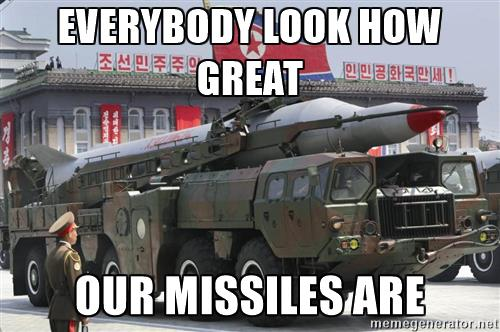
North Korea launched yet another missile test on April 5th, making that the fourth missile test this year. The country has made it clear that it intends to build an intercontinental ballistic missile (ICMB) capable of reaching the US. Long have policy makers in the west brushed aside North Korea’s nuclear developments as unrealistic or unsustainable, yet perhaps we should be a little more concerned at the moment. The test on Wednesday tested a land-based version of North Korea’s submarine missile. Nuclear policy analysts are growing in concern as they think this could be part of the separate stages of the three stage long-range missile. So what do we actually know about North Korea’s nuclear program, and should we be concerned? It’s very likely that North Korea has an ICBM. We have seen mock-ups of ICBMs with different ranges in military parades over the past few years. The KN-14 and the KN-08 have the potential to reach the West Coast of the U.S., but the reliability of these missiles is questionable at best. Though we have only seen mock-ups, it would be a mistake to assume that North Korea isn’t working on developing these missiles. In fact, we are relatively sure that North Korea is building towards putting nuclear warheads on these ICBMs. Scary stuff.
So should the American people be worried? Probably no more than they have been before. As always, North Korea remains one to watch, but these developments don’t necessarily constitute an immediate threat. Still, it would be useful for the Trump administration to develop a plan in the event that North Korea achieves its long-term goal of developing nuclear weapons. Secretary Tillerson released a confusing and unassuring statement on North Korea after the latest test, saying “The United States has spoken enough about North Korea.” It’s unclear what a “new” strategy towards North Korea. We know that the administration doesn’t think that Obama’s strategy was successful, but Trump also said that NAFTA was a disaster yet the draft proposal that floated around Congress last week for renegotiating the trade agreement indicated very few changes. What Tillerson and the Trump Administration fail to realize is that previous administrations have been fairly tough on North Korea, imposing economic sanctions and military pressure to bring them to the table. Yet North Korea has sustained such coercion so far, so why would that change under President Trump? Perhaps what Tillerson means by saying that the US has spoken enough about North Korea is that it’s time for another country to start putting pressure on Pyongyang. And that country should be China. Here’s the trouble with that: you can’t simultaneously posture towards China and ask for its help; that’s not how diplomacy works. Then again, President Trump did come to power on a platform championing his ability to make deals, so who are we to question him.

Tuesday, April 04, 2017

U.S./Iran Posturing II

U.S./Iran Posturing Indicates More Severe Combat to Come:
Who Will Throw the War-Launch Punch?

Above the Waters (Part 2 of 2)

            Incidences of American and Iranian bravado persist in the Persian Gulf and with each one, responsibility is never taken and the rivalry grows stronger. It is clear that testing the water of both countries’ self control is reaching a boiling point. Although Iran and the US clearly disagree about their position in territorial and international water when naval countering occurs, the exact measurement of 12 miles in water is much easier to delineate. What happens then, when the water is no longer the center of contention and airspace confounds the opposition further? Territorial airspace is demarcated using international water borders as well as a country’s borders. Technology is changing all aspects of modern air warfare. As with the numerous naval provocations between Iran and the US, the countries’ position of where the fault lies in airspace incidents and the legitimacy regarding to whom the space belongs is even more conflicting.

Divisive Defenses
            The Strait of Hormuz is a strategic chokepoint between the Persian Gulf and Gulf of Oman through which 20% of the world’s petroleum passes; its territorial waters and airspace shared with Iran and Oman. Iran has threatened to close the Strait numerous times as different disputes arise between the US and US allies. In June 2008, the commander of Iran’s Islamic Revolutionary Guard Corps (IRGC), Mohammad Ali Jafari stated Iran would seal off the Strait if the US or Israel attacked. The US countered with a statement that the closure would be considered an act of war. Other threats of closure were made because of increased sanctions on Iranian oil exports. In 2012, the US deployed significant military reinforcements into the Persian Gulf as a move to preempt the closure of the Strait.
            The 2012 military buildup included Navy ships to better patrol the Strait, aircraft carriers, and F-15C warplanes and stealthy F-22 moved into two separate bases in the Persian Gulf. A 2012 Aljazeera report stated that the US, with an encirclement of military bases in the region, has three main interests in keeping a presence in the Middle East: securing oil, guaranteeing the security of Israel, and combating any threat to US interests. The Defense Department's 2011 report cited 45 bases around Iran, but omitted espionage bases, facilities located in warzones, and Special Operations Command (SOCOM) commandos deployed throughout the region as well. Iran has been and continues to be considered a threat to the US and its allies, justifying any military reinforcement in the area.

            Again, every encounter reported by either country has different stances in regard to where the incident took place and why. In September 2016, Iran reportedly threatened to shoot down two US military planes. Surveillance P-8 Poseidon and the 24-member crew EP-3 Aries reconnaissance flown by members of the US Navy were in the Strait of Hormuz, 13 miles off of Iran's coast. US officials claim that Iran military warned the American planes if they did not change course, they posed the risk of getting shot down. The officials stated the US aircraft ignored the Iranian order and continued their flights. When asked why the US aircraft were operating near Iran, one US official told Fox News, "We wanted to test the Iranian reaction." US military officials have coined the words “unprofessional” and “unsafe” to describe all military encounters with Iran. However if the US continues to scrape territorial borders and admittedly flies missions as reaction “tests,” these coined words should be used interchangeably with regard to either country’s actions.
            Iran recounts that the threat was made to the aircraft members with a preface that the planes were not to enter Iranian airspace. Fox news cited that the latest intelligence assessment reported that there were no Iranian missile launchers in the area. Brigadier General Abdollah Reshadi told reporters that Iran’s Air Defense Force constantly monitors the skies nationwide in preparation for possible hostile activity. “[Our] radar coverage of the Persian Gulf and the Sea of Oman detects aerial traverse by [reconnaissance] aircraft,” Reshadi said. “We detect any flying activity in time and deliver tactical response in less than two minutes.” Deputy Chief of Staff of Iran's Armed Forces, Brigadier General Massoud Jazayeri reiterated that all vessels belonging to the Islamic Republic of Iran are fully aware of international laws and regulations. He stated Iran military forces have always acted based on stipulated standards and refuted all American claims of Iranian misconduct.

Robotic Robberies
            The expansion of the role of technology, specifically unmanned aerial vehicles, (UAVs), makes the future for peace between these two countries appear bleaker. In December 2011, a US RQ-170 Sentinel drone crashed deep in Iranian territory; a top-secret surveillance mission had been underway to keep close tabs on Iranian nuclear activity. Again, the countries disputed the cause of the crash: Iran reported it was shot down or crashed due to Iranian military control system hacking, American officials stated that the drone was lost due to a malfunction. In the days ahead, through a press report, President Obama requested Iran give the drone back. Foreign Ministry spokesman Ramin Mehmanparast responded in a news conference, “It seems that (Obama) has forgotten that our air space was violated, a spying operation conducted and international law trampled.” Requesting an apology from the President, Mehmanparast added that the violation of Iranian airspace can “endanger world peace and security.”

            In November 2012, two attack planes operated by the IRGC attempted to shoot down an unmanned American MQ-1 on a routine surveillance flight in international airspace, 16 miles off Iran, but failed. An alternate report cites a Pentagon spokesman stating the drone was 14 miles from Iran’s coast. Iranian officials stated that the drone was operating over territorial waters. After the interception attempt, the Pentagon decided to escort intelligence surveillance reconnaissance (ISR) drones with mission fighter jets. The next month, the IRGC captured a US ScanEagle drone over the Persian Gulf waters after it crossed into Iranian airspace. The Pentagon reported US efforts were those of continuing surveillance using a fleet of drones in the Persian Gulf for any evidence of Iranian nuclear proliferation. In regard to the drone capture, Iranian authorities reasserted that the IRGC monitored all movements of foreign forces in the Persian Gulf and Strait of Hormuz for its own national security.
           
            In September 2013, the IRGC announced the mass production of the “Shahed 129” drone; said to have a range of 1,700 kilometres, capability of carrying eight missiles and an ability to fly for up to 24 hours. Based on the model of the US ScanEagle drone captured in December 2012, Iran unveiled a reconnaissance drone named “Yasseer.” By November, Iran’s gains on drone technology had reached new heights. Iran unveiled the missile-equipped Fotros drone with a range of 2,000 kilometres, capability to fly at an altitude of 25,000 feet, and maintain a flight time between 16-30 hours. Defense Minister Mohammad Dehgan stated the drone was successfully tested and could carry out reconnaissance missions or launch air-to-surface missile strikes. Using reverse engineering and advanced data decoding, Iran unveiled its production of a drone similar to the US RQ-170 Sentinel, captured in 2011. The Iranian drone was said to be enhanced as well: “the version's weight has remarkably become less, it consumes less fuel, its speed has been increased and the duration that it can fly has improved a lot because of its enhanced body. The Americans had used metal in building the body but we did not use metal at all. It helps to reduce its detectability by radars," Gen. Amir Ali Hajizadeh, head of the aerospace division of the elite Revolutionary Guard, stated publically. This long-range drone can carry four precision-guided bombs.

            The return of diplomatic relations between Iran and the US following the Joint Comprehensive Plan of Action (JCPOA) Iran nuclear agreement in 2015 brought hope that the contention between the countries would lessen. As Iran continued its ambitious drone program, the government persistently publicized its ability and validity for strengthening its defense systems. In January 2016, Iran flew a surveillance drone over French aircraft carrier Charles de Gaulle and the nuclear powered USS Harry S Truman. Both vessels were operating in international water; the USS Truman stationed in the Persian Gulf region for the purpose of launching airstrikes and supporting operations against the Islamic State in Iraq and Syria. The US did not open fire on the drone because it was unarmed and was not considered a threat and the carrier was not conducting flight operations at the time. However, had there had been active takeoffs and landings on the carrier at that time, US handling of the drone may have been quite different. Officials continue to make statements to the public assuring that the US takes all threats seriously, and the military is ready to use force if necessary.

            Iran’s drone program was founded on the captures of downed US drones. Iran now has the advanced radar Nazir. Situated in the desert, the radar is used for detecting small targets at long distances. No stealth aircraft can intrude into Iran’s airspace without coming into service of Nazir. As recently as March 2017, Iran has also produced and deployed a counter-drone weapon: a rifle-shaped jamming device. The Iranian regime says the device can “electronically separate a remotely piloted aircraft from its command pilot and even reprogram it to turn on its owner.” The counter-drone device is said to have the capability to hack the UAV, allowing the device user to reroute the drone, land it safely, or use it against its original operator.

Dueling Derision
            Military drills occur continuously in the Persian Gulf, staged by many different actors. These drills complicate the logistics of the use of the Strait of Hormuz as well as the safety of all vessels in the water. Iran conducts naval drills annually in the Persian Gulf and Strait of Hormuz and often carries out ballistic missile tests throughout the year as well. In a resolution written in April 2016 by US Rep. Randy Forbes, R-Va., who is chairman of the Seapower and Projection Forces Subcommittee of the House Armed Services Committee, Forbes wrote that Iran “failed to ‘adhere to international maritime law’ and by conducting military drills has ‘undermined stability’ in the Persian Gulf.” Forbes was referring to Iran’s naval drills in the Sea of Oman and the Indian Ocean in January as well as a joint naval drill with Oman in December 2015. This resolution made front-page headlines in Iran and again created antagonism, specifically in Iran's Supreme Leader Ayatollah Ali Khamenei who condemned the US military presence in the Persian Gulf. In a speech on May 2, 2016, Khamenei lambasted the US stating, "Today, the enemy makes statements that are bigger than their mouths. They sit and scheme that Iran must not have military drills in the Persian Gulf. What a strange thing to say. They come from that side of the world and conduct drills. What are you guys doing here?"

            In December, Iran was criticized for testing rockets near US warships and commercial traffic near the Strait of Hormuz. Though Iran denied the rocket launches, the US later released video footage showing the rocket fire. During drills in January 2016, Iran’s navy successfully fired surface-to-surface Noor cruise missiles at mock targets. The drill took place over a three-million-square-kilometer area that included parts of the Strait of Hormuz, the Gulf of Oman and the Indian Ocean. The drills are conducted to show Iran’s defensive strength and assert its power within the region, reinforcing its stance that countries within the region should be responsible for the area’s security. In October 2016, the US and UK conducted a bilateral exercise focusing on mine countermeasures (MCMs) with the aim of securing operational readiness in the Persian Gulf area. Both countries continue to practice security measures against the possibility of the other making a move: the concept of diplomatic talks seems to have disappeared.
            As if on stage, both Iran and the US with its allies have already launched flashy military drills in the region by the end of February 2017. American, British, and French naval units created the Unified Trident, involving British Royal Navy flagship HMS Ocean and Type-45 destroyer HMS Daring, US warships USS Hopper and USS Mahan as well as French anti-aircraft frigate FS Forbin. The trilateral exercise was reported to have simulated targeting Iranian combat jets, ships, and coastal missile launching facilities. A US Navy press release reported the 3-day exercise was designed to “enhance mutual capabilities, improve tactical proficiency and strengthen partnerships.” The final drill featured 13 ships from the allied navies sailing in formation, with helicopters flying overhead.

            Within weeks of the Unified Trident exercise, the IRGC launched a large-scale 3-day ground force exercise in an eastern desert area of the country. The military drills included artillery, air defense, drone, infantry and air force units. Later that week, the Iranian navy executed a massive military drill in the Indian Ocean, the Gulf of Oman and the Strait of Hormuz covering an area of 2 million square kilometers. Anti-ship ‘Dehlaviyeh’ missiles and Iran’s homemade coast-to-sea cruise missile, Nasir, were test-fired. Iranian marine commandos and special naval forces had trained in confronting “possible enemy aggression” on Iran’s coast and used “state-of-the-art weapons and equipment” during the exercise, Iran’s Fars news reported. Iran’s military doctrine states that the public display of offensive abilities could serve as a form of deterrence. The defense types and exercises do not violate the JCPOA.

            US Army General Joseph Votel, who heads US Central Command (CENTCOM), spoke before the House Armed Services Committee pushing for the use of military means against Iran. Votel stated, “we need to look at opportunities where we can disrupt [Iran] through military means or other means their activities. We need to look at opportunities where we can expose and hold them accountable for the things that they are doing.” US and Iranian provocations cannot escalate if we seek to keep the diplomatic relations painstakingly regained. We cannot turn our backs on one another, continuously fault the other, and use rhetoric in the media that incites controversy and ire. The countries’ various territorial/international border skirmishes remind me of a sibling holding a finger a centimeter away from the other sibling’s face, the behavior infuriating yet the statement holding true: “I’m not touching you…” Neither country will back down and both will continue to assert their dominance over the Persian Gulf and its defense of the valuable waters. To avoid this impending war, both nations must grow up and agree on rules of behavior. Creating a framework for behavior within the military forces and during drills and exercises could alleviate tension and promote bilateral stability. The promotion of trade and alleviation of sanctions could make passages through the Strait justifiably innocent and peaceful. Both countries should be ashamed of their immature behavior: fancy, modern war toys will still create age-old bloodshed and grief.


U.S./Iran Posturing

U.S./Iran Posturing Indicates More Severe Combat to Come:
Who Will Throw the War-Launch Punch?

Playing Battleship (Part 1 of 2)

            Acts of taunting continue to occur in what resembles a relationship of sibling rivalry between the United States and Iran. Yet how long can either continue to make these close calls until one hothead administration blows its top? I have no intention to point a finger at either country with a “he started it!” point of view. Tensions between Iran and the U.S. date far back in history and continue on. From the involvement of the CIA in orchestrating a coup ousting Iran’s Prime Minister Mohammad Mossadeq in 1955 to American military protection from Iranian attacks of Kuwaiti oil tankers in 1987 and 1988, objectives that the countries hold in common are consistent: oil access and its vital trade route, the Strait of Hormuz.
            From 1988 on, a series of short battles and standoffs continue, increasing military engagement in and around the Strait of Hormuz. The overall animosity and distrust has led to unnecessary tragedies, such as the American warship USS Vincennes that in 1988, shot down an Iranian Airbus after mistaking it for a F-14A Tomcat fighter jet, killing all 290 people on board. In 2008, a U.S. destroyer almost opened fire on an Iranian ship after receiving radio messages misinterpreted as an impending attack. News of the brief capture of U.S. sailors by Iran’s Islamic Revolutionary Guard Corps (IRGC) in January 2016 caught the attention of the U.S. general public. Many who follow world events on a surface level may have suffered from selective hearing once the words “U.S. naval captives” and “Iran” came about through the media. Although the U.S. navy was admittedly at fault for crossing into territorial waters, the brief crisis spurred memories of the 1979 Iran Hostage Crisis for many Americans. This, in turn, brought forth nationalist assumptions that strengthened the notion of Iran’s position in the “axis of evil.”

Varying Versions       
            Each point of view from the opposing countries must be taken into account to fully understand how administrations and media skew public opinion and ultimately create a more unified animosity toward the other. There is a nuance of specific terminology government officials and the media use that create contradictory public assumptions. For example, U.S. media called the sailors “captured” and Iranian officials referred to the situation as the sailors being “detained.” This directly affects how the public views the incident. These official, yet conflicting statements made by the separate administrations leave citizens in both countries picking sides, predominantly backing their own government leaders. With strong public opinion comes a sense of nationalism and defense of one’s beliefs. These beliefs will ultimately lead to a cause for war when each side continues to live with such ardent hostility.
            Nationalism and territorial rights are intertwined. The Strait of Hormuz is 20.75 miles across at its narrowest. In compliance with the Law of Sea Treaty’s 12-mile territorial sea clause, Iran and Oman share territorial water of the Strait of Hormuz and the right to regulate the waters to ensure the security of their country. Ships have the right of innocent passage, including military craft as transit vessels. In Article 16, Section III of the 1958 Geneva Convention, the rule is established that transit is innocent only “so long as it is not prejudicial to the peace, good order or security of the coastal state.” A coastal state is given the right to take the necessary steps in its territorial sea to prevent passage that is not innocent. “This phraseology is nebulous enough as it stands; furthermore, the use of the word ‘prejudicial’ suggests that an actual injury to peace, good order, or security need not be taking place for the passage to be deemed no longer innocent. If a reasonable chance exists that such injury may be in the offing, the coastal state would be in a strong position to decide that the passage is not innocent and exclude the vessel from its territorial waters.”

            Iran has maintained that a coastal State’s sovereignty is subject only to the exercise of the right of innocent passage of ships and that when straits are situated within the territorial sea of one or more States, the legal status of territorial waters must not be affected by the passage through straits used for international navigation. Iran is especially interested in regulating passage through the strait and that free transit or innocent passage exists only when states comply with pertinent regulations. Iran and the US have signed the United Nations Convention on the Law of the Sea (UNCLOS) III but neither has ratified it. Due to the value of the Strait of Hormuz, Iran still holds concerns regarding the Law of the Sea Treaty. Iran holds the belief that passage of other states’ naval ships from territorial waters is dependent on prior notification and observance of the requirements of innocent passage. Innocent passage is subjective, especially when dealing with an outlier country like Iran who wants to assert its presence within the world’s powers. The naval disputes that are occurring at an increasing rate have caused the U.S. and other countries to use military escort ships when crossing for security purposes.

Transit Tension          
            Starting on Tuesday, August 23, 2016, four separate naval engagements occurred between the countries in one week. Four ships belonging to Iran’s IRGC were said to have intercepted two American vessels at high speed, coming within 300 yards of the USS Nitze. “The USS Nitze was accompanied by the guided missile destroyer USS Mason on what an official described as a ‘routine transit’ in international waters at the time of the incident.” The Nitze attempted to make radio contact 12 times with no response; the Iranian ships continued their approach, and the destroyer sounded five short blasts on its whistle, an international danger signal. Leaving the Nitze crew no choice, the vessel was forced to change its course at the expense of coming very close to offshore oilrigs to avoid the Iranian ships. Here, a reader must again consider the two countries’ interpretation of the word “intercept.” The legality of the interception of the vessel is likely dependent on learned bias.
            The following day, American coastal patrol ships the Squall and the Tempest, said to be operating in international waters, were harassed by three boats from the IRGC Navy, “which crisscrossed the Tempest’s bow and created ‘a possible collision hazard’.” Later on, the same day, an Iranian patrol vessel approached the Tempest head-on; ignoring repeated multiple flare, radio, and loudspeaker warnings. The vessel turned away when the Squall then fired three warning shots from its 50-caliber gun. Again on Wednesday, the same patrol vessel that had incited the conflict with the Tempest, intercepted the Stout, a guided missile destroyer, three times. Cmdr. Bill Urban, a spokesman for the Navy’s Fifth Fleet, stated “the Stout maneuvered away and ‘employed devices,’ which he did not identify, in order to dissuade the Iranian vessel from further harassment.” Again, on September 4, 2016, seven Iranian fast-attack boats swarmed a coastal boat, the USS Firebolt. One boat came to a stop 100 yards in front of the American ship. In 2016, 35 Iranian fast-boat encounters occurred that were deemed unsafe and unprofessional.

            The USS Mahan, a destroyer, fired warning shots and used radio calls, flares, and signals when five Iranian ships came 900 yards from three U.S. vessels entering the Strait on January 9, 2017. A US helicopter dropped smoke grenades to deter any further interference. On March 6, 2017, the USNS Invincible, a tracking ship, accompanied by three British Royal Navy ships, were forced to change course when multiple IRGS vessels came within 600 yards of the entourage. An unnamed US official stated that once again radio communications to Iranian ships were not answered. The official also did not disclose where in the Strait the incident occurred.
            Iran’s stance on these events is quite different. Defense minister, Brig. Gen. Hossein Dehqan, stated that naval control and patrols take place only in Iran’s territorial waters and Iran would take action if an intrusion were deemed aggressive. As well, Ayatollah Khamenei “underlined that security of the Persian Gulf region comes within the purview of the regional countries alone, and dismissed the US claim of seeking security in the region.” Khamenei stated that the Persian Gulf security relates to regional countries with common interests, “and not to the US.” He concluded that countries within the Gulf region should provide security to the region itself. Mehdi Hashemi, commander of the IRGC’s Zolfaqar Flotilla, asserted that USNS Invincible was at fault for sailing too close to IRGC vessels in the most recent incident in March. His claim mirrors Khamenei, stating American and British vessels presence in the Gulf region “endangers the security of this strategic region, which provides a huge portion of the world’s energy.”


Belligerents’ Battlegrounds
            Disagreements between the two governments differ as to whether these encounters have occurred within international or territorial waters. The Strait of Hormuz is a geopolitical chokepoint, through which at least 20 percent of the world’s oil flows. The encounters have all been dangerous; the causes of instigation and fault of the countries are disputed each time one occurs. Within the last weeks of March, President Trump vowed that if the US Navy were harassed by Iranian vessels in the Gulf, they would be “shot out of the water.” Army General Joseph Votel of the US Central Command called on the US leadership to take military action against Iran. Speaking to the Armed Services Committee of the House of Representatives of the US Congress, Votel asserted that Iran is the greatest threat to peace in the Middle East.

            In response to statements made by the US military commander, Iran's Defense Minister Hossein Dehghan advised the US to stop bothering the regional countries and leave the Persian Gulf. Chief editor of the newspaper Iran Press Emad Abshenass stated that the US poses a threat to Iran by trying to invade Iranian waters or come as close as possible. He posed that “Iran in turn can also decide to conduct maneuvers in international waters, say, in the Gulf of Mexico.” This supposition may become a reality on the heels of an exercise involving 11 ships and US Navy guided-missile destroyer Mahan that included defensive navigation tactics, gunnery training, ship boarding and search-and-rescue that was recently conducted; the first of its kind since 2011. This exercise is a new trilateral format that will replace separate US-Iraq and US-Kuwait bilateral monthly exercises and be conducted quarterly. The exercises are driven by the three nations’ desire to cooperatively address threats that exist in the Persian Gulf. If and when Iran begins conducting its own war games in the Gulf of Mexico, US reaction to such a strategic move such is dubious. The sibling posturing will reach its end and may spark the beginning of war.


Saturday, April 01, 2017

Russia: A Security Threat?

 
   Following the dissolution of the Soviet empire in the 1990s, many foreign policy pundits from the western world including scholars and policy makers claimed that the United Stated was the sole super power and that the security threat was reduced. This argument was somehow justified. Russia, following the loss of sovereignty over a large portion of its territory, experienced a serious internal crisis. However, while Western countries led by the United States were “celebrating”, Russia seized the opportunity to build up its military empire with the aim to restore its global profile and regain its role in the international order. The aggression of Georgia in 2008 and the recent annexation of Crimea in 2014 are clearly in line with the Kremlin’s objectives. Besides that, Russia's intervention in Syria, its attempt to meddle in the US internal politics, combined with its grandiose program of military modernization, send an urgent message to Western nations.
A disagreement
   For many experts in the foreign policy circle, the conflict in Ukraine has marked a radical shift in terms of the paradigms of the post-Cold War era. Even though the relations between Russia and the West have deteriorated (UN Security Council veto) since the year 2000s (international sanctions), the annexation of the Crimea and the outbreak of the war in Ukraine in 2014 have dramatically exacerbated the tensions. Many people emotionally claimed that another Cold War was on the “horizon”. However, Russia viewed this as a tactic of containment, carried out by the NATO members and characterized by the eastward enlargement of NATO and the deployment of troops near the Russian borders.
   Small Baltic States are pro-western. Russia in the desire to interfere in their internal affairs often claims that the West plays a destabilizing role in these countries. The security concerns of Russian political elites have roots that go back few years ago before the conflict in Ukraine. They are largely the result of Western excessive military interventions in Bosnia, Kosovo, Afghanistan, and Iraq.
The Russian Muscles

   Russia viewed the eastward expansion of NATO as a threat. As the result, it took a new direction by redefining its military roles and increasing its military financial assets in order to create a more cohesive Russian society. In one way or another, Russia, by intervening in Syria, seized the opportunity to test and demonstrate its military capabilities. Also, it was “a must take” opportunity to put to use its new military equipment in the region where it had previously failed (Afghanistan in 1979). Russian remains a weak and centralized state despite its precious military capabilities. However, its growing assertiveness on the international scene should be careful assessed by the West.
The future between the West and Russia
    As the future of the relationships between the West and Russia remain unclear, Russia will continue to be a security threat. The recent Brexit proves that Europe is becoming disintegrated. In addition, the rise of populism in many countries such as France, Germany, Netherlands, and more is giving an advantage to Russia. Also, claiming that “NATO is obsolete” is the biggest threat for the United States, Europe, and small Baltic states that rely on the alliance for their external defense. Finally, the cyber-attacks conducted by Russia clearly denote that Russia is waging a new form of modern warfare.