Sunday, April 13, 2014


Is this Bug Bleeding Us of Our Security on the Internet?

            The Heartbleed Bug—or CVE-2014-0160, as it is officially known—has a lot of people worried about their privacy and security online. The bug, discovered on April 7, 2014, is a weakness in the “OpenSSL cryptographic software library” that enables hackers to steal private information from unwitting victims. Problematically, OpenSSL is the most of its kind, and it is likely that everyone using the internet was affected, either directly or indirectly. 

Any information that was stolen would normally have been protected by the SSL/TSL (transport layer security) encryption, which secures information in the internet. However, the Heartbleed flaw allowed hackers access to users’ email, instant messaging, and virtual private networks. All of this was done without leaving a trace.


            As explained on the Heartbleed Bug website:

The Heartbleed bug allows anyone on the Internet to read the memory of the systems protected by the vulnerable versions of the OpenSSL software. This compromises the secret keys used to identify the service providers and to encrypt the traffic, the names and passwords of the users and the actual content. This allows attackers to eavesdrop on communications, steal data directly from the services and users and to impersonate services and users.”



            A new version of the software has been released—Fixed OpenSSL—which lacks the flaws of the older version. The vulnerable versions have been identified as OpenSSL 1.0.1 through 1.0.1f. These versions were released beginning in March of 2012, and have been spreading for the past two years. The fixed version was released on April 7, 2014.


            It is impossible to tell whom this bug has affected. Before it was discovered by security engineers and Google security expert in Finland, it went undetected. Today, there are websites that test whether a URL is vulnerable, and allows users to see for themselves what passwords they need to change to stay protected.

            Websites are now attempting to determine whether the bug affected them, and what security measures and changes need to be put in place before they can be safe again. Meanwhile, consumers are worried about the possibility that their credit card numbers and other personal information are in the hands of hackers. Computer security experts have urged all internet users to change their passwords to be on the safe side. Passwords for email accounts, bank accounts, and even Facebook and Twitter can all be used to possibly exploit users.
 
            Further complicating the matter is the revelation that not only websites are vulnerable to the bug: many internet devices are as well. At least two-dozen devices have been identified as vulnerable, from servers and routers to video cameras and videoconference devices. Companies would have been especially susceptible to these types of attacks. Hackers would have had access to phone conversations and voicemails, and no one would have been the wiser.


 Not just businesses are vulnerable, though. Thousands of people are at risk of bring hacked if they use certain smartphones. Despite Google’s statement that all of its Android phones were immune to attack, the company added a “limited exception.” However, this exception is not so limited, as the vulnerable version, 4.1.1, is used by 34% of Android users. This version is used in “millions of smartphones and tablets,” making many consumers vulnerable to attack.

Recent revelations have made the Heartbleed Bug even more of a contentious issue. Three days after the Heartbleed Bug was revealed to the masses, reports surfaced that indicated the NSA knew about this bug for two years, and used the vulnerabilities to further spy on U.S. citizens. The NSA exploited the flaws in the OpenSSL software to gather intelligence on internet users and to “pursue national security interests.” However, by failing to tell everyday internet users of the bug, the government left millions of people unprotected from hackers, both international and domestic.

            The NSA denied these reports, claiming that they find out only when the bug was “discovered” by the Codenomicon engineers and Google on April 7th. An email from the ODNI stated, “Reports that NSA or any other part of the government were aware of the so-called Heartbleed vulnerability before 2014 are wrong.” Given the revelations made by Edward Snowden regarding the PRISM program, U.S. citizens are not necessarily inclined to trust the word of the government when it comes to spying.

So with the knowledge that hackers go completely unnoticed, and leave no trace of their presence, the question comes to mind: if using this bug to hack into vulnerable systems leaves no trace of attack, who is to say that the government itself wasn’t ever under attack? Intelligence services all over the world, or even stateless actors, could have gained access national secrets, or federal employees’ identities. If no one can trace them, how will we ever know if they were there?

In the end, if the NSA knew of the Heartbleed Bug and did nothing to warn American citizens, it made a grave mistake. This bug left the security of millions of people vulnerable to attack by hackers, foreign intelligence services, and criminals. If the U.S. government didn’t know about the bug, then what else don’t they know?


Saturday, April 12, 2014

Alternative to War

Earlier this year, Russia decided to occupy Crimea. Since then, the international community has responded to this flagrant violation of international norms by condemning the action and imposing various sanctions on Russia. However, some have called for military intervention, leading many to wonder if sanctions are a strong enough response to such aggression.

The idea of economic sanctions being a practical, liberal alternative to war has become increasingly common. Economists, such as Gary Hufbauer and Daniel Drezner support the idea that sanctions have potential to be highly effective, while others, such as Robert Pape, consider sanctions to be fairly useless overall. Regardless of one’s personal belief over the usefulness of sanctions, nations do tend to favor sanctions as a first step in coercing or dissuading another country from objectionable behavior.

One way to determine the potential effectiveness of sanctions is by using the Conflict Expectations Model, designed by Drezner. In his book, “The Sanctions Paradox: Economic Statecraft and International Relations” Drezner explains the model in details and uses various case studies to test his hypothesis.


Low Expectation of Conflict:
High Expectation of Conflict:
Large Gap in Costs:
Significant Concessions
Moderate Concessions
Small Gap in Costs:
No Attempt at Sanctions
Minor Concessions

From this model, Drezner makes the argument that by calculating the expectation of conflict and how much the sanctions will hurt, it is possible to determine the level of success that can be achieved through the implementation of sanctions. In the instance of North Korea, sanctions have not brought about the desired results (namely the elimination of its nuclear weapons program), but this can largely be attributed to the fact that America is the main proponent of sanctions, yet has very minimal economic ties to North Korea. Using Drezner’s model, it becomes apparently that because North Korea has a high expectation of future conflict and would only incur a small gap in costs from sanctions, the most that the U.S. could reasonably hope for would be minor concessions.

However, it is important to realize that if a targeted country can secure any of the sanctioned goods from another country aside from the sender country, the sanctions will not be as effective. Therefore, sanctions are generally more successful when applied multilaterally. In the case of Russia, Drezner believes that no economic sanction will compel Russia to leave Crimea because of a lack of unity regarding the sanctions, the demanded outcome (a withdrawal from Crimea) is too high a price for Russia, and because it will take time for Russia to feel a substantial impact from the sanctions (and during that time Russia will likely try to establish the current situation as the status quo). Despite this, Drezner believes sanctions should still be leveraged against Russia as an attempt to deter it from repeating this action and because sanctions can be a factor in the solution, even if they are not a complete solution alone.

However, sanctions do not always work, and according to Robert Pape, they rarely work. Pape approaches sanctions from a very narrow perspective and only examines the stated goal of sanctions when determining how successful they were. He further asserts that in reality, it is ultimately the threat of war that often causes a change in behavior.

Nevertheless, sometimes the real policy goals or objectives are not explicitly stated and even if the success rate is fairly minimal, the chance to avoid or lessen the severity of a war by first pursuing economic coercion is worth it. Furthermore, Drezner’s analysis of economic coercion from Russia towards thirteen post-Soviet states appears to disprove the theory that military threats have a higher success rate. Drezner notes that in regards to achieving its goals, “when military power was threatened or exercised, Russia succeeded only 35.7 percent of the time; when economic statecraft was the sole coercive mechanism, the success rate was 80.0 percent.” While this is only a study of Russia vs. former-Soviet states, it does provide solid examples of multiple instances where economic coercion was more successful than military threats.

Another argument against the use of sanctions is that they create a humanitarian crisis. Broad, severe sanctions could certainly do that, but smart sanctions are a way to avoid such an undesirable result. By freezing assets, imposing visa bans, implementing arms embargoes, etc, a sender country is able to target the demographic that it wishes to hurt the most. Specifically, if the leaders of a country are most affected by sanctions, they are more likely to reconsider their decisions.


Part of adequate defense statecraft comes from understanding when it is necessary to go to war, and when it is best to pursue other options, even if they initially appear unrelated to defense or if they seem to indirectly affect military options. Economic statecraft presents a different, but valid perspective when contemplating military action. Economically, politically, and diplomatically isolating a country can have powerful ramifications that will cause the targeted country to reexamine its behavior. If sanctions help avoid a war, then lives have been saved. If it still becomes necessary to turn to armed conflict, then so be it, but it is imperative to explore all other options as well.

Iran: What's New Old Again?

April, 2014 may be considered as a new wave in the U.S.-Iranian diplomatic relations that have been warming up or, instead, cooling down during last few decades. Iran's newly appointed UN Ambassador, Hamid Aboutalebi, was denied a U.S. visa to join the Iranian Mission in the UN Headquarters (NYC). However, the final decision is to be made by the U.S. President, who has been attempting to rebuild trust in bilateral relations with the nuclear power with his final step in as a direct phone call in Fall 2013.

Hamid Aboutalebi is known in Iran as one of the most prominent diplomats for his previous professional service in Belgium, the EU, Australia, and Italy. He is currently accused for being a part of the 1979 takeover of the U.S. Embassy in Tehran, when 52 American diplomats were held in hostage for 444 days. The Iranian senior officials refuse his direct involvement in the Revolution which overthrew Iran's monarchy and introduced the Islamic Republic. Mr. Aboutalebi himself accepts the fact that he was involved but only indirectly, as a translator and assistant in negotiations of the Muslim student group.

The Obama Administration informed the Iranian government to replace its appointment on April 11. However, the official statement from the Ministry of Foreign Affairs in Iran expressed that the government does not have any choice to substitute Mr. Aboutalebi; whereas, the Iranian UN Mission spokesman, Mr. Hamid Babaei said that the U.S.' decision was regrettable and in contravention of international law, the obligation of the host country to accept the decision of a sovereign member in designating its representatives in the UN. In response to the demand of the Iranian officials, the U.S. authorities outlined that denial occurs only in cases when the issue of visa might cause a threat to the national security of the host country.

Denying visas to the UN ambassadorial nominees  has been a rare case. One of the papers, published on the subject (Yale Law School), stipulates that the U.S. Government rejected several Iranians appointed to the UN in 1980s, declaring they played a role in the embassy hostage crisis or other acts against American citizens. Palestinian leader, Yasser Arafat, was also denied visa in 1988 for objective reasons. That precedent prevented him from speaking at the UN. However, to what extent the measure could become a normal procedure is a concern among other UN missions as well. At this point, the Iranian officials aim to pursue only legal mechanisms to persuade the American Government to deal with Foreign Policy matters separately from the international law on the UN missions.

International media started posting articles on how the U.S. risks its improving relations with the Iranian authorities with such a denial. Apparently, the Congress does not follow the logic here. It is a double pressure on President Obama though, who is to make the final decision on 'how to deal' with a possible threat to the U.S.' national security in the face of Mr. Aboutalebi, who has been previously accepted and respected in the American allies across the globe. While the UN has been waiting on announcing its official stand,  the U.S.-Iranian talks on nuclear proliferation programs continue reaching their apogei  with disruptions, such as the denial in visa to Iranian diplomats. Thus far, decades long imposed sanctions on Iran have not shown a great effect; instead, they have been fueling anger of the Iranian officials towards the U.S. inhumane actions (against Iranians and not just the Government). The Obama Administration is now to balance the concerns out in a way, that it will gain wide Congressional support and pursue an ultimate goal of reducing the threat from the nuclear authoritarian power in the Middle East.

Leavin' on a Jet Plane

The US Air Force has had a rough go at it the past year. Recent rumors of drug use and cheating among Air Force personnel tasked with maintaining the readiness of our land based nuclear deterrent led to the resignation of Colonel Robert Stanley, commander of the 341st Missile Wing, and the removal of nine other officers. This of course follows upon the December sacking of Major General Michael J. Carey, commander of the 20th Air Force, which is responsible for 450 nuclear missiles, for his drunken and boorish behavior while on an official trip to Moscow last July. Indeed Air Force malfeasance stretches back to at least 2007, when a B-52 bomber was mistakenly loaded with armed nuclear bombs and flown over the nation's heartland from Minot Air Force Base in Montana to Barksdale Air Force Base in Louisiana. That incident led to the firing of both the civilian Secretary of the Air Force and the Air Force Chief of Staff. With the litany of recent mistakes made by the Air Force and dangerously low morale among its missile forces is it any wonder that some are now arguing for the abolition of the service?

"Push the button, I dare you"
As provocative a solution as abolishing the Air Force seems, doing so will not improve the lagging morale of the nation's missile based nuclear forces. But what, if anything, can be done to ensure these recent mistakes will not be repeated in the future and to improve the forces' morale? The 2014 Quadrennial Defense Review (QDR) seems to offer a starting point for rejuvenating a depressed force.

Of the three pillars for the future defense strategy noted in the QDR; in defending the homeland, pride of place is given to the deterrent effect of US nuclear forces. As stated by the QDR:
Our nuclear forces contribute to deterring aggression against U.S. and allied interests in multiple regions, assuring U.S. allies that our extended deterrence guarantees are credible, and demonstrating that we can defeat or counter aggression if deterrence fails. U.S. nuclear forces also help convince potential adversaries that they cannot successfully escalate their way out of failed conventional aggression against the United States or our allies and partners.
Clearly and repeatedly denoting the mission and responsibilities of the nation's missile based nuclear forces will not only hone the focus of the nation's missileers but also give them a renewed sense of pride in the work they do, something severely lacking since the fall of the Soviet Union. Indeed, as unfortunate as renewed antagonism with Russia over Ukraine has become; the Air Force should take full advantage of the crisis to increase training and improve doctrinal understanding of the mission of its nuclear forces. A well trained force, instilled with a belief in its mission is a happy force.

There are additional measures the Air Force can undertake to improve the morale of its units. As part of its commitment to the Obama administration's New START treaty with Russia, the Air Force will soon remove 50 nuclear missiles from their silos and put them in storage. However, the silos will not be decommissioned, but will be kept 'warm' i.e. fully manned. The Air Force originally planned to decommission and destroy the silos and reduce the missile force, however, fearing the loss of jobs this would entail, certain Congressmen forced the Air Force to keep personnel stationed in the silos. Its hard to see how the morale of highly specialized troops will improve when their mission will entail little more than custodial work. Instead of forcing the Air Force to maintain a bloated force, Congress should allow the silos to be fully decommissioned. The resulting job losses will be insignificant, especially in states where the shale gas boom is creating thousands of jobs.

While there is no silver bullet for curing low morale, the potential danger posed by a depressed nuclear force should spur the Air Force to seek out every cure imaginable. By starting with some of the above recommendations the Air Force will go a long way towards securing the future of America's missile based nuclear deterrent.  
        

Thursday, April 10, 2014

Mali Revisited

The resignation of the entire Malian government last Saturday came as a surprise to observers who anticipated a reshuffle – not a full-blown purge. Although the newly appointed Prime Minister, ex-presidential hopeful and minister of town planning Moussa Mara, is likely already on his way to pulling together a new government, this does not look like an encouraging development in a country who’s territorial integrity was menaced by a separatist-jihadist alliance just a few months ago. Oumar Tatam Ly, the now ex-PM, attributed his decision to the new Malian government’s “dysfunction” and incompetence, stating that it was impossible for the civilian government to achieve its election promises.


Oumar Tatam Ly submitted his government's resignation on Saturday

While trying to get a handle on incompetence and dysfunction is, in and of itself, a good thing, establishing an entirely new government will be a challenge that requires a bit of time. No timeline has been laid out regarding when Mara will announce his new government – and this could be crucial. While President Ibrahim Boubakar Keita (IBK) has a solid mandate (he won well over 70% of the vote in the August 2013 election), the government collapse (or rather, was overthrown) in a 2012 coup resulted in Tuareg separatists and their Islamist allies, including Al Qaeda in the Islamic Maghreb (AQIM), overrunning much of the northern half of the country.  These forces represented such a threat that Mali called on its former colonial master, France, to intervene. While the resignation of the government over the weekend is not equivalent to a military coup, there is enough uncertainty and instability in Mali to merit concern.


The problem here is that in late March, the leader of a new, armed group in Mali’s north – the Coalition for the People of Azawad (CPA) – suggested that the central government could face an uprising if it continues to delay talks on the future of the region. The UN Security Council has also warned of the need to conclude negotiations in order to avoid radicalizing rebels and losing what small security gains had been made with the assistance of the French. Time is thus not something Bamako really has in abundance.

The central government needn’t panic, however: several components of this situation differ enormously from the post-coup environment. For one thing, the alliance between northern Tuareg rebels – primarily the MNLA (Mouvement national pour la liberation de l’Azawad) – and various Islamists groups such as AQIM, Ansar Dine, and the Movement for Unity and Jihad in West Africa (MUJAO) appears unlikely to be reignited in the near term. This relationship, which in no small part facilitated the central government’s abrupt loss of Gao, Kidal, and Timbuktu – as well as the proclamation of an independent State of Azawad in the north in April 2012 – collapsed when the Islamist groups turned on the Tuareg rebels, driving them from the conquered cities. That betrayal led the MNLA to support France’s Operation Serval, aimed at rooting out the Islamists. It also suggests that any future cooperation will be undertaken reluctantly, or only after a fair amount of time has passed and sufficient trust has been established.


This map illustrates the situation in Mali in January 2013

In addition, France currently has some 1,600 troops deployed in Mali who continue to carry out Operation Serval’s mission of neutralizing the jihadist threat in the north.  In fact, France announced in late March that they had killed some 40 AQIM members, including Oumar Ould Hamaha or “Red Beard” – a jihadist with a $3 million bounty on his head. France and Germany have also announced that part of the Franco-German brigade will deploy to Mali to engage in military training with a European mission already in place. That mission has already trained some 3,000 Malian forces. The combination of foreign troops, improved indigenous military capacity, as well as the presence of an (admittedly under-staffed and relatively ill-equipped) UN peacekeeping mission (MINUSMA), all indicate that another territorial crisis or a run on the capital is unlikely. Bamako is in a much better position than it was two years ago.

That being said, there is some cause for concern. According to news reports, more than a year after Operation Serval was launched jihadists are regaining a foothold in some areas in the North. AQIM in particular has chased families from their homes, in addition to conducting an assassination campaign against those who supported the French-Malian operation (MNLA members and leaders have been a favorite target). And while there is a significant international training presence, France is reducing the number of soldiers engaged in actual combat roles from a peak of 5,000 down to about 1,000 through the spring. Whether the newly trained Malian forces and under-manned MINUSMA peacekeepers are capable of maintaining stability in the absence of thousands of French troops remains to be seen.


IBK faces several challenges in the coming months as he pursues reconiliation

Moving forward will depend on Bamako’s ability to pursue national reconciliation with the Tuareg separatists. The good news is that the CPA (unlike its MNLA parent) does not seek full-out independence for the north: that makes it a more acceptable negotiating partner for the government. The problem is that it’s unclear to what extent this particular group has the support of Tuareg elites – the group may be more palatable, but it may also have next to no influence over events in the north. Whatever the path forward, however, resolving the tension between the north and Bamako will be vital to obviating the incentive for a separatist-jihadist alliance and thereby to preventing another crisis in the long term. And to do this, Mali will need a government pretty soon.


If you’re unfamiliar with the Mali 2012-2013 crisis, check out some of the BBC’s coverage here.

Sunday, April 06, 2014

U.S. MRAPs in Pakistan


The U.S. is considering the future for its up to 2000 mine-resistant ambush protected (MRAP) vehicles worth $1 million per unit in Afghanistan after the withdrawal in 2014. Multiple countries (i.e. India, Pakistan, and Afghanistan) expressed their interests in getting the MRAPs from the American troops to leave Afghanistan by the end of this year. However, many had to back out due to high transportation costs of transferring expensive heavy strategic equipment. Only neighboring Pakistan is ready to undertake the full responsibility, due to the possible escalation of the situation with Taliban as the U.S. leaves Afghanistan. Whereas, India feels insecure to have militarily equipped Pakistan on its border, if the U.S. Department of State, eventually, hands the vehicles to the Pakistani government.

The MRAPs in Afghanistan, together with other military equipment, are filed as part of the Excess Defense Articles (EDA) program and can be accessed worldwide. The problem with the military equipment in Afghanistan is in its cost-ineffectiveness when it comes to transporting it back home, to the U.S. According to the U.S. Department of Defense (DoD), who manages the deployment and transportation of the military equipment, the U.S. Army alone has about $25 billion military equipment sitting in Afghanistan right now; and, only 76% of the equipment was decided to ship back to the U.S. which accounts $2-3 billion for transportation and another $8-9 billion -- for repairment. The remaining equipment is not worth even shipping and was labeled as "excess" or a waste of additional $7 billion for shipping home.

Among all the interested parties, the Pakistani government, so far, seems to be the most "appropriate" or logical one to receive the MRAPs in order to continue fighting the Talibans after the U.S.' withdrawal. Moreover, this possible "beneficiary" country is ready to cover the transportation costs (which should be much less due to its proximity to Afghan borders). The U.S. State Department, which approves the decisions on how to deal with the excess, has been considering the Pakistani ally as the best alternative for the current case of the EDA. Pakistani government has been highly supportive of the U.S. Military Mission in Afghanistan and shared the program implementation while fighting against terrorism (i.e. with Al-Qaeda - 2011 "War on Terror" success with Osama bin Laden's assassination) and is expected to continue ensuring security in the region after 2014.

Currently, Indian government is raising claims about possible irresponsibility of the neighboring government in use of the MRAPs and other military equipment, especially, against Indians. And, this fear has its grounds even in the contemporary history of relations between the competing and struggling with insecurity two, India and Pakistan. Even if the countries have been able to find common language in the fight against terrorists (sharing intelligence and exchanging best practices) in the last three decades; however, it is quite early to state about re-established diplomatic and friendly relations between the competitors over disputed territories in the shared region. And, the fact that the two are the U.S. allies has not increased the level of trust of either to the other, even in security terms.

The final decision the DoD will implement soon will, definitely, have an effect on the India-Pakistan relations. At the same time, the Afghan government, unable to keep the MRAPs within its territory due to unbearable costs, will have to ensure stability in the country after the U.S. troops' leave. The new elections are seen to be a new hope for stability to the Afghan people; whereas, the Talibans continue their attacks destabilising the situation and, therefore, increasing vulnerability of the entire region. Possibly, a joint cooperation between the neighboring countries under terroristic threat and mutual response to the common enemy will improve the security situation in the region and contribute to the long-awaited socio-economic development.


A Red Line Worth Defending: Why Iran Must Not Acquire Nuclear Weapons


The Iranian government has long pursued full nuclear capabilities, and despite offering some major concessions to the international community, has refused to give up control of the full nuclear fuel cycle. If the current Joint Plan of Action (JPA) does not succeed in producing a conclusive agreement by July 20, the United States and its allies will be faced with the possibility that Iran will become a nuclear power. In fact, some commentators believe that Iran acquiring nuclear weapons is actually an outcome which should be palatable for the United States. However, this viewpoint ignores the implications for nuclear proliferation both in the Middle East and the world. It is important that the United States makes all possible effort to stop Iran from acquiring nuclear weapons.


In all its rhetoric regarding Iran, Saudi Arabia has made one point very clear - any Iranian nuclear capability will be matched by a Saudi one. The United States has forestalled nuclear weapons programs in South Korea and Japan by extending the American nuclear umbrella - the same cannot be done in the Gulf countries. The governments of Saudi Arabia and other US partners in the region are too unreliable for the United States to commit to their defense with nuclear weapons. The US could alternatively attempt to placate the Saudis via spreading Anti Ballistic Missile (ABM) technology to them and other Gulf states, but rather it would actually do so is open to question. In addition to the deterrent effect one gains from nuclear weapons, a state can derive international prestige and influence. While ABM sites would certainly lessen the threat of Iran's nuclear weapons, it would not put Saudi Arabia on equal footing politically.

A nuclear Iran would also have grave implications for nuclear proliferation worldwide. In addition to the threat of Iranian weapons spreading (advertently or inadvertently), the US and international community face two equally unpalatable choices: gradually welcoming Iran back into the international community, or attempting to maintain Iran's status as a pariah state. An Iran with normalized relations with the rest of the world would represent a massive failure for non-proliferation efforts; it would serve as a clear message of encouragement to any other nuclear aspirant. Simply endure sanctions until one possesses a functional weapon, then return to the international community just as before (but with a nuclear capability in one's pocket). Maintaining Iran as an international pariah would also be problematic; continuing to cut Iran off from the world would certainly not incentivize the government to halt its efforts to spread influence instability in the region.

A nuclear Iran would have grave implications for stability and non-proliferation in both the Middle East and the world. It is imperative that the United States and the international community prevent Iran from acquiring nuclear weapons, in order that the Middle East does not descend further into chaos and decades of progress on halting the spread of nuclear weapons is not undone.

Friday, April 04, 2014

Concerns of Illicit Arms Smuggling by the DPRK

In light of the recent Russian incursion into Ukraine, much of the attention from policy makers and media outlets both internationally and domestically, has understandably shifted towards Eastern Europe and temporarily away from developments in North Korea.  Despite this perceived lack of attention, multiple new developments regarding North Korean arms procurement and testing have occurred over the course of the last several months.  In a report released by the UN Security Council at the beginning of last month, the manner in which the DPRK has been trading embargoed armaments was presented in great detail.

The report, which is an annual assessment of the effectiveness of sanctions against the DPRK, is a 127-page document pinned by eight UN experts.  An extensive system of procedures implemented by the DPRK to circumvent UN sanctions against arms trading was catalogued, using the seizure of the vessel the Chong Chon Gang in Panama, as a chief example. On board covered by tons of sugar, were two Soviet-era MiG-21s, which the Cubans claim were being sent to DPRK for repair, to be later returned to Cuba. Also found on board were numerous types of conventional armaments including anti-tank missiles and rocket propelled grenades, as well as material that could be outfitted for use in missile technology.  Although the seizure of the Chong Chon Gang was seen as a positive capture for the UN, it must be concluded that the DPRK has been using similar tactics throughout the previous decade in which UN sanctions have been implemented.

Caption:  Photo of the seized Chong Chon Gang.  (Source: International Business Times)

Strategies used by the DPRK to circumvent the UN mandated arms embargo strongly resemble some of the tactics used by drug-smugglers and have a reasonable level of sophistication.  The first of these is creating false private companies which operate to create distance from the government and the act of smuggling.  An additional advantage of this is that if assets of the company are frozen or seized, it can represent just a small portion of the overall smuggling, as multiple cover-up companies can be created.  The one issue that this creates for the DPRK is that, no private industry is permitted in that country, making this charade difficult to convincingly prove.  The second strategy used by the DPRK is use of foreign embassies as a tool for smuggling.  Diplomatic protection makes embassies small safe havens abroad, wherein overseers of the 'shipping company' in question can find refuge while planning and executing shipments.  In the case of the Chong Chon Gang, DPRK embassies in Havana and Singapore were used to plan and harbor the seized shipment.

Another tactic that can be used, is to physically conceal illegal contraband being shipped, as mentioned earlier, the two MiG-21s aboard the Chong Chon Gang were covered in tons of sugar.  While this is certainly not a fail safe strategy, it is often times unlikely that customs agents will take the time to search through thousands of tons of legal material without the presence of already founded suspicions.  Further, these shipments can be falsely catalogued by using forged stowage plans and customs declarations, that work further to deceive customs officials at foreign ports.  One last tactic that can be implemented is to conceal a vessels position while moving through open waters.  This can be done by turning off the ships automatic identification systems and falsifying ship logs. From a smuggling perspective, one negative aspect of disarming this automatic identification system, is that it if detected, it is seen immediately identified as suspicious.

Caption: Photo of the estimated 10,000 tons of sugar used to conceal two Soviet-era MiG-21 fighter planes (Source: The Times, United Kingdom)

All of the aforementioned strategies have been implemented by the DPRK to circumvent the UN arms embargo against it, and the fact that only one ship has been seized in recent history, indicates that they have likely achieved some degree of success doing so. This further highlights DPRK belligerence against UN and western sanctions and declarations, and is something which must be more closely monitored going forward.  DPRK arms smuggling coupled with increasingly successful ballistic missile and nuclear testing are likely moving DPRK abilities closer to being able to mount a warhead on a ballistic missile.  The fallout from such a reality is something that would be of grave concern to South Korea, Japan and American military instillations in Asia.  As such, it will be imperative that customs officials globally work together to ensure that DPRK vessels are not shipping illegal arms shipments and that possible additional steps should be taken to search these shipments within the current UN framework.


Treasure of the Sierra Madre: A WWII LST in the South China Sea

"The destinies of two [countries]...seem to be tied by some god-damned things called LST's"
-Winston Churchill


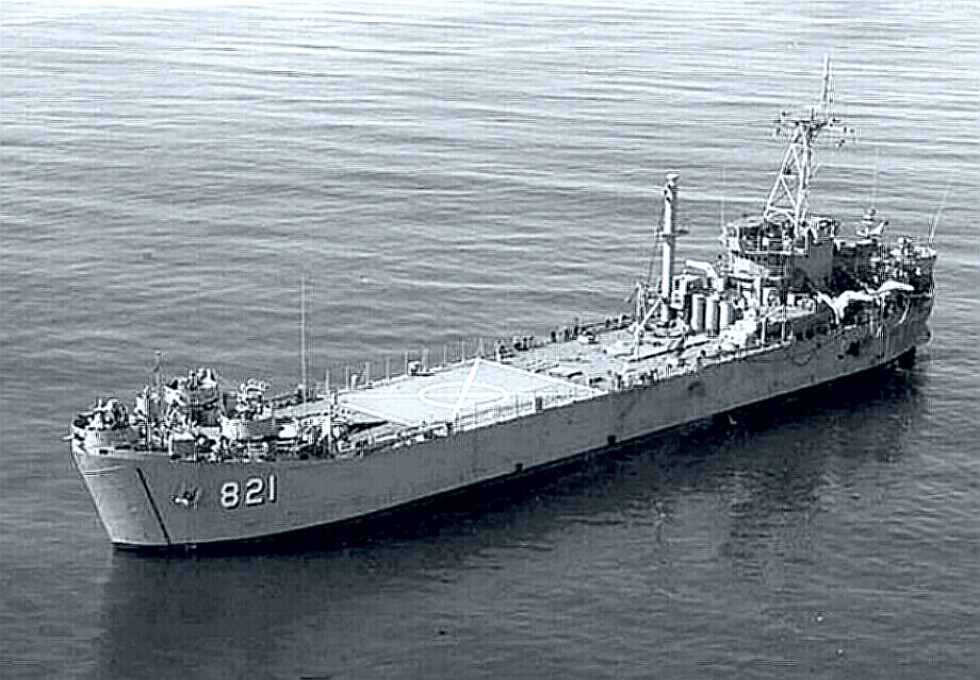
     Once again, the Chinese are agitating about their claims to almost everything in the South China Sea.  An earlier post of mine details how China has expanded its purported reach farther into the Pacific Ocean, much to the dismay of its regional neighbors.  While the PRC claims that such moves are merely for coastal protection, they have recently been pushing oceanic claims to include almost anything with oil or natural gas underneath--ranging from South Korea's Socotra Rock to Japan's Senkaku Island Chain.  The Philippine's Second Thomas Shoal is no exception.  What sets the Thomas Shoal apart is that the Philippine claim is currently being buttressed by the presence of a rusty, beached, 70-year-old WWII LST (Landing Ship, Tank).

Specifically, this one: Former USS Harnett County (LST-821), currently the BRP Sierra Madre (LT-57)

     The USS Harnett County was an LST for the United States in WWII, and served again during Vietnam.  The ship was given to the Phillipines in 1976, wherein its designation was changed to the BRP Sierra Madre.  The Sierra Madre was beached on the Second Thomas Shoal sometime in 1999.  Though it hasn't moved under its own power for decades, it hosts a detachment of Filipino Marines, as it is still officially a commissioned vessel of the Philippine Navy.  The PRC has only recently been pushing its claim to the region, but has gone so far as to interfere with the ship's resupply operations, using aggressive blocking tactics similar to those employed against the USS Cowpens last December. The reason the ship is still officially commissioned and manned is because an attack against it would be tantamount to war between the PRC and the Philippines--and the Philippines' non-NATO ally the United States.

     So why does the Sierra Madre matter any more than the Senkakus or the Socotra Rock?  Unlike the other two disputes, the Sierra Madre is an immediate military concern.  The debate over the Socotra Rock stems more from EEZ concerns, as the scientific station located there cannot legally be considered national territory (as per the UNCLOS).  While the Senkakus have recently seen their own escalations of force, no direct military action has yet been undertaken.  The Sierra Madre is a military vessel, manned by military personnel, surrounded by arguably hostile ships of the People's Liberation Army Navy (PLAN).  The PLAN knows it could easily overrun the decrepit vessel at any time, but so doing would invite instant military retaliation.

     This issue has not gone unnoticed by Washington.  The Council of Foreign Relations reminds us that "risk of conflict in the South China Sea is significant. China, Taiwan, Vietnam, Malaysia, Brunei, and the Philippines have competing territorial and jurisdictional claims, particularly over rights ... to reserves of oil and gas."  After Russia's bold moves against Ukraine, the potential diplomatic implications for the PRC in the South China Sea are immense.  The Obama administration is pushing ASEAN for a comprehensive "code of conduct" in the South China Sea in order to avert any disaster that might lead to war.

     China is viewed by most of the international community as the aggressor in recent South China Sea disputes.  However minor disputes over small rocks in the Pacific may seem, their successful resolution will hopefully set a peaceful precedent of action that will help resolve future oceanic disputes with the Asian powerhouse.  Meanwhile, an old LST that served the United States through two wars may yet be involved in a third.  Only time will tell if Winston Churchill will be proven right, yet again.


(For more information, the NYT has a wonderful article regarding the current condition of the Sierra Madre).

Tuesday, April 01, 2014

Hidden From View

Over the past few years the news has highlighted the use of drones. As the number of drone strikes increases, so does the media coverage. And with increased media coverage, comes greater scrutiny over all things drone related. The civilian deaths, lack of transparency, debate over effectiveness, and so forth all fill news articles, air time, and blogs. However, one aspect of particular interest that has recently started to receive additional attention and be more fully investigated and developed is the psychological affect that drone warfare has on drone operators.

Many people worried that the lack of personal physical proximity to the scene of the strike would create a “video game mentality” where the soldiers flying the drones would feel disconnected and a lack of concern or personal responsibility. However, research is demonstrating that this is not the case and that drone operators often suffer from PTSD and other harmful emotional and psychological issues. Despite the remote nature of the job, there are several reasons why it is such an emotionally taxing occupation.

Together, a pilot and a sensor operator operate the drones. The pilot is the one who fires the missile, but the sensor operator is responsible for using laser guidance to direct the missile to the target. In many cases, the sensor operators are young, sometimes as young as 18 or 19. Their youthfulness, along with a lack of previous experience, makes them especially impressionable and vulnerable.

Drone operators may track and monitor targets for a lengthy period of time – sometimes up to months – and this highlights the humanity of the target for the drone operators and therefore they are not as desensitized as many might think. Furthermore, in order to evaluate the damage, drones will often remain near the scene after an attack and this gives operators a close up look at the death and destruction they created. Fighter pilots, who also engage in aerial attacks, often do not see the actual affects of their bombs on the targets, and so in a sense, they spare themselves from immediately viewing the devastation and pain that they caused.

Although drone pilots are not in physical danger, they have many of the same physical reactions as infantrymen in combat, and they experience high levels of stress. One study reported that "drone operators suffered from the same levels of depression, anxiety, PTSD, alcohol abuse, and suicidal ideation as traditional combat aircrews." In part, this is due to the fact that PTSD and other emotional traumas do not stem solely from intense physical danger and facing death. One author succinctly summed this up when he said, in reference to the psychological damage inflicted on drone operators, that “there is a moral injury that comes from committing violence as well, and the asymmetrical nature of that violence does not eliminate this fact. Trauma is not just what horrors we suffer, but what horrors we commit as well.

With this exposure to horror in mind, another reason for the intense pressure and vulnerability to psychological breakdowns is the lack of camaraderie that drone operators have. While combat troops have other soldiers who are by their side and are going through the exact same experience, drone pilots lack that sense of brotherhood and are more likely to feel alone in their struggle. Just as the pilots are physically removed from the war, they are also often physically removed from a squadron full of support, trust, and close friendship.

In addition to not being in the field with their peers, drone operators experience what many referred to as “whiplash transition.” They go to work in the morning, engage in warfare, and return to their families at night. While this may sound ideal to some, it is extremely challenging for drone pilots to be able to effectively switch from war to household chores and childcare. These soldiers do not have a way to debrief or decompress and they often cannot discuss their work with their family and friends. If drone operators are unable to balance these competing responsibilities, then work, home life, or both will start to deteriorate and that will simply add additional stress.

The amount of collateral damage (that is, civilian deaths) caused by drones has received significant media attention. While regrettable, collateral damage occurs in every war and can happen with soldiers on the ground, bombing, or drone strikes. Drone operators are not immune to feelings of anguish, guilt, and shame after this happens and pure judgment and condemnation, with no help or counseling, only exacerbates these feelings.

To argue that the use of drones spares service members from the horrors of war is inaccurate. Drone operators, albeit in a different way than other combatants, also face intense pressure, stress, and lingering negative side effects from their work. This needs to be fully recognized and addressed so that those suffering emotional trauma from their work can receive the help they need and deserve.

Sunday, March 30, 2014

Will spillover of the Ukrainian conflict happen?


"We Slavs should live under Slavs", thinks the majority of Transnistria's half a million (30% Russian) population. As the situation in neighboring Ukraine escalates, this slogan is gaining popularity in the internationally (by the UN-members) unrecognized Pridnestrovian Moldavian Republic (PMR) or Transnistria autonomous territorial unit with special legal status (according to Republic of Moldova's 1990 designation). Nobody wants a chaos like in Ukraine and believe that Russian 1,199 troops, the 14th Guards Army, will ensure peace in the PMR. The special operation groups of the Russian Military Force has been on the territory of the "state" since the Soviet Union time as a part of peacebuilding mission in the conflict between Moldova and Transnistria. And, the warnings from the NATO and OSCE in 2006 and 2008 on non-interference into internal politics of the independent republic of Moldova have not been heard by the Russian Federation.

Transnistria is not the only possible "buffer zone" where the spillover of the Ukrainian conflict might occur. Almost all of the other 13 post-Soviet states do have a certain proportion of ethnic Russians living on their territories. Civil protests have not been new for the region as well. The year of 2005 attracted billion of television audience across the world to learn more about unstable societies, still transitioning from the Soviet system into  officially democratic one through the means of color (orange, tulip, etc.) revolutions. The outcomes have proven the historical and permanent dependency on the former official center in the space, Moscow. 

It should not be a surprise for a Western observer. The vast majority of the populations in the 15 newly-independent countries agree that standards of living in Russia are higher than in any of the other former-Soviet states. If the new governments could offer more than Russia, nobody would have to go to Russian cities as labor migrants. Additionally, Russia is liked for the continuously subsidized energy resources (primarily, oil and gas) that allow the members of the Commonwealth of Independent States (CIS) overcome fiscal annual challenges. Besides the economic sector, the Russian Federation remains to represent one of the major investors into the education in the space. Millions of students from the CIS receive scholarships to pursue their academic degrees in prominent Russian institutions in Moscow, St. Petersburg, Omsk, and Tomsk.

Politically, present authorities were raised and educated by the former-Soviet Union. Therefore, they are very interconnected and use common language in intraregional relations. As the major economic power and the historical boss, Russian leaders are listened to and often agreed with. Though, the number of representatives of the "independent" states' civil societies thinking differently, nationalistically, is growing and constructing their strategies for future development of own countries, where Russia will be one of the partners in economic, political, social, and security aspects, but not always the main.

However, because the vast majority of the 15 states' population has not been to Europe or the U.S., people cannot make a fully responsible choice of the path they want to pursue in order to live better. And, while the Western media is calling international attention to the invader, Russia, and the high chance for the spillover to take place in Transnistria or even Kyrgyzstan, some of the official statements coming from the CIS highlight shared understanding of the Russian Federation's activities "abroad". And, it becomes even harder to believe that upcoming 5+2 (Russia, Moldova, Transnistria, Ukraine, the OSCE, and observers from the EU and the U.S.), G7 (and not G8), and G20 format talks will dramatically change the aforementioned popular image of "the great power" in the post-Soviet space.