Friday, March 02, 2018

Tactical, But Not Calculated

On Wednesday, one of the senior advisors to the Nuclear Posture Review (NPR), Frank Miller, attempted to defend his argument for low yield nuclear weapons in a piece with War on the Rocks. The suggestion that the U.S. should deploy low yield nuclear weapons to strengthen deterrence has been debated and criticized since the release of the NPR. While Miller attempts to defend himself, he largely does the opposite by stating arguable, minimized theories on what the result of a "limited" nuclear strike would be. In the first NPR in eight years, the authors argue that the U.S. should expand its options in the nuclear arsenal and develop tactical, or low yield nuclear weapons to match Russia, who they believe is doing the same. 

A majority of the criticism has revolved around the dangers of the implementation of low yield nuclear weapons in general and Miller's logic in the matter is certainly flawed. Millers responds that that critics are overstating when they claim that a nuclear strike would likely result in a nuclear war. The problem with the NPR lies even deeper than that, however, as the NPR and Miller's defense largely overstates (and somehow understates, at the same time) the use of a nuclear weapon in the first place. Miller's concern is that without tactical nukes, the United States would not have the proper weapon to respond in a conventional ground war with Russia. First of all, nuclear weapons are not intended for warfare, there are no winners or losers when nuclear weapons are involved because it is impossible to win a nuclear war. Second, why wouldn't a high yield nuclear weapon or a conventional weapon serve an extremely similar, if not the same, purpose in this scenario? Miller then goes on to repeat the argument that the possible chain of events after a nuclear strike is overstated by critics while also acknowledging that no one really knows what happens after deterrence fails. What Miller fails to see in that argument is that it is exactly why the use of nuclear weapons should be avoided at all costs. Low yield or not, if a nuclear weapon is used, deterrence has failed and that is uncharted and dangerous territory. 


In the meantime, while the authors of the NPR wasted all of this time arguing for low yield nukes, Russia was created something much more dangerous with its nuclear weapons arsenal. On Thursday morning, President Vladimir Putin revealed several new advanced strategic weapons systems, quite the opposite of low yield nuclear weapons. These weapons, Putin claimed during his state of the union address, are "invulnerable" and would render US defense systems useless. It seems as though, if the US is truly worried about deterrence and the possibility of a nuclear strike, it might think seriously about acknowledging that there is no such thing as a single nuclear strike and consider whether an arms race with Russia is an arms race the US wants to be in.

Low-Yield Nuclear Weapons and the Undermining of Deterrence Theory

The Trump administration announced its new nuclear strategy earlier in the month of February. The plan aims to match any and all movement made by Russia to modernize their forces--as long as it stays within the boundaries of treaties. In the beginning of March, Russian President Vladmir Putin announced that Russia had new nuclear-capable weapons which make nuclear defense systems “useless.”  

The escalating rhetoric and planned nuclear build-up by the United States might lead one to question the necessity of some of the planned expenditures. The Nuclear Posture Review had called for the fitting of Trident II missiles with low-yield nuclear warheads. Many believe that this is the best and most humane way to counter the escalation of Russian deployment of low-yield nuclear warheads. However, in accordance with nuclear deterrence theory, the possession or use of low yield nuclear undermines security. If a state possesses low yield nuclear weapons this indicates that they intend to be used, as nuclear weapons serve the singular purpose of preventing the use of nuclear weapons. And there can only be two results coming from the use of low-yield nuclear weapons. 
 
First, the use of a single low-yield nuclear weapon utilized against a nuclear power would trigger a second-strike. According to the theory, a second-strike will likely be the entirety of the targeted state's nuclear arsenal, as they must make it impossible for there to be a third strike. Thus, it is imperative that the targeting nation inflict so much damage that a second strike is no longer possible. For this reason, low-yield nuclear weapons are ineffective against nuclear powers beyond deterring the use of nuclear weapons. 

Second, the use of a low-yield nuclear weapon would trigger new nuclear arms race if used against a non-nuclear power. An attack on a non-nuclear state by a nuclear state signals to all non-nuclear powers that, to counter the same fate, they will need to procure their own nuclear stockpile. The other non-nuclear nations will push forward with their own nuclear programs. Because, within nuclear deterrence theory, the only way in which a nation can prevent being the target of a nuclear attack is through mutually assured destruction.
 
The escalating rhetoric of President Trump and President Putin has worked to undermine deterrence theory, but if they continue on their current path of escalation through increasing their nuclear arsenals they might just get to test it.  

Kim’s is Big, Trump’s is Bigger, is Putin’s Biggest?


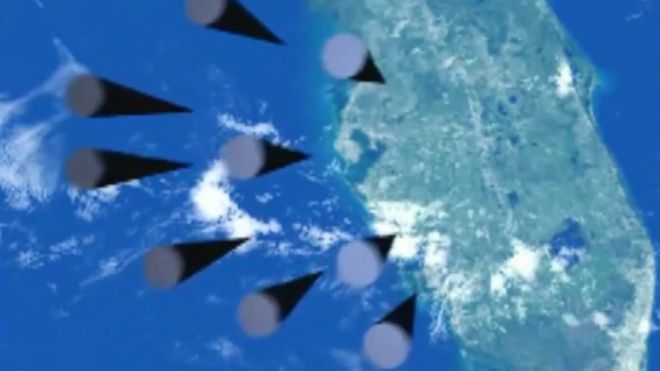
Yesterday Russian President Vladimir Putin addressed his country in the state of the nation speech. One topic he presented is what he is calling “invincible” nuclear weapons. The weapons are claimed to be able to overcome any US missile defense systems. Furthermore, they can reach “anywhere in the world.” In addition to the continued boasting as CNN puts it, Putin displayed an animated video of missiles targeting Florida.


It is unclear if this is hatred towards the famous Florida character, Mickey Mouse, or a heartfelt blow to United States President Donald Trump, who owns several properties and resorts in the Sunshine State. Putin said the West should not take this lightly and that it is not a bluff. More interesting than the motivation behind the animation is that Putin introduced his possession of nuclear tipped cruise missiles. Experts are already making comparisons from Putin’s new weapons and the America operation, Project Pluto. Project Pluto was shut down decades ago due to safety concerns. For more information and a dialogue on the comparison of that project to Putin’s statements, view:  https://www.scientificamerican.com/article/russias-new-nukes-are-similar-to-a-risky-project-the-u-s-abandoned/.

President Putin made a splash with his state of the nation speech. The most head-turning comment was his claim of the weapons he introduced can render the US and NATO defenses useless. Whether or not these weapons are as powerful as he claims will be discovered in time. What we know now is that President Putin is in an election cycle, where he is expected to win in coming weeks. Perhaps the Russian ruler’s statements were political propaganda more than scientific fact. Either way it is clear that Putin has thrown his hat in the center of the ring of nuclear power conversation. Recently there has been a bombardment of tweets from the US President directed towards North Korea’s “little rocket man.” One tweet regarded the size of their nuclear buttons. While Trump claims his is bigger and better than that of the North Korean leader, it appears that Putin has made a claim that his is bigger than Trumps. I imagine the American President’s twitter fingers are itching at a potential post. While his tweet may be in the drafts column for now we can only sit and wait to find out whos button truly measures the largest.


Thursday, March 01, 2018

Cuttin' Grass and Kickin' Ass: Autonomous Robots in the Future

Technological innovations throughout history have changed the face of warfare.  Nations who were able to adopt the newest technologies and incorporate them in their tactical and strategic battle plans had a marked advantage over other nations that lagged behind.  One of the newest technologies that may revolutionize warfare is the coupling of artificial intelligence (AI) and robotics to create autonomous and semi-autonomous robots.  The evolution and development of autonomous weapon systems has been met with concern by some who question the morality of employing such weapons.  However, autonomous robots and weapons systems will play and important role in the future of warfare and the world will not be able to completely stop their employment.

The morality of utilizing autonomous weapon systems in warfare has undoubtedly raised concerns throughout the world.  Recently, over 100 leaders in the technology field sent an open letter to the United Nations requesting a ban on automated weapons.  These specialists believe that autonomous weapons systems are morally reprehensible and deserve to be banned under the UN Convention on 21 nations (I don't count Palestine) are calling for a ban on autonomous weapon systems.   Of the nations calling for a ban, only a few, if any, would be likely to obtain the technology and employ it as a means to lessen the combat power gap between its rivals.  So, who is attempting to open Pandora's box?
Certain Conventional Weapons.  While their concern is understandable, only

The US and China are leading the way when it comes to autonomous weapon systems with ol' Vlady Putin picking up slack in the back.  In 2016, the Chinese held a month-long competition titles "Overcoming Obstacles 2016" in which teams competed in multiple categories by demonstrating the capabilities of their autonomous robots.  In addition, China has announced plans to develop an autonomous multi-role surface vessel named the D3000.

Indeed, the United States is the current leader of the pack when it comes to autonomous weapon systems.  The DARPA developed anti-submarine warfare ship "Sea Hunter" is the first autonomous ship to be launched for testing by the US.  The Sea Hunter has recently completed its sea trial and has C-RAM and the M15 Phalanx CIWS.  Although the US may be in the lead, Russia has expressed interest in automated weapon systems and has been testing their tech as well.
been turned over to the Office of Naval Research for further development.  The US has also met with success in developing defensive automated technologies such as the

Russia recently held a series of tests at a proving ground outside of Moscow in which they tested the Nerekhta.  This unmanned ground vehicle is still being developed but Russia has indicated its desire to use these as an autonomous ground cruise missile (of sorts).  Colonel Pomazuev of the Russian military stated at a recent weapons testing that Russia already has a semi-autonomous tank with a remotely operated turret in the works.

What is clear from all this is that Russia and China have demonstrated their position on how they plan to utilize autonomous robots in warfare.  This is not surprising as China and Russia are desperately trying to close the power gap with the US.  Technologies such as autonomous weapon systems will give those who wield them an advantage.  Autonomous robots will be developed and they will play a definitive role in warfare.  More than likely, the role will encompass both lethal and non-lethal tasks as countries struggle to close the power gap.


Photo Credit: Runaway & Big Think

Underwater Nuclear Drones and the New Arms Race

Vladimir Putin unveiled new nuclear weapons at his state-of-the-nation speech this morning, March 1st. Putin claims that these new weapons increase Russia's current military capability, increasing the gap between Russia and the West in nuclear capability. What weapons were released that created this much uproar? Putin unveiled a new nuclear-powered cruise missile, a nuclear-powered underwater drone, and a hyper-sonic missile. These new weapons, Putin boasts, would render US missile defense worthless.

The nuclear-powered cruise missile will have an effectively infinite range and be invulnerable to missile defense systems. They do not utilize traditional ballistic missile flight paths. Although it seems borderline science fiction, Putin claims that this new missile has a nuclear powered plant that can be installed inside the hull of a cruise missile, thus ensuring virtually unlimited flight paths. Additionally, these missiles have the capability to be low-flying and low-visible, which would bypass the missile defense systems currently in place by the US.

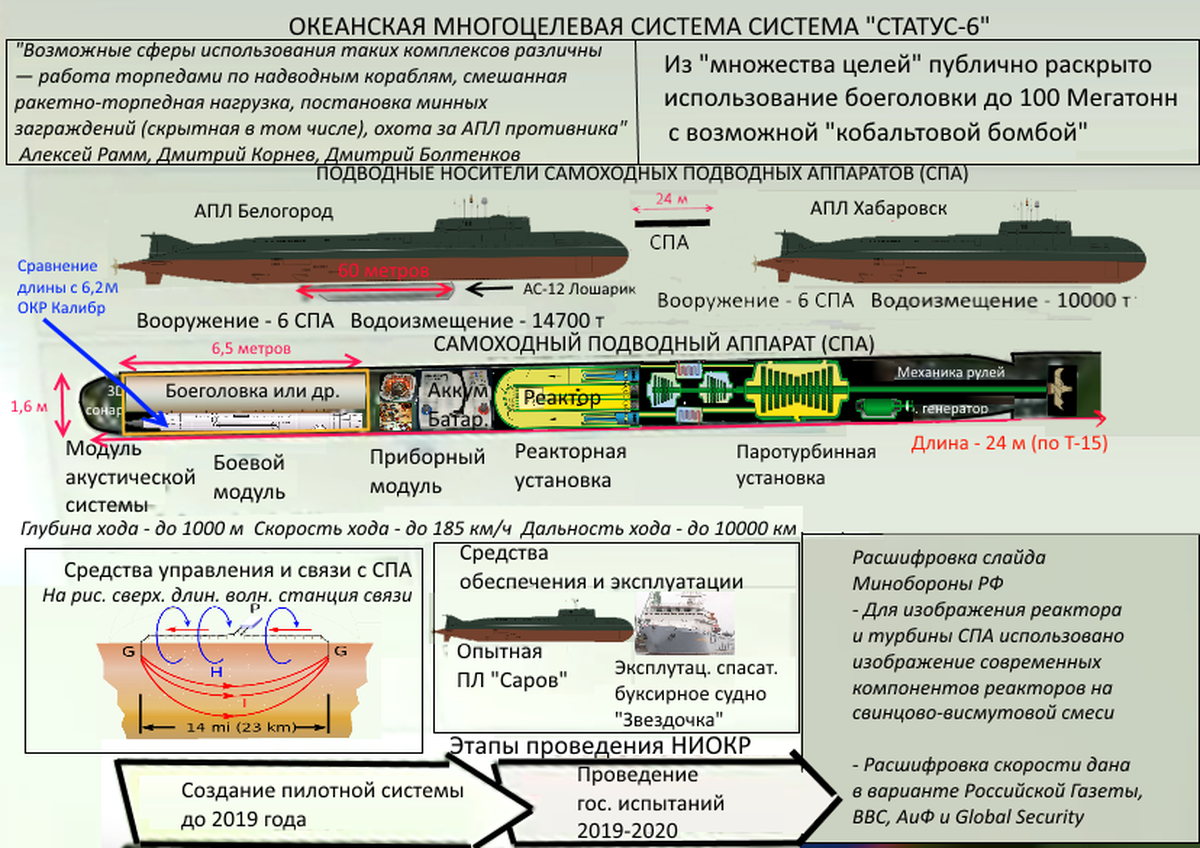
In addition to the nuclear-powered cruise missile, the Russian's have developed an underwater nuclear drone, which the Army has confirmed. The torpedoes launched from the drone are intercontinental, with a range of 6,200 miles, and are reported to be a 100 megaton warhead. The drone was named Status-6. Status-6 has the ability to travel 56 knots and descend up to depths of 3,280 feet below sea level. Plans, shown below, confirmed all of the capabilities that Putin boasted about during his speech.

The last weapon Putin revealed that brings science fiction to reality was the hyper-sonic cruise missile, dubbed Kinzhal. Its speed allows for delivery to a target that would have taken hours in minutes. Kinzhal exceeds the speed of sound by a factor of 10 and can travel a distance of upwards of 2,000km. The capabilities of each of these weapons were shown in videos during his speech. 

The US can put a nuclear warhead on a tomahawk missile, however, we do not have the capabilities to install a nuclear plant inside of a missile. As for the underwater drone, the US has the ability to recreate the Russian weapon but has not yet. The US conducted a test of a hyper-sonic missile in early November of last year, however, hyper-sonic missiles are by no means ready to launch yet. 

Because of the lack of a US counterpart to these new Russian nuclear weapons, the US most definitely will want to develop weapons of equal or greater capability. Due to this historical competitive urge to boost weapons supplies, many fear a new 21st century arms race against a modern Russia which could devastate coffers and lead us to the nuclear brink.