Tuesday, April 25, 2017

Myths About the Global Arm Trade

As Carol Cohn succinctly puts it in her piece Sex and Death in the Rational World of Defense Intellectuals:  "Defense intellectuals are men who use the concept of deterrence to explain why it is safe to have weapons of a kind and number it is not safe to use". Although her analysis focuses on nuclear weapons, the same can be applied to the global arms trade and the myths that are regularly spouted by those who benefit from it. Although there is always some form of opposition to wars, there are even more who are able to rationalize war because they believe the arms industry is necessary in some form (or the arms trade directly benefits them, read: military-industrial complex). As a result, the arms trade has become one powerful component of a geopolitical infrastructure that helps drive global conflict.  A few of these myths are outlined below:


  1. "Higher Defense Spending Means Increased Security"
No where has the military increased security threats so significantly than in the Middle East in the last 15 years. An ill conceived invasion of Iraq and the longest war the US has ever fought, is still continuing in Afghanistan. This was all to fight a "War on Terror", which is really a "War on War" and increases the possibility of slipping into a state of perpetual war. A study done by RAND in 2008 looked at the life cycles of 648 terrorist groups from 1968 to 2006. 46% of terrorist groups ceased to exist because they were incorporated into political structures, while only 7% of terrorist groups were effectively destroyed by military campaigns. As a country that spends 14 times more on the Pentagon than the State Department, and already has a grossly distorted defense budget, the US has made a moral decision that militarization is more important than the well being of the population, and has accepted a situation that is spiraling out of control. To defense companies, it doesn't matter whether a war is being won or lost. They are still making money all the same. 

   2. "National Security Requires Secrecy" 

While it is certainly true that many elements of national security must remain top secret to protect the interests of countries, we live in an age of excessive secrecy that is born out of the Cold War. The defense industry is linked to national security concerns which acts as a cloak in many arms transactions. Tony Blair, one of the most prolific arms salesmen of all time, provides a great example of this. When challenged by the Serious Fraud Office Enquiry about serious corruption in BAE systems involving huge amounts of bribes paid to Saudi officials, Blair simply stopped the enquiry because of endangering Britain's security. A few years earlier, he "convinced" South African president Thabo Mbeki to sign a $10bn deal with BAE systems. This is also the same time Mbeki confessed South Africa did not have enough public funds to treat the disproportionate AIDS epidemic. A study done a few years later showed that $10bn could have provided every South African school with a stocked library and employed a teacher for 20 years. Or put a roof over the head of 2m South Africans, 200,000 less than the ultimate goal of putting a roof over everyone's head. Or, it could have provided anti-retroviral treatment to every afflicted South African for 12 years. But the scarce public funds went to weapons South Africa didn't need. The irony is almost painful. 

    3.  "Corruption is only in Developing Countries and Marginal to the Defense Industry as a      Whole"

Aside from being an inherently ignorant statement in itself, a further look into the arms trade show that developed countries are the ones that stimulate corruption for their own profits. It is not a coincidence that in 2015, 83% of Britain's arms exports went to Saudi Arabia (valued at $800m, who then received $800m worth of oil from the kingdom). A majority of these arms ended up being used on the Saudi population, but even more went to killing civilians in Yemen, to which Britain has continued to turn a blind eye. Many forget that the arms trade itself is hard wired for corruption and buying friends. The highly technical nature of the system means very few people are able to critically evaluate deals, and are more prone to bribery. The revolving door phenomenon is prolific throughout the West (read: Dick Cheney and Halliburton), meaning the same individuals circulate between the government and private sectors to align the interests of the two. 

We have seen Eisenhower devote 1/5 of his farewell address to warning us about the dangers of the military-industrial complex. With President Trump slowly formulating his foreign policy doctrine, we see a new willingness to pump high tech weaponry into global hot spots and fuel lucrative but destabilizing arms races. The situation is dire, and at this point, it seems the only people who are invested in the state are those like Lockheed Martin. 


Towards a new Afghan Model?

The Afghan military was dealt another blow last Friday when Taliban fighters killed more than 140 soldiers at Mazar-i-Sharif military base. This attack exemplifies the struggle for control and security challenges the Afghan government faces. It was one of the deadliest attacks on the Afghan army since 2001.


This attack represents an important ongoing struggle for the Afghan forces - can they perform without significant American support?


The tactics the Taliban used are also important to make note of. The fighters arrived in Ford Ranger trucks painted like army vehicles; they had army uniforms and convincing paperwork. After gaining entry to the base, they opened fire and a disastrous shoot out ensued. Last month, Taliban fighters dressed as medics entered a military hospital, killing dozens of patients of patients and staff. That begs the question: why isn’t the Afghan army taking stronger security precautions at military facilities?


mattis .jpeg


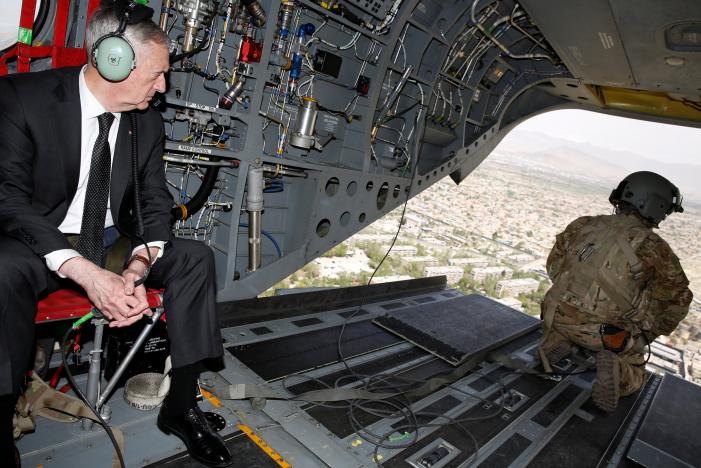
On Monday, Defense Secretary Mattis flew into Kabul right as Afghan Defense Minister Abdullah Habibi and Army Chief of Staff Qadam Shah Shahim turned in their resignations in the wake of the attack. The Afghan commanders want more US troops on the ground. But will that help? Unless the Afghan military are willing to actively learn from US forces and make a real effort to implement strategies on their own, they will never make progress. Though Secretary Mattis might be looking to build a new Afghan strategy, perhaps that is not what the Afghan military need. A lot of their problems are internal, such as “a lack of commitment from recruits, exacerbated by terrible conditions, corruption from the officer class and poor air support.”


The Afghan model, i.e. training local troops to fight the Taliban with the support of US precision air strikes, worked well in the early 2000s, but there is not the same measure of political support for such a strategy now. US public opinion is also at play here. The public don’t want to see more boots on the ground in Afghanistan, or even an enhanced presence in the country.

Afghanistan continues to be a very challenging situation for US foreign policy. The President needs to prioritize, as he also faces a serious problem with North Korea and a domestic crisis of legitimacy. If a bigger military presence in Afghanistan is necessary, it needs to be part of a broader strategy that encourages the government forces to become less reliant on US forces.

Sanctions are good, but do they really matter at this point?


The Trump administration on April 24, 2017 moved to impose sanction on the Syrian government following its alleged used of sarin, a chemical agent, on civilians. The sanctions only affect 271 employees of the Syrian government who the Trump administration believe is responsible for producing chemical weapons and ballistic missiles. The targeted employees are part of President Bashar Assad’s Scientific Study and Research Center (SSRC).

According to Treasury Secretary Steven Mnuchin, the action is one of the largest his department’s Office of Foreign Assets has ever had to undertake. He asserts that “the United States is sending a strong message with this action that we will not tolerate the use of chemical weapons by any actor, and we intend to hold the Assad regime accountable for its unacceptable behavior”.

While this latest move by the Trump administration to punish the use of chemical weapons is praiseworthy, it remains to be seen whether it would effectively serve as a deterrent to further use. President George W. Bush placed sanctions on the Syria regime back in 2005, targeting the same SSRC and accusing it of producing weapons of mass destruction. However, as time went by, the Syria government continued to do so.

Further sanctions on Syria at this point in the ongoing civil war are an indication of the Trump’s administration’s lack of a clear policy objective in the war torn country. Just as sanctions did not prevent Russia from pursuing its policies in Ukraine, it will not change the status quo in Syria. As Russia continues to do Syria’s bidding, it will be increasingly difficult for the Trump administration to achieve its foreign policy goals.

As thousands of lives continue to be claimed in the conflict, it is imperative that the Trump administration confront Mr. Putin and seek to determine what could be done in order to stop the bloodbath. Although Mr. Assad is far from being expandable from a Russian perspective, figuring out what should be done about him would be a good place to start. The US-Turkey-Saudi coalition wants the removal of Assad by all means necessary whereas the Russo-Iranian coalition are intent on fighting extremist and terrorist organizations on the ground in Syria.

Despite of all Assad’s atrocities, his army represents the only thing preventing the total collapse of Syrian institutions and preserving the territorial integrity of the country. The fall of Assad at the hands of the US-led coalition could further destabilize the country as Sunni extremists come pouring in. It would be wise and critical for the US to either help clear Syria of terrorist groups or at least prevent the Gulf monarchies from funding said groups at the possible expense of the relationship with said monarchies. The alternative to that suggestion would be further escalation of the conflict as more lives continue to be lost and and a refugee crisis of unprecedented proportion.

Monday, April 24, 2017

A World at War

The multi-billion dollar business of the international conventional arms trade involves virtually every country in the world. Every day around the globe, people’s lives are being irrevocably changed by the use of guns, tanks, and missiles. The International Arms Trade, by Rachel Stohl and Suzette Grillot, explores the complexities and realities of the global conventional weapons trade. In particular, the authors assess the role of the largest arms exporters and importers, the business of selling conventional arms around the world, and shed new light on the illicit arms trade and the shadowy dealers who profit from this deadly commerce. Curiously, the book does not investigate the proliferation of unconventional weapons, nuclear weapons in particular, which have the potential to be far more destabilizing and destructive.
Why do states acquire nuclear weapons? Debs and Monteiro show in Nuclear Politics that proliferation is driven by security concerns. Proliferation occurs only when a state has both the willingness and opportunity to build the bomb. A state has the willingness to nuclearize when it faces a serious security threat without the support of a reliable ally. It has the opportunity when its conventional forces or allied protection are sufficient to deter preventive attacks. This theory explains why so few countries have developed nuclear weapons. Protected states do not want them; weak and unprotected ones cannot get them. Which brings us to North Korea. Perhaps frustrated from domestic gridlock, the DPRK’s nuclear weapons program has become a target of the Trump administration. The DPRK’s nuclear weapons development follows this theory. China, having agreed to sanctions, is an unreliable ally. The US, with its preemptive strikes in Iraq and Libya, poses a serious security threat in the eyes of DPRK leadership. The US has previously been unwilling to act militarily because a DPRK conventional assault in retaliation on Seoul would devastate South Korea and potentially kill millions of people. And while the Chinese have not been great allies to the North, they would likely not tolerate a US led invasion of North Korea. The DPRK then is at the sweet spot for acquiring Nuclear Weapons. The US defense establishment seems to think that the North having nuclear weapons is unacceptable. This position stems from the perceived irrationality of the Kim regime and the bellicose rhetoric spouted from the DPRK.
Since 1945, most strategic thinking about nuclear weapons has focused on deterrence: using nuclear threats to prevent attacks against the nation’s territory and interests. But an often overlooked question is whether nuclear threats can also coerce adversaries to relinquish possessions or change their behavior. Can nuclear weapons be used to blackmail other countries? The prevailing wisdom is that nuclear weapons are useful for coercion, but Nuclear Weapons and Coercive Diplomacy, by Todd Sechser and Matthew Fuhrmann, shows that this view is wrong. Nuclear weapons are useful for deterrence and self-defense only, not for coercion. The authors evaluate the role of nuclear weapons in several foreign policy contexts and present a trove of quantitative and historical evidence that nuclear weapons do not help countries achieve better results in coercive diplomacy. The evidence is clear: the benefits of possessing nuclear weapons are almost exclusively defensive, not offensive.
With this defensive principle in mind, let’s look at the Kim regime’s signaled intentions. In May of 2016, North Korean leader Kim Jong-un announced that Pyongyang sought to normalize relations with states hostile towards it. Kim also claimed the North would never attack first. While addressing the Congress of the ruling Workers’ Party (WPK), Kim stated that North Korea would not resort to the use of nuclear weapons unless the country’s sovereignty was challenged. Pyongyang “will improve and normalize the relations with those countries which respect the sovereignty of the DPRK and are friendly towards it, though they had been hostile toward it in the past,” official North Korean KCNA news agency quoted Kim as saying. “As a responsible nuclear weapons state, our Republic will not use a nuclear weapon unless its sovereignty is encroached upon by any aggressive hostile forces with nukes,” the statement said, as quoted by Reuters. North Korea’s leader, who has been the target of UN criticism for its relentless development of nuclear weapons over the past years, indicated that the country may abandon its war-mongering rhetoric, while promising that it “will faithfully fulfill its obligation for non-proliferation and strive for global denuclearization.” The UN has sanctioned North Korea over its nuclear weapons program. However, the new round of sanctions didn’t deter the North’s leadership from escalating the already tense situation on the peninsula. In response to joint US-South Korean military drills, which lasted from March 7 to April 30, the North fired two short-range ballistic missiles into the East Sea. Kim had said ahead of the military exercises in which more than 300,000 South Korean and some 15,000 American participated, that if attacked, the North would resort to “a preemptive and offensive nuclear strike” against the allies. Now a year later, does this situation seem familiar?
What has changed this year is the position of the Trump administration to use force if necessary. As previously stated, the main issue with the defense establishment is Pyongyang’s rationality or lack thereof. For sure, North Korea is the most isolated and belligerent nation to acquire the bomb. But the DPRK leadership is not irrational nor suicidal. The Kim regime has only its own selfish interests at heart. The North is often big on bark with little to no bite. What should truly worry us is a North Korean intelligence failure, a misjudgment, or a military incident that escalates out of control. A concern that the United States may initiate a preemptive Israeli-like strike on its C4ISR systems and nuclear facilities would be a rational basis for retaliation. A U.S.-South Korean combined invasion would be a rational cause for nuclear retaliation.
Hopefully, the Trump administration’s jingoistic rhetoric is just a ploy to convince the Chinese to put more pressure on the North; China has notoriously lax enforcement measures for sanctions. But there are problems with this coercive diplomacy. For one, it is unclear how much influence China truly has over the North Korean leadership. And while Thomas Schelling would approve, the administration is playing a deadly game of chicken. The challenge for Washington then is to reduce these risks of escalation. It could start by accepting what it cannot change: Kim Jong-Un’s regime is going to keep the bomb. The DPRK sees it as a crutch for survival. While strengthening its defense commitment to South Korea, the U.S. should attempt to normalize relations with the North to better assure open lines of communication so as to prevent any event from starting a nuclear war.
The entire U.S. Senate has been invited to the White House for a briefing on Wednesday about the North Korea situation. Secretary of State Rex Tillerson, Secretary of Defense Jim Mattis, Chairman of the Joint Chiefs of Staff Gen. Joseph Dunford and Director of National Intelligence Dan Coats will brief the lawmakers. It is rare for the entire Senate to be invited to such a briefing. Could this meeting be a first step in a request for a use of force, like the Israeli preemptive strike against Iran or the U.S. preemptive war against Iraq? Let’s hope not and let’s hope cooler heads prevail. Otherwise we should all prepare for a world at war. 

NATO and France's Election

After the first round of elections in France, one thing is clear: the French people are tired of the establishment. Both candidates that will participate in the May 7th run-off election, Marine Le Pen and Emmanuel Macron, have a vastly different future in mind for France. It is widely reported on what both candidates feel about the European Union. However, the two also have different opinions on whether or not France should stay in NATO. Le Pen believes that NATO, like the EU, is obsolete and is planning a ‘Frexit’. Macron wants to stay in both. Both candidates offer a different future for France as well as NATO.


Marine Le Pen is the furthest right-winged candidate in this election. Le Pen has targeted a group of French people who are tired of the status quo. Part of that status quo is France’s NATO membership. She recently condemned Donald Trump for reversing his stance on NATO. In an interview she stated, “He [Trump] said that he would not be the policeman of the world… but it seems today that he has changed his mind.” A significant portion of France’s population (21.43%) voted for Le Pen in the first election. While Le Pen most likely will not win the second election, it shows how the French people feel about NATO.

Emmanuel Macron is expected to be the next president of France. Macron is pro-NATO, but the majority those who ran for the French presidency were not. Macron’s apparent win shows that for now France will likely remain in NATO. However, with dissatisfaction of NATO growing in the country, it is hard to predict what will happen in the next French election. If the French people continue to be dissatisfied with NATO, candidates like Le Pen may continue to gain prominence.

If the United States and other NATO powers want France to stay, they must address the problem France has with NATO. Le Pen has said, “I consider that France does not have to submit to the calendar of the United States, so I want France to leave the integrated command of NATO.” If NATO wants France to stay, it’s obvious that they will have to share control better. It is questionable whether other NATO powers will go for this, such as the United States, however NATO will need to balance its members in risk of becoming actually obsolete.

Thursday, April 20, 2017

All Bark and No Bite? American Foreign Policy in North Korea

US Vice President Mike Pence spent this past week on an official visit to
South Korea. While in the region, he spoke at the Demilitarization Zone (DMZ). His speech came at an opportune time, just hours after a failed missile test in North Korea. Pence’s statements during his South Korea trip have been strong, telling South Koreans that North Korea ‘would do well not to test’ Donald Trump. However, is this just talk? The US has shown that it would rather let China deal with this issue. Therefore Pence’s visit may have just been for show, and does not signal a strong US action.

There were speculations before the North Korea missile test that it was imminent due to the importance of April 15th. It marks Kim Il-Sung’s, the founder and first leader of North Korea, birthday. When informed of this possibility, US President Donald Trump made his displeasure known via Twitter. There were even suggestions that the US would try and intercept the North Korean missile test. Of course, the military decided that this option posed too many risks for escalation.

This pattern seems to be continuing in North Korea. The US has strong words for the country, but does not follow through on any action. Instead, the US would prefer to use China’s influence in North Korea to solve this problem. The likelihood of China militarily attacking North Korea is also extremely low. Chairman Xi Jinping has made it clear that China prefers dialogue rather than action. As one of North Korea’s closest allies and its neighbor, it is clear why they would prefer this option. Since Trump is signaling that it might let China take the lead on this issue, talks may be the way the international community goes.

The option of letting China take the lead on the North Korean issue is most likely the best option for the US. However, it runs the risk of North Korea not taking America’s threats seriously. North Korea has already seen that Trump’s tweets may not mean action and instead only harsher words. If the US is going to let China take the lead on the North Korean problem, it will need to stop barking at North Korea and instead get ready to come to the negotiation table.

Tuesday, April 18, 2017

Is Redundancy a Valid Argument?


Related image
Interservice competition has always been a problem since the creation of the different branches of the U.S. military. Over time, cooperation has indeed increased, leaving little room for competition, however, this issue still remains. Some reasons why competition thrives and cooperation is dwindled are redundancy, service culture, quest for autonomy, resource conflicts, and turf battles. It is not uncommon for redundancy to be listed as one of the reasons why interservice cooperation is impeded. However is this reason actually rational?

The United States services/branches have broken down along a sea, air, land medium logic. The United States Armed Forces consist of the Army, Marine Corps, Navy, Air Force, and Coast Guard. Each unit is designed to work individually and as a team. Instead of unified services in accord, we have services competing to be the most relevant and while some inter service competition can be positive, it is mostly negative. The argument of redundancy is made because there are supposedly many overlapping capabilities which are both a cause and consequence of fighting.


Each branch of the Armed Forces has been equipped with its own mission, vision and culture. They each have their own goals and mediums of operation. Why then do these military branches blame redundancy for their inability to cooperate? On April 7th, the US Navy carried out a strike against Syria. The USS Porter fired a Tomahawk Cruise Missile from the Mediterranean Sea. On April 13th 7:32pm local time, The GBU-43/B Massive Ordnance Air Blast bomb (MOAB) was dropped by the United States Air Force on a network of fortified underground tunnels that ISIS had been using to stage attacks on government forces. On April 13th, it was confirmed that 40 more U.S. Army soldiers will be sent into Somalia to train Somali soldiers. In the argument of redundancy, any branch could have performed any of these operations.
For the most part, it seems the only redundant part of this is national security. If everyone focused on their medium of operation and set goals, there would be little concern about who can do what best. The Air Force training allows for Air Forces officers to excel above and beyond in the air. Sending Air Force officials into Somalia to train Somalian Forces might be successful as well but arguably not as effective as the Army. Lastly, the separation of Forces allows for efficient delegation of tasks. When an operation is to be carried out, given the description of the mission, it is obvious what military branch is responsible for carrying out that mission. Having just one joint military would just turn an already chaotic situation into a more chaotic one.