Sunday, March 30, 2014

Alaska: Following in Crimea’s Footsteps?


Alaska: Following in Crimea’s Footsteps?

Crimea isn’t the only home to Russian descendants who want to rejoin the Motherland. After its creation on March 21, 2014, a petition set up through the WhiteHouse.gov website entitled “Alaska Back to Russia” had already obtained over 30,000 signatures.

 http://l.yimg.com/bt/api/res/1.2/XtvyvaWFd0VZVGD3Fg804w--/YXBwaWQ9eW5ld3M7cT04NTt3PTYzMA--/http://l.yimg.com/dh/ap/default/140327/alaskapetition.jpg


Despite the fact that it is impossible to determine just how many of the signatures are authentic, the chatter on Twitter has confirmed that at least some of those who support the petition are quite serious about their wish to be governed by the Kremlin.

 http://deathandtaxesmag.wpengine.netdna-cdn.com/wp-content/uploads/2014/03/russia-takes-over-alaska-e1395781508765.png


The creator of the petition is an unidentified Anchorage resident who is known only by the moniker “S.V.” The petition itself is awkwardly worded, and often difficult to understand, but the intention is clear enough. If the petition achieves 100,000 signatures in 30 days, the White House will have to issue an official response, though it is doubtful that the administration’s answer will be any different than the one issued in reaction to a similar petition begun by residents in Texas: “our states remain united.”

 http://a.abcnews.com/images/Politics/ht_texas_independence_lpl_12112_wg.jpg


Even if the petition achieves the necessary votes for a response from the White House, the supporters’ hope of achieving secession is slim to none. In the wake of the Civil War and, in particular, as a result of the case Texas v. White in 1869, Supreme Court Justice Salmon P. Chase wrote, “The union between Texas and the other states was as complete, as perpetual, and as indissoluble as the union between the original states. There was no place for reconsideration or revocation, except through revolution or through consent of the States.”

More recently, Supreme Court Justice Antonin Scalia argued in a 2006 letter that, “if there was any constitutional issue resolved by the Civil Was, it is that there is no right to secede…the United States cannot be sued without its consent, and it has not consented to this sort of a suit.” Essentially, to go forward with a legal case in trying to obtain secession would require the state to sue the United States, but this is impossible, simply because the United States cannot be sued unless it wants to be.

 http://24.media.tumblr.com/tumblr_mdrw4foEKr1qg53kdo1_r1_500.png


All of this brings us around to the topic of whether a state will be allowed, at any point, to sue for secession. In particular, will Alaska be granted this right?

The answer is, quite obviously, no.

The benefits that Alaska has brought to the United States are too great to be forfeited. Alaska was purchased by Secretary of State William Seward in 1867, who paid Russia $7.2 million for the territory. This transaction later became known as “Seward’s folly” or “Seward’s icebox”, for most of Alaska was uninhabitable and considered a useless addition to the United States, despite the two-cents per acre selling price.

The settling of the land was slow to start, but after the discovery of gold in 1898, people moved in droves, and the state’s natural resources has made it a valuable asset ever since.

Regardless of the government’s response to the petition, if it issues one, one fact is clear: this is going to continue happening. Residents of all 50 states have appealed for secession, and in the case of Texas, over 125,000 people signed the petition. Despite the fact that the United States government holds the reigns on the decision of whether to grant attention to the petitions, it would do them well to look at the trends to find out what it can do to bring unity back to the nation.

Tuesday, March 25, 2014

Nuclear NATO

Back in May of 2012, the North Atlantic Treaty Organization published its “Deterrence and Defence Posture Review,” stating that the Alliance would work towards creating conditions permissive of further non-strategic force reductions in Europe. At the same time, however, nuclear weapons remained a “core component of NATO’s overall capabilities for deterrence and defence.” The crisis in Ukraine, aside from seemingly invigorating NATO, has brought nuclear weapons in Europe – and therefore NATO’s nuclear weapons – back into the spotlight. NATO Secretary General Anders Fogh Rasmussen said on Wednesday that Russia’s activities in Crimea will likely affect arms control efforts, and pleaded with European Allies to increase their overall defense spending. This, in combination with the 2014 Nuclear Security Summit in the Netherlands taking place yesterday and today, suggests that now is a prime opportunity to review NATO’s nuclear reality.


First and foremost, let’s get something straight: Russia’s activities in Ukraine are not a sign of NATO’s failure to deter (although it does not bode particularly well for the Alliance either). Ukraine is not a NATO member and does not officially (or implicitly) fall under its Article 5 mutual defense umbrella. Even the 1994 Budapest Memorandum, which specifically concerns respecting Ukraine’s national borders, does not require the United States and the United Kingdom – whom you might call NATO princelings – to respond militarily to a violation of Ukraine’s sovereign territory. Ultimately, Russia has never launched a conventional or nuclear attack against a NATO Member (although some accuse the Kremlin of perpetrating the massive wave of cyber attacks Estonia experienced in 2007). So NATO’s deterrence has not failed.

And yet, the great curse of deterrence is that we cannot truly know if it has succeeded, either. How do you explain a nonevent? Did Russia plan to invade Poland in 2002, and then give up that program in the knowledge that it would trigger a nuclear response? Or perhaps Russia is simply uninterested in Poland (admittedly, this seems unlikely if you take a long view of history and Russia’s tendency to expand outwards in pursuit of security and the Russian exceptionalist dream). It’s nearly impossible to say either way.

There are other problems with NATO’s deterrence posture. For one thing, its development of a ballistic missile defense (BMD) capability flies in the face of traditional deterrence theory (which is no doubt part of why Russia objects so strongly to it).  One of the cardinal rules of deterrence is that both sides (whomever they may be) must have an assured second-strike capability that will inflict unacceptable damage to the enemy in retaliation for launching an initial attack. BMD capabilities reduce the likelihood that unacceptable damage will be inflicted – meaning that your opponent will not be deterred from launching an initial strike. While NATO’s BMD is not truly directed against Russia and is not truly even oriented around deterring nuclear attacks, on the whole missile defense does not – theoretically, at least – work very well with a deterrent posture (hence the Anti-Ballistic Missile Treaty signed by the U.S. and the USSR back in 1972, and from which the U.S. withdrew in 2002). This issue has been a huge source of tension between the Alliance and it’s Partner for Peace to the east.


Another challenge – this one common to all states possessing nuclear weapons – is credibility. Deterrence does not simply mean having enough weapons to inflict unacceptable damage: Your adversary must believe that you have the capability as well as the will to use it. Would NATO – all 28 Members – ever be able to agree on launching a nuclear response, especially to a non-nuclear attack against one Ally? The Alliance does work to ensure that all member nations participate in planning and in command, control, and consultations regarding nuclear weapons. The Nuclear Planning Group allows nuclear and non-nuclear Allies to help develop NATO’s nuclear policy and posture. The question of whether the Alliance would actually resort to using nuclear weapons, however, remains unanswered. It is not implausible to argue that the stigma surrounding nuclear weapons (and especially their use) may discourage Allies from viewing them as a true option.

Finally, some have expressed exasperation with the fact that NATO’s nuclear deterrence capabilities have proven insufficient to stop Russia from interfering in the internal affairs of Alliance hopefuls. The 2008 war between Georgia and Russia is held up as a prime example of this. NATO had promised Georgia eventual membership during its 2008 summit, but the latter’s war with Russia in August of that year essentially froze momentum. Some have linked Russia’s decision to act directly to Georgia’s “flirtation” with the Alliance. Although there had been no direct overtures between Ukraine and NATO directly preceding this more recent crisis, the argument that protesters’ EU-preferences are suggestive of a desire to join the Alliance are not completely absurd (especially since Allies did agree at that same 2008 summit that Ukraine would eventually become a Member). This represents a legitimate criticism of the Alliance’s deterrence posture, but only if one assumes that it’s nuclear policies extend beyond actual membership to potential, future Allies. That assumption is questionable


An even more important question for NATO today, however, is which of its abilities (or combination thereof) actually bears responsibility for deterring Russian activity against actual Allies (keeping in mind the fact that NATO capabilities are not officially directed against any particular adversary – potential or current). During the Cold War, the Soviet Red Army’s vast conventional superiority meant that nuclear weapons were pretty much all that stood between the USSR and a Soviet European continent – at least in the minds of the West. That is no longer the case. Despite declining defense spending over the past decade in Europe (military budgets have shrunk by 10-15%), NATO has a significant degree of conventional superiority over Russia (in terms of capabilities, if not willingness to use them). Perhaps, then, a nuclear deterrent against Russia is not truly necessary (especially considering the fact that Russia maintains some 2,000 tactical nuclear weapons, NATO is estimated to have between 160 and 200 gravity bombs in Europe).


Of course, all of this is not to recommend that NATO entirely abandon its nuclear weapons. If nothing else, maintaining a minimal deterrence force will help ensure that the Alliance is not subject to nuclear blackmail, even if that force is not solely responsible for preventing Russian (or other) aggression. In addition, the weapons have a great deal of symbolic significance that may only become more important in the aftermath of Russia’s annexation of Crimea. At the same time, NATO and especially its eastern Allies need to recognize (as they have in the past) that playing chicken with Russia is not a good idea. While the argument that Russia has a right to a buffer zone against the Alliance is tired, NATO should recognize that some neutral(ish) space between them might be just as much in its interest.

Thursday, March 06, 2014

Putin and Geopolitics

This week, Russian President Vladimir Putin sent troops into Ukraine's Crimean peninsula, igniting what British Foreign Secretary William Hague called the "biggest crisis in Europe in the 21st century." While answers to the question of why Putin invaded Crimea have ranged from the fanciful to the comical, no one seems to have a good grasp on Putin's thinking. Indeed, German Chancellor Angela Merkel has even questioned whether Putin is "in touch with reality." While it may be hard for us 'rationalists' in the West to understand why Putin would accept international condemnation of his actions for what we see as insignificant gains, this way of thinking underscores the West's fundamental misunderstanding of how Putin views the world.

Born and raised at a time during the Cold War when it was generally accepted in the West that the Soviet Union was ascendant in world affairs, Putin must have been crushed by the collapse of the Soviet Empire in the early 1990s. Indeed, in a speech in 2005, Putin said as much when he called the collapse of the Soviet Union the "greatest geopolitical catastrophe of the century." Indeed, while the speech seems to be forgotten in the context of the media's coverage of the events in Ukraine, it underscores that, to Putin, the East-West conflict of the last century was rooted much more in geopolitical differences between the US and USSR than in ideological or economic differences. If this holds true, the only way for us to understand why Putin acted in Ukraine is to understand the underpinnings of the geopolitical contest between the two superpowers of last century and how Putin unique brand of Russian irredentism hopes for a return to that contest.

The basic precepts of the geopolitical contest between the US and USSR can be found in the works of British geographer Halford Mackinder. To Mackinder, the world seemed to be divided into two parts; the first and most important was the 'world island.' The world island consisted of both the Eurasian and African continents and contained most of the worlds resources. Within the world island was, Mackinder believed, a 'pivot area' or heartland. The heartland, as Mackinder defined it, was a geographic area inaccessible to influence from the sea. This was important, Mackinder noted, due to the fact that the other major area of the world, the 'insular crescent' of North and South America, had its power based in its unfettered access to the sea. This access to the sea made the insular crescent wholly a maritime power, whereas the heartland was a singular land power. Competition between land and sea power is one of the main precepts of Mackinder's theory.
Mackinder's world, where the 'pivot' or heartland and insular crescent lie in opposition to one another
At the time of Mackinder's writing, in the early 20th century, heartland power was manifest in the Russian Empire, while insular power was manifest in British Empire. The advantage in the competition between land and sea power had, in the past centuries, as Mackinder saw it, laid with sea power and thus the British Empire. This was mostly due to the efficiency sea transport held over land transport and indeed Britain's navy allowed the Empire to exist. However, in a time when rail networks and new transportation options like air travel, were beginning to come online, Mackinder believed the advantage had swung to land power. An industrializing Russia would be able to take advantage of the interior lines of communications the heartland provided to expand its influence. With its new found advantage over sea based power, Mackinder foresaw the inevitable expansion of Russian heartland power out of its traditional boundaries until it controlled the world island and thus world events. Mackinder summed up his argument as:

Who rules the Heartland commands the World-Island,
Who rules the World-Island commands the world.

Improving upon Mackinder's theory, American political scientist Nicholas Spykman, writing mid-century, added one more important geographic area to the world, the 'rimland.' Spykman defined the rimland as the area of land between Mackinder's insular crescent and heartland; essentially Western Europe, Arabia and monsoon Asia. Unlike Mackinder, Spykman did not believe the expansion of the heartland out of its boarders was preordained. Instead, he believed the heartland and insular crescent would battle one another for influence over the rimland. If heartland influence dominated the rimland, the heartland would dominate the world, in contrast, if insular crescent sea power exerted a domineering influence on the rimland, it would control world events. Spykman believed the First and Second World Wars had been fought specifically for dominance of the rimland. he summed up his theory:

Who controls the rimland rules Eurasia; who rules Eurasia controls the destines of the world.

Spkyman's world, where the heartland and insular crescent (here the new world) vie for control of the rimland
Mackinder and Spykman's theories were both extremely influential in the 20th century. In the aftermath of the Second World War, the US became, much like Mackinder, ever fearful of Soviet expansion out of the heartland. In response, the US attempted to hem in or 'contain' the Soviet Union by developing a series of alliances (NATO, CENTO, and SEATO) based in Spykman's rimland. While the advent of nuclear weapons seemed to negate the importance of geography, allowing instead for the heartland and insular crescent to bypass the rimland and strike one another directly with ICBMs, deterrence theory effectively neutralized any chance of this happening and the rimland retained its geographic importance. By 1989, US domination of the rimland had caused the Soviet Union to collapse.

In the post-Cold War era United States, geography, and its study, fell victim to the 'end of history' and 'world is flat' mindsets popularized by social scientists at the time. US power began to be measured in megabytes and silicon valley start-ups. Geography was bunk. Nevertheless, in the Second World of the former Soviet Union, where the technological revolution was only in its infancy and economic opportunities were limited, the only obvious way, it seemed, to restore Russia to greatness was through regaining geopolitical relevance.

This is what Putin is attempting to do. His 2008 invasion of Georgia, much in the same vein as the invasion of Crimea, was an attempt to reestablish Russian control over the South Caucasus, which has historically been part of the heartland. The Eurasian Union has extended Russian influence over the states of Central Asia, bringing them once more into the fold of the old Soviet sphere of influence. Ukraine, lying at the south western corner of the heartland, must, in Putin's mind, either retain a government friendly to Russia or become a part of Russia proper. In the coming years it may become more common to see attempts by Russia to influence the European part of the rimland. Hopefully, with a better understanding as to why Russia is acting in this way, the US will better be able to preempt or respond to Russian actions. Of course this will require Americans ease back on believing technology has conquered geography a task that, in the age of cell phones and high speed internet, seems almost as untenable as Ukraine retaking the Crimean Peninsula.

Monday, March 03, 2014

The Beginning of the End for NATO?


 In the latest turn of events regarding the evolving crisis in Eastern Europe, Ukraine called on NATO to help protect its territorial integrity and Poland invoked Article IV of the founding Washington Treaty, calling for consultations. The North Atlantic Council (NAC) – including representatives of all 28 NATO member nations – will meet tomorrow (Tuesday) to discuss the developments in Ukraine.


Russia’s movement into Crimea and the escalating tensions in the region are seen as threats to nearby Allied countries, many of whom retain a sensitivity to the security menace represented by their former communist master. A dramatic announcement of NATO action following this meeting is both unlikely and undesirable given the fact that Crimea appears to be a lost cause, that any such action would likely only escalate tensions, and that the U.S., at least, has no desire to intervene militarily. Indeed, one Pentagon official noted that despite Putin’s charge through President Obama’s latest set of red lines, “there has been no change to [the U.S.’s] military deployments.”


And yet, Poland’s request is not an insignificant step. While Article 4 merely calls for consultations and is distinct from the infamous “one-for-all-and-all-for-one” collective defense article (that’s Article 5), it has still only been invoked 3 other times over the course of 63 years (by Turkey, following concerns emanating from wars in Iraq and Syria).[i] This is the first time the Article has been invoked in response to Russian actions, which is significant given the amount of effort NATO has expended over the past decade to illustrate that it perceives Russia as a partner (see the NATO-Russia Council’s website, for example). With friends like these, who needs enemies?

So what is Poland hoping to accomplish by calling for the NAC to meet? It’s not exactly clear, but what is evident is the need for NATO to tread carefully. The Eastern European and Baltic members view the Alliance as an essential component of their ability to resist Russian dominance. One interesting possibility may be for Poland to try to accelerate plans to install missile interceptors as part of the European Phased Adaptive Approach missile defense program (currently, these are scheduled to be in place by 2018). Alternatively, Poland may ask for NATO to temporarily reinforce certain capabilities, much as the Alliance supplemented Turkey’s air defense systems back in 2012 following the shooting down of a Turkish jet by Syrian forces. Or Poland might make no requests, simply relying on the significance of the invocation to communicate a political message.


You might remember that, under the original plans for a missile shield in Europe, Poland would have had 10 interceptors in place by 2012 – President Obama scrapped this program back in 2009, in what some perceived as a concession in the effort to “reset” U.S.-Russian relations. Particularly ironic in this situation is the fact that the first of four U.S. Navy ships that will act as the centerpiece of NATO’s ballistic missile defense effort – the USS Donald Cook – arrived in its new homeport in Spain less than a month ago. While great for NATO, this probably won’t do much to reassure Poland or the other Eastern European allies. Importantly, if NATO fails to reassure its Members now, the future of the Alliance will be bleak indeed. This means that NATO must do everything in its power to reinforce its commitment to its Eastern members.

Meanwhile, Ukraine’s plea for NATO assistance is nowhere near as interesting as the potential for it to call upon the 1994 Budapest Memorandum between Ukraine, the U.S., the U.K., and Russia. Under this agreement, Ukraine dismantled all of its nuclear weapons and sent them to Russia in return for recognition of its sovereignty and territorial integrity. If ever a situation arose where some aspect of the memorandum was violated (i.e. Russia occupied part of Ukraine), the parties would “consult.”


There is no promise of U.S. or British military (or other) commitment in the event of a Russian invasion of Ukraine contained in the language of the Memorandum, and yet a refusal to intervene by these two nations may have some unexpected consequences on NATO’s future as well.  It must be kept in mind that Article 5 of the Washington Treaty no more obliges military intervention in the event of a territorial attack than does the Budapest Memorandum. The risk, then, is that the Eastern European Allies will look at a failure to respond vigorously (especially by the U.S.) in Ukraine as a sign of NATO’s fading commitment and effectiveness. The ramifications for a variety of issues, from coalition warfare to nuclear proliferation, could be unpleasant. [ii]

NATO is still very much the backbone of security in Europe. And yet the fear that, when it comes down to it, the Alliance will not come to the defense of its members against a major power such as Russia remains. NATO’s path through this crisis is fraught with difficult decisions and limited options. This author only hopes that the Alliance finds its way through without losing its credibility and its soul.


[i] Article 5 has been invoked once – in response to the 9/11 attacks on the U.S.
[ii] This is not, of course, to suggest that these documents are necessarily of equal significance for their signatories, nor is it meant as an argument for military intervention in Ukraine.

Sunday, March 02, 2014

Did American Defense Statecraft doom Ukraine?

To anyone who follows world events, saying "Ukraine is currently a hotbed of activity" would be the understatement of the year (so far).  Within the last few days, events have taken more critical turns.  After months of protests, the Ukrainian Prime Minister Mykola Azarov resigned.  Repressive anti-protest laws were quickly repealed in attempts to mollify the destructive crowds, then issued a warrant for Azarov's arrest.  Azarov vanished shortly thereafter.


This prompted Russian Prime Minister Dmitry Medvedev to proclaim Ukraine's acting government as illegitimate, while Russian President Vladimir Putin on claimed that all foreign intervention in the country was "adding to the unrest in the former Soviet republic."  


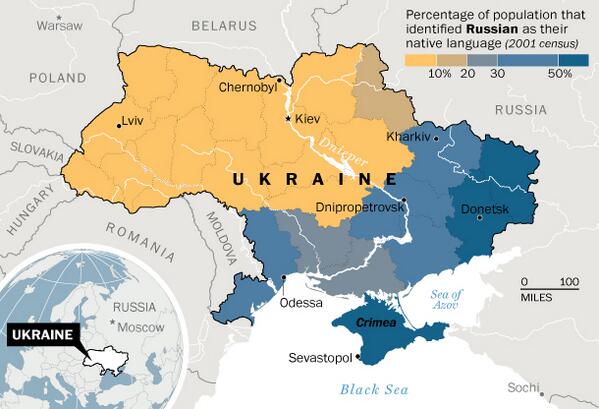
Now, it appears as though the Russians are planning to invade, or have already done so (as suggested by the presence of heavily armed, unidentified military personnel after the Russian parliament voted to intervene).  In response, Ukraine is mobilizing its army to counter the perceived "declaration of war."  Complicating this mobilization effort is the fact that the Ukraine is an intrinsically diverse country, as evidenced by the apparent defection of the Ukrainian Naval Chief and the Ukrainian naval flagship to the side of pro-Russian forces in the Crimean Peninsula.

The Hetman Sahaydachny, the Ukrainian Frigate in question

Events have certainly shown that the Russians can still "catch the world off guard."  So where did the international community go wrong?  More specifically, where did the United States go wrong?  And how does American Defense Statecraft fit into the mix?

The failure of American Defense Statecraft to dissuade Russian intervention in the Ukraine can easily date to 2008's Russo-Georgian War.  In response to that Russian incursion into a bordering nation, the international reaction was rather tepid, with then-President Bush saying "Bullying and intimidation are not acceptable" in the 21st century.  Aside from political bluster and grandstanding, nothing much happened.  After the use of chemical weapons in the Syrian civil war, President Obama bungled his way through threatening involvement before backing away from his purported commitment to the region.  In response to Russian aggression in the region, rather than mobilize military units Obama said there would be "costs" associated with Putins actions.  Given that Putin is well aware of the United States' much publicized "Asia Pivot," Obama's stated goals to get American troops out of the Middle East, and America's recently announced plans to shrink the size of its military, there can be no doubt that Putin has weighed Obama's "costs" and found them negligible.

The Telegraph claims that it is Putin's goal to make a laughingstock out of the USA, the west, and NATO in general.  Even their journalists recognize that
It is a textbook KGB-led operation: the agent provocateur, followed by a self-organised militia, then Russian military protection to defend 'their’ people. The tactic was used to good effect throughout the Soviet period in Communist coups. It’s what brought down the government of Afghanistan and caused 30 years of war. And again it is unlikely to be resisted.
The pro-war President Bush did nothing to Russia in response to aggression in 2008.  The Peace-prize winning President Obama continues to do nothing in response to the slaughter of the Syrian people, instead letting Russia take the lead.  And rather than meet force with force, Obama is countering Soviet tactics with hollow words.  The United States is not led by a Cold Warrior, and Ukraine will pay the price.

With such terrible Defense Statecraft, perhaps the next set of European protests will be to push a nation towards the ever-dominant Russia, and away from the toothless "alliances" of the EU or NATO.