“International Herald Leader”, a
Chinese state-run newspaper publishes a commentary to advise PLA Navy to build
oversea naval bases to protect its energy line in Indian Ocean area.
The article forecasts 18 possible
overseas bases of PLA Navy, including Chongjin Port (North Korea), Moresby Port
(Papua New Guinea), Sihanoukville Port (Cambodia), Koh Lanta Port (Thailand),
Sittwe Port (Myanmar), DHAKA Port (Bangladesh), Gwadar Port (Pakistan),
Hambantota Port (Sri Lanka), Maldives, Seychelles, Djibouti Port (Djibouti),
Lagos Port (Nigeria), Mombasa Port (Kenya), Dar es Salaam Port (Tanzania),
Luanda Port (Angola) and Walvis Bay Port (Namibia).
Chinese navy to build oversea bases is
not a new topic. Couple years ago, news reported that Pakistan has requested China
to build its first oversea naval base; Seychelles has proposed the same request
as well. Recently, even a rumor has a saying about that Iran would like to
provide a small island to China for building an oversea naval base. No matter
if it’s true or not, all of these news are a sign of Chinese naval force’s
growth, and show that China to build overseas naval bases is becoming a more
serious worldwide talk.
China is the second largest economy in
the world, and one of the fastest growing economies. Its development is largely
relying on importing oversea energy and resources. Most of its oil and gas
imports come from Middle East and East Africa (except Russia and Central Asia).
And China’s most oversea mineral resources purchase is from Africa, Australia
and Brazil. Among all these countries, except Australia and Brazil are on the
“East Route”, the rest countries are all on the “West Route”. The “West Route”
can be seen as China’s energy line, which is in Indian Ocean area, especially
in Strait of Malacca. That’s why we can see 16 of the possible overseas naval
bases are all on the “West Route”. Also, China’s growing global economic
interests also need China to build a reliable naval force.
China has been to avoid the
establishment of naval bases abroad is largely due to the legacy of its long-term
foreign policy, non-interference in internal affairs of others and non-aligned
foreign policy, especially the principle of no overseas military bases.
However, this declaration has become less high profile in recent years. . In
last year’s 18th CCP National Congress, former leader of China, Hu
urged to build strong national defense and powerful armed forces that are
commensurate with China’s international standing and meet the needs of its
security and development interests. This actually provides the legitimacy for
China to build an overseas naval presence. Another realistic reason is that Chinese
naval force is still weak. PLA still doesn’t have the ability and capability to
build military bases abroad. But as China’s first aircraft carrier - Liaoning’s
service in PLA Navy, the Chinese navy has already officially started its
journey in blue water.
In fact, there is no reason to doubt that China
intends to create a world network of military bases, so that the PLA have the
ability to support China’s growing global interests. Even Japan has built its
first overseas naval base already. And PLA achieves global presence is also a
necessary step of China’s road to rise. PLA
Navy to build overseas naval bases is just a time issue.
I’ve been meaning to do a write up on some of the topics at
the most recent RSA Conference on cybersecurity issues for a while, and it’s certainly
overdue. Sure, a lot of the presentations are oriented towards private companies,
but the issues matter to all entities – individuals, law firms, defense
contractors, corporations, and governments. Let’s take a look at some of the
big ideas:
Know Thine Enemy!
We don’t know the enemy, but the enemy knows us. Art
Gillibrand of HP referred to Sun Tzu’s Art of War when articulating
the current security climate. Defenders are at a real disadvantage these days,
and it’s not going to change anytime soon. Gillibrand presented some rather
depressing statistics: 94% of breaches are not detected by in-house IT.
Meanwhile, between 2010 and 2011, the time spent to repair a breach had
increased by 71%, while the cost of repairing a breach also increased by 41%. So,
defenders are spending more time, and more money on fixing breaches, and
haven’t gotten any better at detecting them in the first place. So, why are we
losing ground, and what do we do about it?
We don’t understand cyberattackers. We don’t know how they
work, we don’t know who they are, and as a result, we don’t know much about how
to stop them. Meanwhile, cyber attackers have specialized, through the very
same principles that organize companies. Almost every Hollywood movie with a
hacking element in the plot depicts one guy who is single-handedly capable of
breaching a system and exploiting the system for profit. Spoiler alert:
Hollywood isn’t accurate. Criminal attacks generally operate in a market with a
“distinct process”, and tasks are allocated to different actors within that
market. Some individuals within the market are responsible for collecting data
on suitable targets through various open-source opportunities, such as Facebook
or Linkedin. These profiles are then sold to cyber attackers, who determine
vulnerable access points and map the network. This information is then sold to
the larger black market. This is of course, a simplification. A great resource on the how the market is organized and operates is a 2010 Panda Security Report, available here.
Gillibrand argues persuasively that there needs to be a new
cyber strategy, one which acknowledges that cyber threats have been so
effective in part, because they rely on a huge network of intelligence. Another
statistic? 86% of total cyberdefense expenditures are oriented around infiltration blocking. It’s a losing battle. Instead, those with stakes in
cyber defense need to figure out an efficient method to identify threats from
individuals, organizations and markets, and communicate these threats to the broader
community. This isn’t just something for private companies to figure out –
policymakers should be taking note. Private organizations may not be the best equipped to
handle the intelligence capabilities that the cyber environment requires on their
own.
Authentication, Hostile Toasters, and Pseudonymity
This was a big topic at RSA. When Google devotes its time at
an RSA conference to a topic, it’s worth it to pay attention. How do you ensure
that people are who they say they are, but only to the entities that need to know?
Can we also associate devices with their owners? Vint Cerf attempted to issue
that very challenge to conference attendees, with the following requirements: a
device must be constructed to generate unique key-pairs, the private key must
not be extractable unless it destroys the pair, the private key cannot be
computed from the public key, and either key must be able to encypt or
de-encrypt on demand. It’s a tall order. It becomes a bigger problem when we
consider the current and future scope of authentication needs. Cerf noted that
internet-capable refrigerators, picture frames, and yes, even toasters, are
entering the market and providing more opportunities for compromise than ever
before. If you thought protecting your credit card was the big priority, just
wait until hackers figure out how to burn your toast. Joking aside, the
proliferation of devices associated with an individual are creating big
problems for existing authentication measures.
In 2002, LG introduced a $17,000 internet-capable refrigerator.
Another conference attendee sought to address the problem. Paul
Summers of the Jericho Forum and CEO of the Global Identity Foundation was also
there to drum up support. “Right now, with the system we have in place, we
don’t have any connection to the person.” Bingo. Biometric readers, DNA links,
and iris reading are great new technologies. That doesn’t mean they’ve fixed the end-user issue. Summers’ proposal is interesting: assign a
single crypto to an individual, which has several pieces of data - some of
which are publicly available, some of which are privately held, and neither of
which can be used to complete the full crypto. Each entity may only request and receive a
certain number of crypto components for any given request. It’s an interesting
premise, that’s been alluded to in other cybersecurity discussions elsewhere.
It’s a nice idea, that may eventually transform the way we interact online, but there’s definitely a
lot that still needs to be fleshed out. How does a bank make sure that the two
components received are the right ones? Will it be one private crypto
component, and one public crypto component? Can it be ensured (in this day and
age), that all components of the crypto could not be found through some online
research? The proposal reminds me a bit of the security questions often
used to authenticate identity. Name of my first pet? Chances are, you could
probably find that out on Facebook or by calling my mother under false
pretenses. No, the name of my first pet is not on Facebook, but for a lot of
people, that information probably is. Also, please don’t call my mother.
And My Personal Favorite: “Lessons from Stuxnet” (for
Defenders) – William Cheswick (Cheswick.com)
You really can’t have any serious discussion about cyber
attacks without at least acknowledging Stuxnet. Stuxnet is one of the most visible examples of a remote cyber attacks which
resulted in actual physical damage. There are just so many interesting components
worth discussing. So, what makes Stuxnet so scary?
-How easy it is. Okay, it’s not actually
really easy to design a highly specific bit of code that only affects one
particular kind of hardware, put it into a USB drive, and then make sure it
gets into one of the most secure places in Iran. But what is scarily easy about
it – is that it only takes one USB stick. That’s right, just one. Cheswick
highlighted the problem perfectly: if you put a flash drive in an
organization’s parking lot, it only takes one person to pick it up, and plug it
in at work. Humans are naturally curious, and in a room of a few dozen people,
one person is going to try to plug the thing in. We’re not sure if that’s
precisely the scenario that happened, but the problem would still be the same.
Defenders have to make sure ALL employees know not to play with foreign USBs.
-How damaging it can be. Estimates vary
as to how much damage the Stuxnet worm actually did in terms of Iran’s nuclear
program. However, Stuxnet wasn’t just about “hard damage”. It was also about
soft damage. In the Stuxnet case, it was engineered to overwhelm centrifuge
components, but it was also about decreasing overall confidence in the venture.
Soft damage can also simply be the erasure of data. A cost and labor intensive
project could potentially be shelved simply on the basis of soft damage.
-If you’re not actively looking for the
threat, you won’t find it. There’s a lot of ways for a Stuxnet-style attack
to happen undetected for a long time. Apparently, there are a lot of people in
IT who just don’t bother updating their network maps regularly enough. Network
maps should (but often don’t) include everything from printers to industrial
controllers. Bought a new printer and forgot to add it? Mistake. Printer
firmware is fabulous for hiding all sorts of things. Also, network maps
typically have notes about exactly what is on there. Centrifuge locations on
there? That’s just reduced time and effort for attackers to know exactly where
they need to go on their shopping spree. Meanwhile, this attack doesn’t
even need the internet to tell its creators that it’s working. It just needs to
create a live link, perhaps through a VPN, using STP headers to
release small chunks of information. Only a small amount of information is
necessary, as in just one or two packets per day, making it even more difficult
to detect. A Stuxnet-style attack could also use a cell network to exfiltrate
information. So, not only can your employees only use work-issued USBs, they
may also not be able to bring their cell phones to work.
But there’s hope. This presentation was geared towards
(primarily) private industry. Cheswick raised some interesting points though
that will probably have to be (or already have been) put in place in law firms,
defense contractors, and government agencies. The new rules in a post-Stuxnet
era: keep your network maps updated, don’t allow foreign USB drives, be discriminatory
about cell phone access, and monitor low TTL packets. For those interested in the technical details about Stuxnet, here's the Symantec report. Fair warning, don't expect a Live Free, Die Hard action sequence in there.
Now that we've covered all the good stuff, I'm looking forward to hearing about the DEFCON conference in August. I bet there will be a lot of complaining over the recent conviction of Andrew "Weev" Auernheimer under the Computer Fraud and Abuse Act, for his exploitation of AT&T back in 2010. If the RSA conference was any indication, the FBI isn't going to be the only one collecting information on guys like Weev. Hackers may very soon have profiles on them distributed throughout the security community. It's about time.
Last Wednesday (20 March) the Senate Judiciary Committee held a hearing on possible privacy abuse--pertaining to drones, of course. Targeted killings overseas have made drones controversial and often suspect among average Americans and the impending reality of extensive drone use at home raises understandable suspicion. The concerns shouldn't be understated. Use of drones in the US is practical; they're "cheap, able and ubiquitous," and, as far as the greater public is concerned, likely to be snooping on you in the near future. I don't mean to belittle any concerns related to drones and privacy issues, because those concerns are legitimate, well founded, and--in my opinion--wholly appropriate. Any new technology demands policy keep pace--and at the moment, legislation seems to be inadequate.
That's an issue for another blog post. Here, I want to outline some of the seriously awesome things that drones could potentially do--and things that they're already doing--all of which have little to nothing to do with privacy concerns or targeted killings.
Journalism
To be fair, I realize that Drone Journalism easily translates into a little UAV hovering directly outside the Kardashians' bathroom window. Again, privacy concerns. But paparazzi aside, drones have some interesting applications for the field of journalism. A few universities have picked up on this as well. The University of Nebraska-Lincoln offers a course in Drone Journalism, and the University of Missouri offers a similar program. Below is a video showing one of UNL's test flights.
Both the University of Nebraska-Lincoln and the University of Missouri register their UAVs with the FAA and are following their strict guidelines. Most news stories developed using this application are, understandably, about the environment and conservation. But the potential of using drones to report on traffic and to provide bird's eye views of natural disasters and crime scenes is well understood and anticipated. One can easily appreciate how this application would effortlessly extend to disaster relief. Drones could easily go into places too dangerous for rescue workers, and efficiently search for survivors across large swathes of territory.
Also, just imagine how drones could be used to photograph non-arena sporting events, such as extreme sports. Instead of attaching a camera to clothing, an athlete could have a drone companion--providing up close and personal footage of the athlete's performance.
Infrastructure monitoring
The United States has a lot of roads and a lot of bridges, you may have noticed. These roads and bridges require a fair amount of upkeep and monitoring to stay safe for public use. Consider this, there are roughly 4 million miles of roadway in the United States, that's something like 500x the diameter of earth. Who's watching all these roads? Who's making sure they stay in working order?
The easy answer for the future? Drones. Drones are cheap, cheaper than sending out actual human beings to squint at a stretch of blacktop. Drones would monitor highways and other forms of infrastructure (dams, bridges, etc.), survey land with laser mapping technologies, and automatically alert officials to things like traffic jams and accidents. In fact, the Georgia Department of Transportation recently received a grant from the Federal Highway Administration to do just that.
Environmental research, conservation, and compliance
The US Geological Survey (USGS) was been testing Raven A, a frankly adorable (and US Army decommissioned) 3 foot long drone, equipped with a camera to see if it can be repurposed to conduct aerial counts of an endangered species: the sandhill crane--a species that is notoriously skittish. Here's a video of the Raven A in action:
The wildlife perspective easily extends to hunting applications. Take the story from the end of this New York Times article, for example: a Cy Brown of Bunkie, La., began hunting feral pigs nocturnally by outfitting a basic model airplane with a heat-sensing camera. The plane, dubbed Dehogaflier, was piloted around his brother's rice farm (where the pigs were gorging themselves on the crop) feeding live images of the pigs to Cy on the ground. A friend with a shotgun took care of the rest--no sloughing through the muck in search of the errant pigs for hours necessary. Handy. The other side of the coin, poaching, are also easily addressed. Use of drones would make it much easier for US Fish and Wildlife and even game wardens to pick up on and shut down illegal hunting.
Use of drones would also assist the efforts of environmental law enforcement officials. Suddenly, midnight dumpings and other nefarious activities would be much harder to get away with. Also, the great news? Using a drone to monitor suspect companies is cheaper and more effective than sending a representative to do an on site inspection.
The flights were scheduled to start in January of 2013, and they're only the first of a multiyear campaign to study how changes in water vapor in the stratosphere can impact global climate. The Airborne Tropical Tropopause Experiment (ATTREX) relies on a Global Hawk drone (pictured)--a type of aircraft also used by the U.S. Navy and the Air Force. NASA anticipates that ATTREX will provide "unprecedented measurements of the tropical tropopause." Which, in its own way, is pretty cool.
There are, of course, more applications--such as drones securing the border and drones being used in provide aid and support during natural disasters. I've tried to provide some possible uses that aren't quite as obvious. Simply put, there's more to drones than blowing up terrorists and spying on American citizens. Drones have some pretty impressive civilian applications that will only serve to improve our quality of living. Legitimate concerns kept in mind, drones are worth getting excited about.
For many of us at the Patterson School, the War in Iraq was the most prominent foreign policy issue (debacle?) that defined our formative years. I remember watching the TV in my bedroom during my junior year of high school as reports surfaced of stealth fighters providing the opening bombs that ultimately led to "Shock and Awe." Although the 1990s saw its fair share of violent conflicts (Rwanda, the Balkans, etc.), nothing like this new round of war had occupied our attention since Desert Storm. Since we just commemorated the ten-year anniversary of our invasion, I thought I'd provide a little context.
Oct. 11, 2002 -- Force authorized
Congress authorizes the use of force against Iraq. Ending a somber debate that pushed past midnight, the Senate votes, 77 to 23, for the resolution. The action came hours after the House gave its approval on a 296-133 vote.
Nov. 8, 2002 -- U.N. ultimatum
United Nations Security Council passes Resolution 1441 calling on Iraq to cooperate with weapons inspectors. The show of international unity sends a strong message to Iraqi President Saddam Hussein that he is without allies if he continues to defy the United Nations, ambassadors said.
Jan. 28, 2003 -- ‘Imminent threat’
Speaking to a skeptical world, President Bush in his State of Union address gives a forceful and detailed denunciation of Iraq. He promises new evidence that Saddam Hussein’s regime poses an imminent danger to the world and demands the United Nations convene in just one week to consider the threat.
Feb. 5, 2003 -- Colin Powell at U.N.
Secretary of State Colin Powell argues before the Security Council that the U.S. has evidence of weapons of mass destruction in Iraq, based on information provided by source codenamed “Curveball,” who later admitted to lying.
March 17, 2003 -- Bush’s ultimatum
President gives Saddam Hussein a 48-hour deadline to leave Iraq or face sure destruction “at a time of our choosing.”
March 20, 2003 -- U.S. Forces Enter Iraq
U.S. and British troops sweep into southern Iraq in an invasion aimed at Baghdad, where a new wave of missiles and bombs struck a presidential compound housing several government departments at the heart of Saddam Hussein’s power.
April 9, 2003 -- Baghdad falls
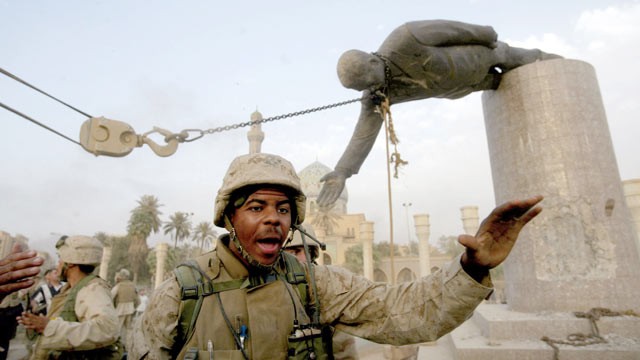
U.S. troops break Saddam Hussein’s 24-year grip on Iraq. With help from the Marines, Iraqis topple a four-story statue of the president. Looting of government and public buildings, including museums and armories, ensues unchecked amid mass disorder.
May 1, 2003 -- ‘Mission accomplished’
Aboard USS Abraham Lincoln, President Bush tells a cheering crew that U.S. forces have brought about a ‘turning of the tide’ against terrorism. Underneath a banner reading “Mission Accomplished,” the president says the conflict with Iraq marked the beginning of “a new era” in waging war.
Dec. 13 2003 -- Hussein caught
Saddam Hussein was captured by American forces at a farmhouse in ad-Dawr near Tikrit in a hole in Operation Red Dawn.
June 28, 2004 -- Iraqis take power
Led by Prime Minister Iyad Allawi, an interim Iraqi government takes power from U.S. administrator L. Paul Bremer III after a furtive ceremony meant to preempt insurgent attacks that could have disrupted the hand-over.
Jan. 30, 2005 -- Iraqis vote
Millions of Iraqis defy violence, calls for a boycott and a legacy of despotism to cast ballots in the nation’s first multiparty elections in half a century.
Dec. 30, 2006 -- Hussein executed
A defiant Saddam Hussein is hanged at dawn in a secret concrete death chamber. Before his execution, he denounces the West and Iran.
Jan. 10, 2007 -- Troop surge
President Bush acknowledges that his previous strategy has failed and announces the U.S. needs to add more than 20,000 troops in order to avert defeat.
Aug. 19, 2010 -- Combat troops leave
The last of U.S. combat troops withdraw from Iraq. The move comes amid a deep political crisis that many think could turn increasingly violent, and Iraqis are deeply apprehensive.
Despite our substantial military success in the initial invasion, the United States was unprepared to execute the occupation needed to reunify the country. Moreover, we had no plan in place to guide our efforts. According to then Defense Secretary Donald Rumsfeld, "Our exit strategy in Iraq is success; it's that simple. The objective is not to leave [but] to succeed in our mission."
President Bush tapped Lieutenant General Jay Garner to lead the transition in Iraq. His strategy -- which quickly led to his ouster -- was to maintain the same state institutions that operated under Saddam, although many (including many Iraqis) wanted a clean slate. The problem was "Excluding all 1.5 million party members from the new government would mean shutting out virtually every public servant, precisely the people who know how to get things running again."[1] Garner's logic was: "As in any totalitarian regime, there were many people who needed to join the Baath Party in order to get ahead in their careers. We don't have a problem with most of them." American forces would work to identify the nefarious elements within the state and bring them to justice. To prepare Iraq for a quick American exit, Garner pushed ahead with a plan to have national elections as soon as possible (within as ninety days of the fall of Saddam) that would install a new Iraqi government. The general was swiftly replaced by L. Paul Bremmer. After his ouster, reports stated Garner said "he fell out with the Bush circle because he wanted free elections and rejected an imposed programme of privatisation."[2]
The resulting policy of de-Ba'athification proved disastrous. The the International Center for Transitional Justice's:
research and interviews with the official body that led de-Baathification initiatives for much of this period showed that these wholesale dismissals, combined with a lack of due process, badly undermined Iraq's government and military structures and fuelled a sense of grievance among those affected - not just employees, but also their families, friends and communities. It is unsurprising that the process became a significant contributing factor in widespread social and political conflict.[3]
The Iraqi military was especially affected by de-Ba'athification, which resulted in the dismissal of up to 500,000 soldiers. Ultimately, the decision to disband the army fueled a growing insurgency.
In the aftermath of CPA Orders 1 and 2, Ba’ath officials became natural allies to the angry and financially troubled ex-soldiers of the Iraqi Army after the Army was disbanded, with no effort made to recall those former soldiers who may have remained interested in serving. The ability of senior Ba’ath leaders to obtain and provide funding to the insurgency was particularly important in helping to organize it into an effective force able to include unemployed and desperate Iraqis willing to strike at U.S. forces for money.[4]
As of March 2007, the Sunni insurgency stood at 70,000 fighters. There were approximately 1,300 foreign mujahedeen fighters. The sectarian conflict broke out into fullon civil war in Iraq in which almost The violence prompted President Bush to commit an additional 20,000 troops in the so-called "surge." The surge was ultimately successful because it took advantage of a new dynamic within Sunni tribes in western Iraq: the Anbar Awakening. "The Awakening movement, a predominantly Sunni Arab force recruited to fight Sunni Islamic extremists like Al Qaeda in Mesopotamia, has become a great success story after its spread from Sunni tribes in Anbar Province to become an ad-hoc armed force of 65,000 to 80,000 across the country in less than a year."[5]
Seven years, over 130,000 civilians, and more than $2 trillion dollars spent, the last american combat troops left Iraq in August 2010.[6] And for all that blood and treasure, the United States gained little. A study conducted by the Costs of War Project by the Watson Institute for International Studies at Brown University:
concluded the United States gained little from the war while Iraq was traumatized by it. The war reinvigorated radical Islamist militants in the region, set back women's rights, and weakened an already precarious healthcare system, the report said. Meanwhile, the $212 billion reconstruction effort was largely a failure with most of that money spent on security or lost to waste and fraud, it said. [Ibid]
Given the traumatic experience we've had in Iraq, it's worthwhile to ask: How has Iraq changed us? And for that analysis, I defer to Dan Drezner:
Here's the thing: Deep down, the American people are pretty realist. The legacy of Operation Iraqi Freedom is that this realist consensus has cemented itself further in the American psyche. The American public has an aversion to using force unless the national interest is at stake, and a deep aversion to using force to do things like promote democracy or human rights. . . .
It took a generation and the end of the Cold War for the lessons of Vietnam to fade away. I'd wager that it will take at least a generation for the legacy effects of the Iraq War.
Indeed, in American history, the war that Operation Iraqi Freedom reminds me of isn't Vietnam -- it's the War of 1812. That was another war of choice that was launched in no small part because of War Hawks in the halls of Congress. It went disastrously for the United States save the Battle of New Orleans, which allowed politicians to put a gloss of victory on an otherwise calamitous conflict. The long-term political effects on some of the War Hawks were pretty severe however (see: John C. Calhoun).
Operation Iraqi Freedom's effects on the international system were minor at best. The effects on American foreign policy, however, are significant and will be with us for some time to come.
That conclusion is all the more instructive given the the number of conflicts around the globe in which the United States could become involved: North Korea, East and South China Sea disputes, Taiwan/China, Syria, Iran's nuclear program. The list goes on.
Obama, Netanyahu and the future of the Two State Solution
--- Edit 3/18/2013: Also, this is...relevant. And hysterical.
---
Right now, things between Israel and her perpetual ally, the United States, are a bit chilly. Obama, who is going to Jerusalem this week, knows full well that Israelis do not regard him as a friendly president. Personal relations between President Obama and recently re-elected Israeli Prime Minister, Netanyahu, are decidedly frigid. They have been for the past four years. Netanyahu openly preferred Obama's opponent (Mitt Romney, in case you've already forgotten) during the last election.
Netanyahu and Obama coexisting.
Romney and Netanyahu enjoying each other's company excessively in October 2012.
Needless to say, there's not exactly any lost love between Barack Obama and Benjamin Netanyahu and that'll make the task before Obama only that much more difficult. The task being pushing for that two-state solution, the death of which more and more people are constantly bemoaning.
According to a lot of people (the Economist) that's a dream Barack Obama should fight to keep alive.
The United Nations, the White House, and most influential actors around the world believe that "any solution ending that strife [between Israel and Palestinians], must be based on two separate states:" a mainly Jewish one, Israel; and a mainly Arab one, Palestine. In this vision, the border between the two states should be based on the border that existed before the 1967 ("Six Day") war. This border is known as the "green line." Of course some adjustments and land swaps should be made to reflect the current situation. Jerusalem itself would be a shared, but divided capital.
That's one vision--which, of course, is not without its flaws, but is perhaps more palatable, and more likely, than other visions for the future of the region floating out in the ether.
Blame for the failure during Obama's first administration to advance the cause of peace between Israelis and Palestinians falls upon both parties. Obama and Netanyahu shared "gross mistakes" in efforts to further the cause. Obama failed to persuade the Israelis of their need to strike a deal with the Palestinians, Netanyahu went behind the president's back to Congress and persisted in expanding Jewish settlements on Palestinian land. Talks, naturally, have stagnated; further negotiations seem unlikely as "the Palestinians are as inept as the Israelis are unyielding." It falls, therefore, to Barack Obama (scheduled to arrive in Israel on 20 March) and new Secretary of State John Kerry to detail a peace plan on their own.
Obama's mission in the upcoming trip to the Israelis, the Economist argues, is to "convince Mr Netanyahu and ordinary Israelis that he believes making peace is in their interest and he is determined to get involved." This, of course, means making it clear that a two state solution is simply the only solution. This will be a hard sell; presently the cause is in tatters--the one state solution is gaining supporters of, impossibly, both supremacists and romantics--those idealists who dream, starry-eyed, of Arabs and Jews coexisting peacefully in a bi-national state. It's a good dream, but not a plausible one--at least not at this point. Of course, the one state solution is also supported by the presence of Jewish settlements on the West Bank who have become so great in numbers that they make "a contiguous, viable Palestine hard to construct."
The Economist argues that a one-state solution could end in tragedy for the interests of Israel. The Economist briefing this week: "The Middle East peace process: Could two become one?", argues that the one-state option is a dangerous distraction, for Israel in particular. Palestinians are out-breeding the Jewish Israelis, and if they were confronted by a single state where Palestinians have a voting majority, may find things going south for them very, very quickly. They'd eventually face a harsh decision: "give up the idea of a Jewish state or deprive Palestinians of their rights as citizens." Apartheid Israel? Furthermore, Israeli prospects would turn ugly before that decision manifested. With the rest of the Arab world embracing democracy (sort of) Israel could not afford to continue suppressing "millions of surly Palestinians" under occupation--certainly not "without risking both international anger and another Palestinian uprising" which no one wants, really.
Obviously, this would best be avoided entirely, bringing us directly back to the two state solution and what the Economist, at least, regards as Obama's responsibility to it. Obama, and the United States, wants a two state solution as much as anyone; it remains a core national security interest to the US. Obama's venture to Israel on March 20th will mark the first visit to the country since he's taken office. Making Israel a stop on his first overseas trip during his second term, shows Obama's intention to demonstrate support to Israel--support that will be publicly reaffirmed this week. He will profess his love for the Jewish state, he will reaffirm the unbreakable bond between the US and Israel, he will reassure Israelis that he will stop Iran from acquiring a nuclear weapon. Netanyahu will make responding overtures, and they will try to "move past the friction of the last few years now that both have won re-election." Maybe the frost between the two leaders will thaw now that their political futures are more secure; maybe they will feel greater freedom to act belligerently towards the other. As the Economist pointed out: "America's support for Israel in international organisations such as the UN will not be infinite. This president is not running again. If Mr Netanyahu tries to outflank [Obama] in Congress, he can expect a fight."
Returning to peace talks will be difficult. Israel is busy with fiscal concerns (including the need for budget cuts) and this may preoccupy the government in the short-to-mid term. The formation of the new coalition places endorsement of the two state option in political limbo, at least for now. Some worry that a "surge" in settlement building is on the horizon, which will, naturally, push hope for talks firmly in the opposite direction.
There is the question of whether talks should continue at the present time at all. Both parties are exceedingly frustrated with the other and it seems unlikely that any ground will be made. Also, considering Palestinian frustration at their own government's failure, "it's possible that the Palestinian Authority could not survive another round of failed negotiations." Regardless, many feel that the United States could do a lot behind the scenes to push the process along in the absence of formal talks. These activities include working with Israel on issues regarding the possible cessation of settlement construction and Palestinian prisoners held in Israeli prisons---pursuit of these issues would bolster the Palestinian Authority's credibility. The Palestine Authority, for its part, should use "every opportunity" to express their desire to commit to a two state solution. President Mahmoud Abbas's speech at the 2012 UN General Assembly was regarded by Israelis as inflammatory--it wasn't exactly helpful in advancing the process.
Nevertheless, Palestine and the Palestinian Authority cannot sustain indefinitely in the limbo of the current status quo. In turn, neither can Israel itself. The United States should work with both parties in order to guarantee the eventual return to negotiation, when appropriate, in order to continue towards the final goal: end of occupation and conflict in the region. The United States, as Obama should remind his hosts this week, is vital to guaranteeing the success of this process.
This last Friday, Defense Secretary Chuck Hagel announced
the US intent to strengthen its missile defenses. This statement is in response
to North Korea’s ongoing provocations of an impending nuclear strike against
the US.
The Department of Defense (DoD) will add 14 new
anti-missile interceptors at For Greely, Alaska. This action moves the
deployment of a second missile-defense radar in Japan. All of these actions
contradict earlier decisions made by the Obama administration. DoD hopes these
implementations will strike down incoming missiles, in addition to the creation
of a site on the East Coast. The 14 anti-missile interceptors will cost
approximately $1 billion and will need congressional approval.
Sec. Hagel hopes these new interceptors will strengthen
defense and maintain the US commitment to regional allies and partners.
With all of this being said, North Korea continued to make
threats of a preemptive nuclear attack against the US. At the same time, the
United Nations (UN) is preparing new sanctions against North Korea due to the
February 12th nuclear test. It is important to note, nuclear experts
say North Korea is not a legitimate threat to the sovereignty of the US because
it still lacks the capability of connecting a nuclear weapon to an
intercontinental ballistic missile (ICBM).
The announcement and actions by the DoD are justifiable
because it is important to stay ahead of the threat from North Korea. Both the
December rocket launch and the nuclear test elevated the risk or potential
threat from a nuclear ICBM. Moreover, these actions should not be considered a
balance to the ICBM arsenals in China or Russia (or Iran), and the US should
clearly and diplomatically communicate with regional actors that these missile
defense systems are solely for threat from North Korea.
Before the missile interceptors are implemented, the missiles
should (obviously) be tested because the proposed interceptors have not hit a
target since 2008. There are three contractors involved with these
interceptors: Boeing Co., Raytheon Co., and Orbital Sciences Corp.
Overall, the implementation of these interceptors will
present a clear message to Kim Jung-un (leaders of North Korea) and should make
him think twice before continuing his current rhetoric and actions. The
missiles will impose real costs for North Korea if they every decide to utilize
their nuclear arsenal.
Even though the 14 interceptors fall short of the Bush
administration recommendations of 44 interceptors, the strategy is a step in
the right direction.
Chuck Hagel, former US senator and current Secretary of Defense,
faces daunting challenges within the first weeks of starting his post. Since he
gained confirmation, Congress failed to pass a deal that would have avoided
automatic spending cuts, and the tasks of winding down the military presence in
Afghanistan and maneuvering the 'Asian Pivot' are daunting, to say the least.
In addition to these challenges, the DoD continues to struggle with auditing
its budget.
The Defense Department is presently not able to be audited in its entirety. As
shocking as this information may be, it actually gets worse. The DoD is required by law to provide annual
financial statements since 1990. It has yet to comply. At first, it planned to
be ready for audit by 1996, then by 2007. Now, the projected year is 2017. This
history of failure has been particularly disappointing for members of Congress,
who fear that the Pentagon's complex budget conceals corruption, waste, and
bloat. With pressure mounting on the DoD to slim down, a budget ready for audit
will make it more likely that cuts will prudently be made and less likely that
well-run programs will be cut while wasteful departments prosper.
As of right now, Hagel can begin the process with a public promise that he'll
hand a complete audit of the DoD to the chairman of the Armed Services
Committee before the next president takes the oath of office in Janurary 2017.
He can push for more of the Pentagon to be ready for audit before that date.
To call out those who resist his philosophies, Hagel can then use his public
presence to promote his efforts, and a new hard-charging comptroller will be
key to finalizing a proper audit. I also recommend that Hagel should also warn
subordinates that if they cannot deliver budgets for audit on his timeline,
he'll find people who can.
If Sec. Hagel successfully pulls this off, he will win the support and respect
of the Armed Services Committee. He'll also get support beyond the Beltway.
That will give him room to operate, room that he currently doesn't have.
A successful
10-minute test flight of China’s Falcon Eagle was a surprise to many observers
of Chinese military industry. The new project was first unveiled just a few
months ago, in November 2012 and demonstrated significant advancement in the Chinese
production capabilities. This advanced multi-functional fighter jet is also
referred to as F-60 or J-31 and is described as the smaller version of more
famous J-20. J-31 is compared to both American F-35 and Russian Yak-141. Its
external appearance and design is similar to F-35, but it’s powered by Russian
produced Klimov RD-93 turbofans, as is J-20 and most other Chinese planes.
Despite the
successful test flight and the fact that Beijing is publicizing this project
much more than any other military projects underway, J-31 is still rather
mysterious. Details of the aircraft performance such as effectiveness of its
sensors, radar-absorbing coating, production plan and many others are still
unknown. All we know is that it’s a fifth generation stealth fighter jet with
vertical takeoff and landing capabilities. This leaves lots of room for
speculations about its function and capacities. The following are some of the
major assumptions:
J-31/F-60 fifth generation stealth fighter jet
Whereas J-20
is larger and intended for ground attack missions, J-31 will have both
air-to-air and air-to-surface attack capacities and will most likely serve as
the cover for J-20. Thus, these two fighters will be complementing each other.
J-31’s
enhanced double-wheeled nose and two big tail wings indicate its vertical
takeoff and landing capability, which leads to the assumption that J-31 is
intended for aircraft carriers, specifically for the newly built Liaoning. This
theory was backed up by the reports of the Military-Industrial Courier (Russian
language Defense newspaper) saying that J-31 project was funded by the PLA Navy
directly.
Military-Industrial
Courier also noted that during the November 2012 Zhuhai Airshow, PLA was much
willing to present and advertise J-31 than J-20, which makes analysts think that
Falcon Eagle is intended for international markets, while J-20 is for Chinese
military and remains secretive. It is expected that J-31 will be much cheaper
and cost-effective than its American counterpart.
Falcon Eagle reminds us of
several important things about Chinese military production capabilities. First
of all, growth of Chinese military industry has undeniably accelerated in the
last decade or so. It is already capable of sustaining multiple overlapping
advanced programs – in addition to J-31 Shenyang Aircraft Corporation (SAC) is
working on several other projects such as J-11B and carrier-based J-15.
Further, competition between two major Chinese military producers is becoming
more vivid. SAC’s main challenger, Chengdu Aircraft Industry Group is producing
the J-20 fighter jet. This competition undoubtedly encourages development of
the industry. That said, it will still take at least two more years until J-20
and J-31 projects are ready to enter the production.
Engines remain the Achilles heel of Chinese
military industry. Most of Chinese planes are still powered by Russian engines,
which account more than 90 percent of all Russian aerospace exports to China.
Moscow and Beijing are further deepening cooperation in the transfer of Russian
knowledge and expertise in combat aviation and its after-sales in the format of
Sino-Russian interstate committee for military-technical cooperation. Sides
expect that agreements reached in this format will ease and legitimize the
process of intellectual property transfer. China hopes to develop her own
engines sooner rather than later and reduce her dependence on Russian aerospace
industry.
What makes the US military so overwhelmingly dominant by international standards? 3 things: Preponderance (sheer size of the force), Technology (most advanced tools of warfare), and force employment (the capability and effective employment of our individual service men and women). How will admission of women into combat arms affect force quality?By direction of the Secretary of Defense every position that is currently closed to women will be reviewed and opened unless an exception to policy is requested and approved based upon the 5 Guiding Principles established by the joint chiefs of staff. By these guidelines the arguments against inclusion of women based upon degraded social dynamics within units (fraternization, sexual tensions, expanded considerations in billeting or field operations) will have difficulty overcoming the SECDEF's standards for accepting gender based exclusion. Arguments against inclusion based upon the idea that force quality is necessarily degraded, however may hold if (1) lower standards for physical capability are applied to combat arms postions in order to facilitate the integration of women and (2) the lower standards necessarily diminish force quality within that particular field due to the nature of the position. If lower standards are not applied to positions within the combat arms and the existing male only standards for physical ability are observed, then gender exclusion simply won't have a leg to stand on. If lower standards are applied to facilitate gender diversity in the combat arms positions currently excluded to women, then those fields that can best demonstrate a diminished level of force quality due to a fundamental dependency upon the physical ability of the individuals within that field will be best postioned to make an argument for gender based exclusion. I would hypothesize that the spectrum for the strongest case for gender exclusion would begin with specialized forces ( Rangers, SEALS, RECON, PARARESCUE, etc.) and Infantry. This spectrum would likely end with the most mechanized combats arms fields (Tanks (the first five minutes is enough to get the idea), artillery) having the weakest case for gender exclusion...That is not to say that these fields cannot make a case at all but rather that physical capability is further from the core group of compentencies that determine force quality in the latter fields relative to the former.




 Posts
Posts

